

How Does An Airbag Work?
 Airbags – they’re in every single new car coming out and if your car doesn’t have at least one airbag somewhere, it’s probably old enough to just about qualify as a classic. It’s probably just about getting to the point that Millennials (or the children of Millennials – whatever trendy label you slap on that generation) will probably take airbags for granted much the same way that Gen X takes seatbelts for granted. (Boomers and Busters probably remember a time before seatbelts were compulsory back and front – I’m Gen X and I’ve got vague memories of cars with no rear seatbelts. They weren’t common.)
The airbag concept has been around since the early 1950s, with patents being granted just about simultaneously in the US and in Germany to two different inventors, Walter Linderer and John Hetrick (which makes me suspect a little idea swapping was going on during the post-war Allied occupation of Berlin). However, airbags didn’t really become popular until the 1970s, which was when Ford decided to give them a try. This was about the time when legislating bodies around the world were taking a long, hard look at what was happening on the roads and were really getting serious about road safety, although it wasn’t until 1984 that the US made seatbelt use compulsory. It was also in the 1980s that saw vehicles of all marques installing airbags in an attempt to pick up accreditation from the newly established EuroNCAP.
2017 Renault Megane GT & Renault Megane Zen: Private Fleet Car Review.
Renault‘s Australian renaissance continues to build momentum, with the all new Koleos and Megane range attracting plenty of positive comment. It’s fair to say that the GT and Zen Megane cars should be on your radar, and here’s why, as Private Fleet drives the Renault Megane GT and Renault Megane Zen.
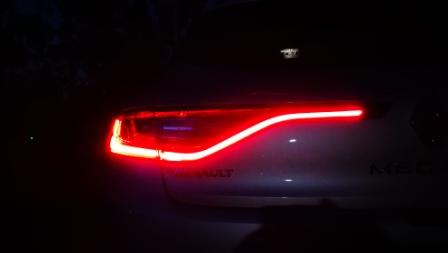
 The Megane is a sweet looker, with a curvy overall shape and an extra bit of sheetmetal at the rear to emphasise the profile. Both have LED running lights in a hockey stick shape, LED rear lights and the GT takes that further with LEDs powering the main front lights. It’s compact outside, at 4359 mm in length and runs on a 2670 mm wheelbase, which offers 180 mm of rear seat knee room.
 Shoulder room for the 1814 mm wide (mirrors folded) pair is 1441 mm up front and 1390 mm in the rear. Front and rear track are almost identical at 1591 mm and 1586 mm. It’s a slightly bigger car, this fourth generation Megane, than the previous version, with the wheelbase 29 mm longer for an increase in overall length of 57 mm.
 Up front there’s a duet of petrol engines, with the Zen packing a mere 1200 cc four cylinder, with 97 kilowatts and 205 Nm. The turbocharged GT has 151 kilowatts at 6000 and a hefty 280 torques at 2400 rpm from a 1.6L powerplant. Both run on standard 95RON and power down via a seven speed dual clutch auto. From the fifty litre tank, Renault quotes a combined fuel consumption figure of 5.6L/100 km and 6.0L/100 km. Around town it’s just 6.8L/100 km or 7.8L/100 km.
 The GT is marked as 4Control, with subtle badging on the B pillars. This makes one wonder if it’s four wheel drive; no, it’s four wheel steering, with a rear wheel steering setup adding to the amazing agility of the five door hatch. It’s engineered so it’ll turn the rear wheels in the opposite direction to the front at either 80 kph or 60 kph, depending on which drive mode you’ve selected.
 Above those speeds the rears will turn in the same direction as the front. Does it work? Oh yes sir, it does. So do the brakes, in that unlike too many there’s real feedback, real bite, as soon as the pedal is touched. Distances between you and the car in front can be more finely judged with a variation of pressure, not relying on something to happen with a depression of an inch or so before action happens.
With the car riding on GT specific springs, dampers, and roll bars to the rest of the range, and combining with a super responsive steering system, lends the GT a sporting prowess that isn’t at odds with its seemingly cheapish $38K price. Turn in is crisp, sharp, and understeer is relegated to the file marked “No Longer Applicable”. This is thanks to a computer system that analyses steering angle and input 100 times per second. Not only is the GT a sharp handler, it rides better than the Zen.  The lower spec car has 16 inch alloys, the GT rolls on 18s. Rubber is 205/55 for the Zen and 225/40 for the GT. The GT is sometimes jittery, but rides across imperfections better than the Zen, with the Zen more prone to bump steer and road intrusions, plus just that little more float from undulations. It’s by no means a bad handler in its own right, but backed against the wall by the brawnier GT, the differences are apparent.
Lamborghini Huracán Performante Breaks The 'Ring's Lap Record.
The Lamborghini Huracán Performante has already proved its extraordinary capabilities ahead of its unveiling at Geneva Motor Show next week. On 5 October 2016, the Huracán Performante set a new production car lap record of 6:52.01 min on the Nürburgring Nordschleife in Germany.
Following the day’s open sessions on the “Ring”, at 17.00 officials closed the track to other manufacturers. After official track checks this left just a
15-minute window for Lamborghini to make one attempt at the lap record with a production Huracán Performante, still in its development camouflage.
2017 Peugeot 2008 Lands On Aussie Roads.
The French Revolution continues, with Peugeot unveiling its revamped 2008 SUV. There’s been a streamlining of the range, a change to a sole engine/transmission combination, and some trim changes. Here’s the way the range shakes down.
The engine is a turbocharged three cylinder, at 1.2 litres of capacity. That’s bolted to a Japanese sourced six speed auto and it’s this combination that will be the only engine and transmission available in a three model range. The names will be Active, Allure, and GT-Line, with the latter replacing the Outdoor that also offered a diesel and manual.
 The undersquare 12 valve engine will produce a peak power of 81 kilowatts at 5500 rpm, and peak torque is a healthy 205 Nm at 1500 rpm. That’s good enough to see a 0-100 kph time of 11.3 seconds for the near 1200 kilogram vehicle. Peugeot rate the fuel consumption and tested in the real world as 4.8L/100 km for the combined cycle from a 50L tank using 95RON. There’s also an adaptable drive system, with Normal, Snow, Mud etc available via a dial in the centre console.
 The facelift isn’t extensive but side by side it’d be noticeable compared to the outgoing models. There’s a new grille which will be a signature look for future models. Peugeot’s design team have imbued the headlights with a feline look, with a black and chrome finish. The tail lights have been slightly revamped, with a more noticeable claw look. All cars will be fitted with roofrails, adding some extra height and topping out at 1556 mm. Ending the roof on the 4159 mm long 2008 is a roof spoiler and the range will be enhanced by a new colour, Ultimate Red.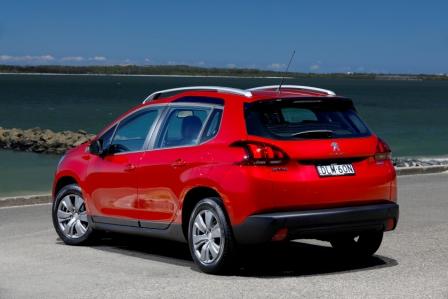
 Standard equipment will cover items such as reverse camera, parking sensors, Stop/Start, MirrorLink and Apple CarPlay. The Allure and GT-Line will also be equipped with Active City Brake and City Park, a self parking system, plus auto head lights and rain sensing wipers. The Active will roll on 16 inch alloys, with 195/60 rubber, whereas the other two go up an inch and slightly wider at 205/50/17. There’s a full sized spare but at odds with the others in 185/65/15 profile.

 At the time of writing, the GT-Line will be made available some time after the release of the Active and Allure. What the two cars at launch will offer is comprehensive. Hill Start Assist, Emergency Brake Assist, all power windows are one touch, heated and folding door mirrors, and seven inch touchscreen. The Active dips out on satnav as standard but can option it in. Leather trim for the tiller is common but on the park brake in the Allure only. A panoramic glass roof is also an option for the Allure as are heated seats (no ventilation for the Aussie market is an oversight.) Cargo is reasonable, with 410L which increases to 917L with the seats down.
 Pricing remains, understandably, sharp, at $26490 for the Active, an increase of $1000 but with extra equipment. The Allure remains the same price at $30990 and gains extra kit, and the GT-Line is slated to come in at $32990, with all prices at a Recommended Retail Price. Head to www.peugeot.com.au for details and to book a test drive.
 Level 2, 9 Help Street