

Car Manufacturer Global Sales Q1-17
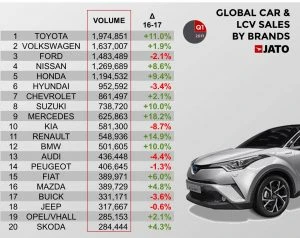
The first half of 2017 has seen a number of new and interesting models coming onto the market by various car manufacturers. It’s interesting to view, globally, how each car manufacturer’s sales has been tracking in the first few months of 2017. According to JATO Dynamics figures, the big winner during the first quarter of 2017 has been the Renault-Nissan Alliance group recording huge growth in sales around the world.
BMW Goes Back To The Future With M4 CS.
BMW Australia has released details of the forthcoming M4 CS. With a whopping 338 kilowatt engine and packing a torque punch of 600 Nm, the hot two door will start from $211,610.00 with an expected release date of late 2017.
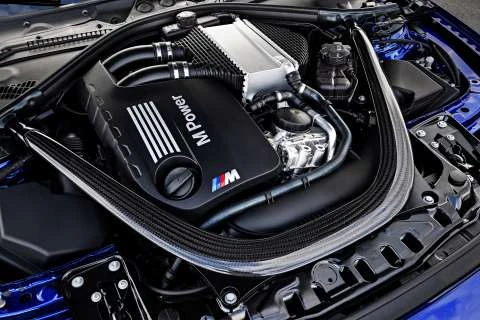
It’ll sit at the top of a refreshed M4 range, comprising the M4, M4 Pure, M4 Competition and also sources elements from the limited edition M4 GTS.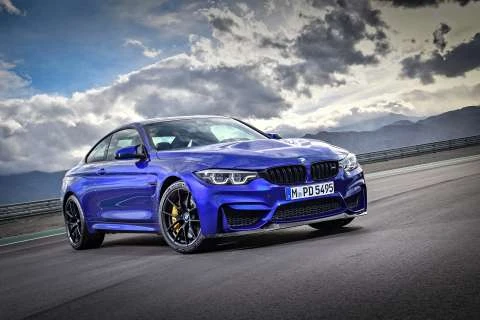 The CS also harkens back to the 1960s, with the CS nomenclature first seen on the beautiful 3200 CS of 1962. It swapped to the 2000 CS in 1965, and the evocative 1971 E9 Series 3.0 CS. The current version uses BMW’s legendary straight six powerplant, with a 3.0L capacity. There’s two mono-scroll turbos strapped to the engine, which features a rigid closed-deck cylinder block, forged crankshaft and arc-sprayed cylinder walls, the six-cylinder is light and strong with minimal friction loss and outstanding high-rev capability, all the way to a 7,600rpm red-line.
 The turbos dump unwanted air via a dual-branch sports exhaust system with quad 80mm tailpipes which adds an aggressive acoustic while keeping back pressure as low as possible. Electronically-controlled exhaust flaps further contribute to exhaust volume and gas flow depending on the vehicle’s load state and selected drive mode.
Changes in the engine’s electronic management system leads to a 7kW power increase over the M4 Competition, with 338kW available at 6,250rpm. Vitally, peak torque is improved by 50Nm to a round 600Nm, a match for the legendary M4 GTS. According to the BMW M dynamometer charts, the M4 CS peak torque figure is generated from 4,000rpm to 5,380rpm.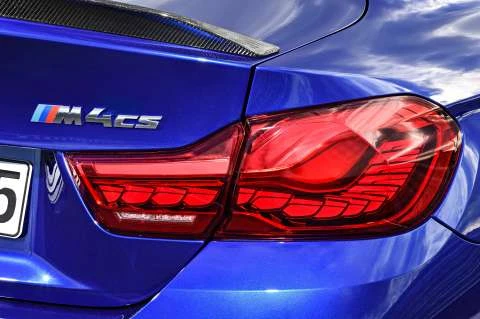 There’s a specific chassis tune for the M4 CS, with the aluminuim based structure allowing a driver to choose from Comfort, Sport, and Sport+. Up front is a lightweight double-joint spring strut layout, with the five-link axle featured at the rear. All suspension links and wheel carriers are made from forged aluminium. The M4 CS will ride on 10 spoke forged alloy wheels, with the front being 9 x 19 inches and weighing just 9 kilos, whilst the rears will weigh just under ten kilos and be 10 x 20 inches in size. Brakes are four piston fronts and twin pistons at the rear.
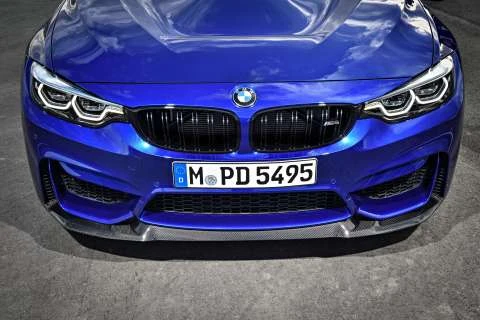 The whole car weights under 1600 kilos thanks to lightweight carbon-fibre and carbon fibre reinforced plastic (CFRP), with an exposed carbon fibre diffuser that is specific to the CS and helps to substantially reduce front axle ‘lift’. The twin headlights are LEDs, the bonnet is CFRP, as is the roof and weighs six kilos lighter than a steel roof. The rear diffuser is also CFRP and is borrowed from the M4 GTS as is the exclusive Organic LED rear lighting system.
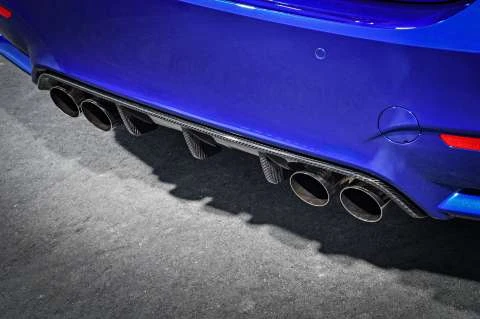 It’s more track and sports focused inside than a regular M4, but there’s still plenty of luxury, with Alcantara trim on the door armrests, passenger side dash tim which includes an etched CS designation, on the centre console and mixed in with leather on the seats. A leather wrapped tiller is available as a no-cost option.
Van Review: 2017 Mercedes-Benz Sprinter 313 Transfer Minibus
Private Fleet offers a huge thanks to Blake at Mercedes-Benz Vans Australia as we take a look at a light commercial passenger vehicle. The first vehicle to be reviewed is the 2017 Mercedes-Benz Sprinter 313 Transfer Minibus. The Sprinter Transfer Minibus is, well, a Minibus variant of the Sprinter van and it is, visually, one big unit. Available with a low (as the review vehicle had) or high roof, at 2524 mm or 2818 mm, it’s lonnnng at 5926 mm. Width? 1993 mm or 2426 mm with the (heated) mirrors included. Seating capacity is twelve, with driver and two up front, and two/three/four mix behind, with all seats fitted with belts and there’s a fire extinguisher and emergency escape panel as well. Even the wheelbase is huge, nearly as long as some small cars are at a total length of 3665 mm. There’s a sense of irony for the uninitiated when M-B state that this is a medium wheelbase model…
 The heart and soul of the Mercedes-Benz van range is the engine and transmission combination. The Sprinter 313 Transfer is no exception, with a seemingly small Euro 5 compliant 2.2L diesel and seven speed auto driveline. Peak power comes in at 3800 rpm with 120 kW on offer, with peak torque just 360 Nm between 1400 to 2400 rpm. Bear in mind, though, it’s a seven speed auto and at 110 kph, the tacho is sitting on 2200 revs, smack bang in the peak torque figure.
The transmission is a superb unit. Gear changes are physically imperceptible, with only the engine note, a restrained yet noticeable diesel thrum, and the flick of the tacho needle, giving away the ratio has swapped. On the go on the highway and freeway, it’s an effortless cruiser and it was a delight to drive.
Tesla Car Australia Expands The Network Range.
A concern for owners and drivers of purely electrically powered cars is what’s called “range anxiety”. Much like a conventional car, range will vary depending on driving style, with spirited and exuberant driving draining charge quicker.
Tesla Cars Australia recently updated the list of charging stations available, with its 300th charge point being added at the Yarra Valley De Bortoli estate at Dixon’s Creek in Victoria. Over that, Tesla have added 100 charger stations in just six months and announced a global doubling of stations, demonstrating their committment to making having a Tesla car as convenient as possible.
 Level 2, 9 Help Street