

German Odds And Ends: VW Crafter Van & Audi TT
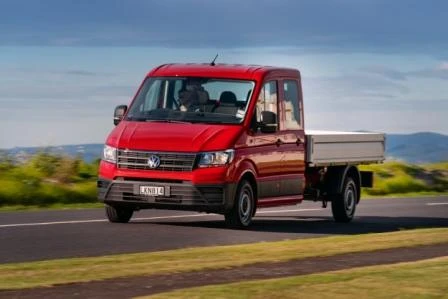
They’re the lifeblood of the small courier driver business, of the larger postal delivery services. LCVs or Light Commercial Vehicles come in various shapes and forms, including the van. There’s plenty to choose from and Volkswagen has just made that choice even more difficult.
Women and Auto Design

Honda/Acura NSX
The chances are your car was designed by a man, but with more women becoming involved in the automotive industry we might well wonder whether our car was designed by a man or a woman? This is an interesting question that many of us have likely never given much thought to. We all love a nice looking, nice driving car, so I wonder how many women are involved in the automotive design industry that we don’t know about. Really, there are very few clues that would reveal a car designer’s gender.
Private Fleet Car Review: 2018 Jeep Compass Limited
Jeep. It’s a name that’s synonymous with unbreakable cars, uncompromising off road ability, and being uniquely American. Well, once. Any Jeep labelled TrailHawk is still uncompromising in its ability to deal with mud, snow, sand, gravel, as easily as the tarmac, but not all Jeeps are unbreakable and not all Jeeps are American. I reviewed a Jeep a couple of years that refused to play ball. It was a time when quality control wasn’t part of the first sentence in how to build one. Thankfully it seems those times are well and truly past as our Indian built 2018 Jeep Compass Limited with 2.4L petrol fed “Tigershark” engine proved.
 The time the Compass Limited spent with us coincided with a trip that would ultimately cover 1150 kilometres. This would start at AWT’s Blue Mountains based HQ, south via Goulbourn and Queanbeyan, east of Canberra, to Cooma before overnighting at the Aalberg Chalet. Mine hosts were Ulla and Lindsay, an engaging and effervescent couple, providing an atmosphere of welcome and warmth. From there a few hours at Thredbo for ski lessons for my junior staffers, before a drive along the “Barry Way” via Dalgety, the Boco wind farm, and the parched depths of the NSW plains before our eastward bounds journey had us in Bega for one night. From there is was north through Narooma, Ulladulla, and Nowra, diverting through the gorgeous Kangaroo Valley and marveling at the once ocean floor cliffs before rejoining the Hume on our way home.
 The Compass sits above the Renegade and below the Cherokee in Jeep’s substantial range. A choice of four trim levels are available, with Sport, Longitude, Limited, and TrailHawk on offer. The Compass Liited has a 2.4L petrol engine named Tigershark, or the preferred for long distance haulage diesel. The petrol engine has 129kW, 229 Nm, and a nine speed CVT auto. Fuel consumption is quoted as 9.7L/100km on a combined cycle from the 60 litre tank and 7.4L/100 for the highway. AWT’s best figure was 8.6L/100km on a purely highway driven cycle. This was with four up and the cargo area filled with three bags/travel cases. The petrol Limited’s weight is 1503 kilograms dry.
 Our journey starts with an eastwards bound run from the lower Blue Mountains to one of Sydney’s orbital freeways, The M7 takes drivers south towards the city bound M5 or the Canberra and beyond Hume. What’s immediately noticeable is suspension tune. It leans towards the harder side of compliance, and there’s an initial feeling that tyres were at the wrong pressure. That didn’t turn out to be the situation. What was also becoming clear was the lack of torque at low revs. On the flatter country roads it would purr along in a quiet, unfussed, manner. Thew CVT changes smoothly, unobtrusively. Heading towards Goulbourn, around two hours drive south of Sydney. there’s some good long gradients that test cars and with that peak torque available at 3900 rpm it needs a hefty shove on the go pedal to get the engine and transmission to drop back enough to get close to that rev point. Forward motion slows appreciably and in order to keep safety up for traffic flow, more pedal is needed.
 Downhill runs have the CVT finding itself in a cog and holding that, using the engine as a braking device. This would be ideal in a hybrid to charge batteries but it’s disconcerting in the Compass as it holds revs in the upper range. There’s a little more effort than expected to move the gear selector left to engage manual shift mode and override the computer’s selection choice. The movement isn’t silky smooth either. The same applies to the indicator stalk, mounted on the left hand side of the steering column in this case. There’s a plasticky click to engage but there’s an upside. Just about every other car maker has a soft touch program that indicates just three times. the Compass Limited’s blinker count is five.As the journey progresses south what also becomes noticeable is the lack of real road safety shown by far too many other drivers. NSW and the ACT have a myopic focus on speed as to why people crash. By the time a stop at Lake George, twenty or so minutes north of Canberra is undertaken, the amount of vehicles successfully completing a safe lane change is one. That’s the Jeep.
 The all purpose rubber fitted, Bridgestone‘s Turanza, with a 225/55/18 profile isn’t a fan of the rougher road surfaces and transmits that to the cabin via the MacPherson strut front and Chapman front rear. Get onto the smooth blacktop and the noise level drops dramatically and the ride becomes far more enjoyable too. Queanbeyan and it’s an 80 kp/h limit. The Compass Limited exercises her brakes here more than anywhere, with traffic lights and roundabouts working together to not make a fluid traffic flow possible. Unexpectedly the initial feeling of the seats being hard and lacking in support is slowly being disproved, with no real sensation of seat cushion related fatigue. The storage nook based under the passenger seat cushion is handy too.
Outside temperatures vary along the way. Countering that is the Jeep’s electric seats (quick, thankfully) and dual controlled climate control. There’s dial or icons on the eight inch touchscreen which are well laid out, simple to use, and efficiently effective. Economy has stabilised at 8.6L/100 and a pitstop for a break and top up has been undertaken. Mid afternoon has Cooma through the front windscreen. We’re in a convoy that includes an Audi Q7 and Ford Territory, driven by people that have no sense of road manners or safety. One overtaking lane has a Range Rover and Corolla ahead of the Jeep, with the Corolla inexplicably moving right, forcing the Rangie to brake momentarily before scooting past the left side of the Toyota. This has allowed us to do the same as the Corolla is clearly struggling. However again that lack of low rev torque is appreciable but the cams come on song at around 3500, and there’s a noticeable in the Jeep’s behaviour. It’s needed as the Q7 ranges up behind the Corolla before a sudden non indicated dart left to take up position a foot shy of the Compass. The merge lane to one lane is here and all of a sudden the Territory is almost buried in the Corolla’s rear, with the driver having no apparent sense of when to brake appropriately. The Jeep’s overall drive and safety package have been tested and passed.
Private Fleet Car Review: 2018 Holden Equinox LT Diesel.
This review is a little different in that the difference between the Holden Equinox LT petrol we’ve reviewed and the Holden Equinox LT diesel is….the engine. And gearbox. Apart from that, there literally is nothing different about the car inside or out. Same interior trim, same annoying Stop/Start tech that canNOT be switched off manually, same reasonably attractive exterior. The link to that review is here: 2018 Holden Equinox LS Plus and LT petrol
What the diesel offers is a 1.6L capacity engine, with a six speed auto transmission only. The current RRP is $39,990 and that’s a three thousand dollar difference over the equivalent petrol version. Standard warranty is five years but Holden were offering a seven year package.
Peak power is 100kW, with peak torque being a very good (for the size of the engine) 320Nm. That’s a narrow maxium torque range, from 2000 to just 2250 rpm. Fuel consumption for the 1.6L in LT trim is a thrifty 5.6L/100 kilometres on the combined cycle. Go to the heavier LTZ & LTZ-V and that goes to 5.7L/100km or 5.9L/100 km. The six speed auto is also a standard auto, in that it’s a torque converter style, not a dual clutch or CVT. It’s an interesting drive setup; the traction control appears to have been formulated to allow some front wheel drive slip. Give the go pedal a good prod from stand still and there’s a noticeable scrabbling for grip for a second or two before the tyres hook up. Actual forward motion is deceptively quick. There’s a mild thrum from the front, which indicates there’s plenty of noise insulation and there is. There’s sheets fitted to the wheel arch and firewall, plus there’s a form of active noise cancellation too. The transmission selector is the same mechanism as found on the nine speed, with a rocker + and – switch for manual shifting. Like most well sorted electronic autos, there’s little to be gained in normal driving conditions by using the manual change. From a standing start and a low throttle application, the six speeder rarely disappointed. The diesel itself is throttle responsive, with a free spinning nature up to around 4000 rpm. Our real world drive, covering both urban and highway, saw a final fuel consumption figure of 6.1L/100 with a 75/25 urban leaning driving style.
 Level 2, 9 Help Street