

Buy A New Car
Private Fleet Car Review: 2017 MY Kia Optima Si
Kia’s big mid sized car, or mid sized big car, the Optima, has proved to be a stayer in recent years. For 2017 Kia has streamlined the range, with it now compromising the Si and GT, with the latter now packing a turbo engine and replacing the Platinum nameplate. A Wheel Thing takes time with the entry level Kia Optima Si. There’s a good reason why the range is now just two: the Si gets crammed full of standard equipment found as options elsewhere. Apart from the standard, mandated, safety equipment such as ABS, airbags and the like, there’s Hill Start Assist, the flashing brake lights Emergency Stop Signal, parking sensors front & rear with dash display, rear view camera with guidelines, Lane Departure Warning, Autonomous Emergency Braking, auto headlights and with auto levelling. Straight up, that’s an impressive features list from a $38500 driveaway (no options or metallic paint) priced car.
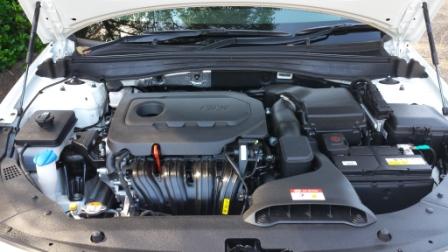 What you’ll get up front is Kia’s 2.4L, with 138 kilowatts and 241 torques at 4000 rpm put to the front wheels via a six speed auto. It’s an engine that needs a rev to get the 1540 kg car going and that’s reflected in the consumption. The combined figure is quoted as 8.3L/100 km on standard unleaded, with an urban figure of 12.0L. That’s simply too high in today’s eco aimed environment and has been the Optima’s weak spot since the current shape was released in 2013. Take it out on the freeway and expect just over 6.0L/100 km from the huge 70 litre tank.
 It weighs a bit because it IS a big car but not as much as similar sized competitors. It’s big car in length at 4855 mm, big car in width at 1860 mm but has a low 1465 mm to show why in profile it’s seen as slinky and sensuous. It’s a good sized wheelbase, too, at 2805 mm, which translates into plenty of internal space, including a huge 510 litre boot space that is more than adequate for a family shop or a holiday away.
 Design wise there’s subtle but crucial changes, keeping the Si’s looks fresh. It’s a more defined tiger nose grille, the LED lights in the lower quadrants of the intake inside the reprofiled bumper, the slimmer tail lights, extended boot lid, and the Continental rubber on the 17 inch alloys. A good looker? Absolutely. The test car came in Clear White, one of five colours available for the Si, with Silky Silver, Platinum Graphite, Gravity Blue and Temptation Red also available as an optionable cost (check with your dealer for pricing).
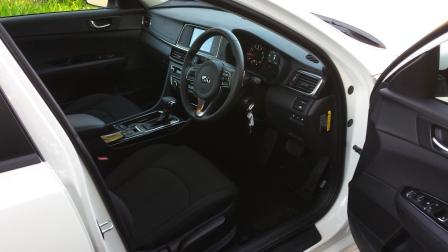 Inside it’s black cloth for the Si, on well sculpted, supportive and well bolstered, manually operated seats. For the Si, that’s the sole trim choice available. The driver and front seat passenger see a fluid, flowing, dash, with an ergonomically smart layout. The upper section, nearest the window, has a curve not unlike that seen in a premium British brand and the dash plastic has an almost leather look to the texture.
 Tabs have a soft feel and are of Kia’s semi matte finish. The overall effect is of quality and presence and wouldn’t be out of place in some more expensive Euro spec cars. And although the window line is high in proportion to the sides, there’s still plenty of all around vision. If you have portable devices or smartphones, there’s four 12 Volt sockets; two front and two for the rear seats, mounted at the rear of the centre console.
 Entertainment is courtesy of a 7 inch touchscreen with navigation, complete with USB/Auxiliary/Bluetooth streaming and a Speed Dependent Volume Control. It’s AM/FM only with limited RDS (Radio Data Service) capability, leaving the Si Optima behind some competitors. Sound quality in FM is good enough, however, with tuner sensitivity only rarely showing a dropout.
 Where the Si further shines is on the road. Think of the suspension tune as “sporting luxury”. Punted over a broken up tarmac surface at Sydney Motorsport Park, there’s plenty of absorption, compliance, plushness before firming up rapidly but not uncomfortably. Kia Australia works very closely with Kia’s headquarters to work on suspension tune for Australia and again that effort shows and pays off. Even being front wheel drive there’s barely a hint of that, with no torque steer yet an appreciable weight and heft to the steering feel. Speedbumps? Not a problem? Dive under brakes? Not enough to worry about. Dealing with undulations? C’mon, why ask!
 Pushed hard into a certain roundabout which has a direction of travel change of over 180 degrees, there was no understeer and the rear followed the front around without question. Nope, no tyre squeal either, before you ask. The electrically assisted steering is not overdone in how it works with the three steering modes, and the Motor Driven Power Steering Module is steering column mounted, allowing Kia to tune towars the more luxury side as opposed to the GT’s rack mounted setup.
It’s quiet, too, on the road, with the 2.4 litre engine only intruding slightly and that only when pressed hard. Wind and tyre noice are negligible at best and only mildly noticed at worst. Combined with the seating, you will emerge from a long drive without the subconscious stress outside noise brings in.
At The End Of The Drive.
At the time of writing, the Optima Si was priced at $34490 plus ORCs. Along with the seven year warranty, Kia offer capped price servicing over those seven years, starting off with $331.00 for the first service at one year or 15000 kilometres, with a maximum of $769.00 at the 60000 kilometre service for the Optima Si.
What a new buyer gets for their hard earned is a thoroughly well sorted car, with plenty of Australian input, a huge boot, plenty of standard features and astoundingly good value for money.
For more information on the Australian spec2017 MY Kia Optima go here: 2017 model year Kia Optima
Private Fleet Car Review: 2016 Audi A4 Avant Quattro S-Line
Long seen as a pioneer of all wheel drive vehicles, Audi’s Quattro system is possibly one of the best of its kind available. Couple it with a torquey turbocharged four, a mostly user friendly DSG transmission, and with Audi’s S-Line trim inside the wagon or Avant body, it’s an iron fist in a velvet glove. All up, it’s the Audi A4 Avant Quattro S-Line. Up front, behind the LED lit headlights, lies a 2.0L four cylinder turbocharged engine in an in-line configuration, fed on a diet of 95RON petrol. When prodded with the angry stick, the 1615 kilogram machine (thanks to a weight reducing aluminuiom chassis) will be hauled away to 100 kilometres per hour in just six seconds to a limited top speed of 250 kmh, seeing maximum torque of 370 nm (1600 to 4500 rpm) being applied via the seven speed dual clutch auto to all four wheels. Keep the foot buried and the tachometer on the full LCD dash screen will swing around to over 6000 rpm, delivering peak power of 185 kilowatts between 5000 to 6000 revs.
 Being the beast it can be, it’ll drink and drink hard when continually pushed. Consumption of the good fluid can be over 12.0 litres for every one hundred kilometres covered. However, it can also be docile, averaging around 7.0L per 100 km for normal around town work. Audi’s figures are 6.6L/100 km on the combined cycle for the Avant from a 58 litre tank.
Drivewise, punch the accelerator whilst on the freeway and the torque spread shrugs aside any opposition, watching the numbers change with alacrity. It’s a situation that well trained drivers will appreciate and understand. Should one wish to drive with a touch more verve and a little more zing, Audi has a drive mode selector, offering four options including Dynamic. This holds the gear shift point for longer, changes the engine’s ignition mapping to suit and provides the driver a more assertive driving experience. This would be ideal for an owner to take to a track day and find out the true limits of what this very capable machine can see. The downside to this is a lack of anything welcome stroking the ears. Although you can hear the engine working, it’s muted, lacking a real sense of buzz and excitement, whilst at the rear there’s a faint “phut, phut” as the transmission changes up.
 It’s a little too easy to confuse it at times; it’s not a fan of very low throttle applications such as those coming out from your driveaway, or in city traffic. The engine takes a moment too long to telegraph what it’s doing and the transmission furthers that lag. It’ll all too easily change down to an unwanted ratio on some downhill runs, especially at lower speeds required due to the road itself or traffic ahead, necessitating a flick of the paddle shift to get it to a more appropriate ratio. There was the occasional indecision in traffic and a clunk as the gearbox and AWD system talked to each other momentarily before reaching a decision on what to do.
 However, it’s as easy as breathing in regards to engaging the system. A rocker style gear selector is what Audi uses; foot on brake, press the Start/Stop button, pull lightly back for Drive or push forward for Reverse. Park is engaged by a push button at the top right and it couldn’t be more simple to use. Manual mode is simple tip to the right and rocking forward or back or using the paddle shifters.
 Being all wheel drive is one thing, but if the tyres aren’t up to the game, you’ll be hard pressed to fully appreciate what it does. Thankfully Audi has wrapped all four 19 inch wheels with rubber from Pirelli in a 245/35 profile. On the curvy, winding, roads A Wheel Thing uses every day, the Avant simply hunkers down, hands the driver a note saying “I’ve got this” and powers through as if Velcro, superglue and liquid nails have held the chassis to the rails it’s on. In one of the roundabouts near home, which to access the desired road requires a change of direction of over 180 degrees, there was no under or oversteer at all.
 The well weighted and pin sharp responsive steering had the Avant planted firmly, squarely, confidently, in this kind of situation and worked hand in glove with the sports suspension. Think of one of the hard erasers you had a school; squeeze it and there’s a touch of compression before it shops the squeeze. Close your eyes and imagine that’s the ride quality of the A4 Avant Quattro; firm but not hard, compliant enough to not dislodge the teeth but solid enough to let you know it’s just eaten a ripple in the road for breakfast. Helping with front end and overall chassis stability is the alloy strut tower brace.
 If there was a design quibble, it was something constantly mentioned by the junior members of A Wheel Thing: Daddy, why do the door handles open upwards? I don’t like it.
The test vehicle came clad in a delicious metallic blue paint, wrapping the slinky Avant and showing off its subtle curvature, and was complemented by a power blue colour for the seats. Yes, they were electrically operated. Yes, they were comfortable. Yes, they were a sports bucket style. Yes, they came with two tablet devices attached for the rear seat passengers. No, this car did not come fitted with the data enabled SIM card allowing certain usage options such as in-car wifi hotspot. No, it did not come with switches in the cargo area to release the 40/20/40 split fold seats. What the test car did come with was some of the vast array of options Audi has for the A4, both as options and fitted as standard for the Quattro. The folding and heated external mirrors for example, the sports suspension which drops ride height by 20 mm, Audi’s virtual cockpit including HUD, and parking assistance ($2735 and $1255), with the S-Line package covering the 19 inch wheels with V spokes/stainless steel pedals/matt brushed aluminuim inlays and more for $4160.
The Drive Select, Side Assist Blind Spot Warning, Cruise Control, Rear Cross Traffic Assist, and space saver spare are standard fitment, as are the LED headlights with self levelling and dynamic (inside to out in motion) indicators. Heating and venting, however, are optionable and are a questionable cost at $2600. And although Bluetooth streaming and digital radio are standard, the Bang and Olufson sound system is a $1950 option. In the upper centre of the dash is an 8.3 inch multimedia screen, operated via a control dial ahead of the gear selector. It’s not a retractable screen either, making it look oddly out of place. The system displays a hi-res map, the fact you’re listening to a radio station but won’t simultaneously show the RDS (Radio Data Service) information. The twin screens on th erear of the seats are a $4680 option in the Avant Quattro yet are a thousand dollars cheaper in the sedan version…
 At the stern is a powered tail gate, with plenty of LED lighting (a nice touch to have one directly overhead when open), with a rear camera that’s part of the 360 degree system. It’s 1025 mm from the rear of the car to the rear axle line, with the lip of the gate just 630 mm above the ground in normal trim. Overall length is 4725 mm with a wheelbase of 2820 mm, track is 1575 mm/1550 mm front and rear.
 Interior room benefits from good packaging: 1476 and 1446 mm are the numbers for hip room front and rear yet there’s a massive 505L for the cargo section (once you remove the cargo blind) with the rear seats up. Fold them, they don’t go completely flat, but you’ll still get 1500 or so litres.
 Safety wraps the A4 Avant Quattro in eight airbags, including full length curtain airbags, pre-tensioning seatbelts (which provide a somewhat eerie feeling as they slide up your shoulder by themselves), the excellent presense crash avoidance system and pedestrian friendly active bonnet. Peace of mind comes with a three year/unlimited kilometre warranty.
At The End Of The Drive.
It’s testament to Audi that, although they make a range of SUVs, they recognise that the station wagon still has a measure of appeal. With a starting driveaway price of just over $70K, it’s also priced reasonably fairly for the huge amount of standard kit, although Aussies used to the humble Kingswood or Falcom wagon might snort in their coffee.
It offers up a wonderful ride and handling package, a comfortable and well appointed interior, a plentiful tange of options however with some question marks over price and value for some.
Head over to Audi Australia and follow the links for information on the A4 range including the A4 Avant Quattro S-Line.
Making Sense of the Difference Between 4WD and AWD

Source: news.com.au
With Australians purchasing new cars at a record pace, a surge in the growth of SUV sales saw the category land fractionally behind the number of passenger vehicles sold during August. Which leads to a common, yet often misunderstood, question – what exactly is the difference between 4WD and AWD? In many instances, consumers are led to believe these two systems are the same. However, there is a notable distinction between the two, which will shape your driving experience.
FWD (front-wheel drive) and RWD (rear-wheel drive) vehicles rely upon a single axle to distribute power to move the car. Conversely, 4WD (four-wheel drive) vehicles depend upon a distribution of torque from the transmission going to all wheels at the same time. This transfer is done via a component called a transfer case, ensuring an even distribution. As a result, 4WD vehicles have added versatility – they are equipped for off-road driving, typically across terrain such as mud and rocks.
However, in some instances, like turning, having power supplied to all wheels is undesirable or simply unnecessary. To account for this, some 4WD systems can be controlled (activated/deactivated) through a central mechanism – a dashboard switch, or via a handle. When the system is off, the car effectively operates like a two-wheel drive vehicle. In 4WD vehicles where such controls are not available, they will permanently act as a four-wheel drive, but a differential is used to adjust the individual axle and wheel speed where necessary.
There are also controls which allow differential regulation of the system (either high or low), so that one can distribute the power in a non-equal fashion. In turn, these options can be used to either mitigate the effects of locked wheels, or make them act in such a manner.

Source: Subaru.com.au
On the other hand, the AWD (all-wheel drive) system is used across a wider variety of vehicles, particularly passenger vehicles but also ‘mini’ SUV’s. The other notable feature is that they are effectively in use all the time, and cannot be ‘deactivated’. In a mechanical AWD system, three differential gearboxes help to distribute the torque to the front and rear axle, and then each of the wheels. Meanwhile, electronic AWD systems use an engine control unit, as well as a myriad of sensors, to distribute the torque where it’s required.
This type of system is most suited to wet or slippery driving conditions, or in sporting applications where each wheel has a different level of friction with the ground. While not quite possessing the off-roading capabilities, or low-range driving associated with 4WD vehicles, general handling and weight distribution is considered to be superior, and one doesn’t need to adjust the system to calibrate it.
With that said, both systems do share one commonality – that is, they generally increase the weight of your vehicle, which in turn decreases your fuel economy.
If you have any questions, don’t hesitate to contact us.
Best wishes,
The Private Fleet Team
Private Fleet Car Review: 2016 Kia Cerato S Hatch
Kia’s Cerato underwent a mild nip and tuck in 2016; with a reprofiled nose the main visual change it’s freshened the look even though the now superceded model wasn’t in danger of looking dated. Available in a four door sedan and five door hatch with four trim levels, (S, S Premium, Si and SLi) plus a sole 2.0L engine for the range, Private Fleet’s Dave Conole takes on the 2016 S hatchback with auto. Engine and transmission have been left untouched and that’s not entirely a good thing. There’s a harshness, almost a grating vibration in the drivetrain up to medium throttle, plus a notable hesitancy, a lag, in gear shifting in the six speed auto fitted to this car. The Cerato’s accelerator responds better to being pushed hard and you’ll see that vibration gone, along with the speedo and tacho needles whizzing around the dials rapidly. Power peaks at 112 kW (6200 rpm) and maximum torque is a not indecent 192 Nm @ 4000 revs.
 Being a smallish capacity petrol fueled four, it’s typical that higher revs extract better performance, albeit at the cost of economy, to a point. Kia claims 9.8L/100 km of 91 RON from the fifty litre tank in the urban cycle and A Wheel Thing pretty much matched those numbers. Having said that, it’s a figure that’s too high for this sort of vehicle and is spanked by Suzuki’s new Vitara range for economy. On the highway, the six speed auto sees the figure drop to a more reasonable 5.7L/100 km. The S is the only model of the four to offer a manual, sadly.
 Weighing in at 1332 kilos (dry), the Cerato hatch proved nimble on its feet to counter the thirst. Although needing more steering lock than expected for low speed ninety degree turns, ie, coming into a non-stop required corner, it’s otherwise responsive, answering the call to move left or right in a freeway flow in a smooth and progressive move. The weight itself of the steering was heavier than expected, but a pleasant weight compared to the light, over assisted electrically powered systems in other cars.
Ride quality is something that Kia Australia has invested heavily on, and it shows. There’s revised springs at the front McPherson struts, a slightly stiffer setup to improve the already excellent balance between comfort and handling, plus improvements to the power steering unit, adding to the feel and weight, as mentioned. There’s even been a change to the steering’s computer processing, which enhances the three driving modes of Eco, Normal, and Sport.
Tyre grip from the 205/55 Nexen NBlue rubber is pretty damned good too, with superglue meets spider’s web when it comes to hanging on, and silently, when really thrown into turns. There’s minimal road noise as well, plus that softness can be enjoyed on the flatter roads with just a hint of float creeping in, rather than a nauseating up and down, again thanks to the springs and shocks being further calibrated for Aussie roads. The overall impression was of a slightly soft yet unfussed ride, matched with enough grip to suit most drivers in the market for this car. Outside, the changes to the nose are reflected in the shape of the headlight assembly, grille, and lower corners of the bumper up front, with flow through vents. The effect is a sharper and edgier look and actually harkens back to the model before the one this replaces.
The rear in the S is unchanged. Not even the tail light lenses have been changed…The S is also the only version to get steel wheels and plastic covers but all four do get a full sized spare. The hatcg is also slightly shorter overall than the sedan, at 4350 mm against 4560 mm for the sedan, but both ride on the same wheelbase at 2700 mm. It also stands a fraction taller at 1450 mm, with 15 mm the difference between the two. Parking sensors? Front and rear, thank you.
 Inside, cargo space is over 620 litres, more than enough for a weekly shop for a family of four and houses a full sized spare. There’s the usual assortment of bottle and cup holders, the traditional placement of USB/Aux sockets for external audio sources plus Bluetooth as well. The S gets a non touchscreen head unit which can be optioned out to include a 7-inch touchscreen audio visual unit with reversing camera, Android Auto connection and dusk sensing headlights in a $500 option pack. The dash display is non colour and you’ll get the tried and proven dials for the aircon in a single zone set up.
 The plastics themselves have a mix of textures, with the dash a ruppled design whilst the tabs and buttons have that almost suede look. Kia say that there’s been an improvement to the overall presentation of the plastics…personally you’d be hard pushed to tell. The interior is also Model T when it comes to colour choice; you can have black, black, or black. Outside one can choose from eight, including a pearl white, two shades of blue and a grey.
 Kia don’t skimp on the safety, of course: airbags at the front, side and curtain, front seatbelt pretensioners, Hill Start Assist, Emergency Stop Signal, whilst niceties such as Land Departure Warning, Blind Spot Detection and Rear Cross Traffic Alert are left to the Si and SLi.
When it comes to warranty, there’s Kia’s standard seven years and there’s also their capped price servicing, staring at $289 for the first year or 15000 kilometres (at the time of writing) with a maximum cost of $487 for year four. At The End Of The Drive.
As always, Kia have provided a serviceable product. With a RRP of $22290 plus an optioned metallic paint cost of $520, (but a drive away price on introduction of $19990), it’s wallet friendly. Combine that with a user friendly chassis, a competent chassis, a comfortable enough office at the entry level, the only real downside is the niggling thorn of fuel economy. Ten litres per hundred kilometres is simply not good enough anymore.
More details can be found here: 2016 Kia Cerato hatch.
 Level 2, 9 Help Street