

Buy A New Car
Jaguar Electrifies London With E-Pace.
Jaguar’s relentless onslaught with new models continues, with the forthcoming E-Pace giving an electrifying performance during its world premiere unveiling. Driven by professional stunt driver Terry Grant, the car was driven inside London’s ExCel building, one of a handful of venues big enough to accomodate the run up and structure that lead to the E-Pace being driven through a barrel roll. The incredible vision can be found here: Jaguar E-Pace barrel roll
E-Pace takes the Jaguar design philosophy of the “Art of Performance” to the next level with this world record setting drive. It also finalised over two years of testing across four continents to ensure the E-Pace would fit snugly into the Jaguar family.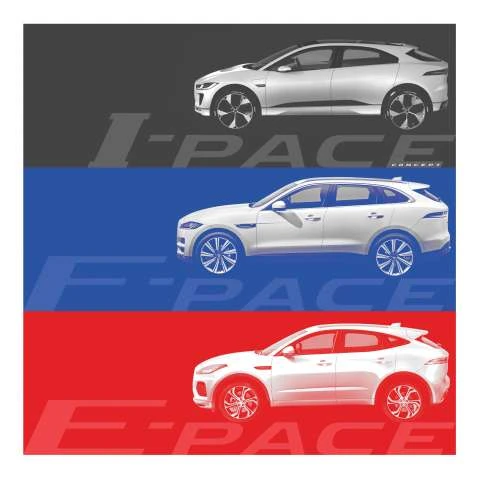 Powered almost exclusively by 2.0L diesels, with two different power outputs available at the top end from the 2.0L petrol engine, the E-Pace slots into the growing small SUV with an overall length of 4395 mm, stands 1649 mm tall, and will have a total width (including mirrors) of 2088 mm. The wheelbase will be 2681 mm, maximising interior room for the five seater vehicle. The differing power outputs will have the variants see 0-100 kph times from 10.1 seconds down to sub six seconds.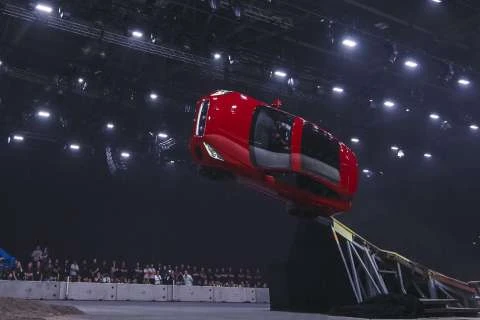
Jaguar’s also added some pretty handy tech. A 4G wireless system allows up to eight devices to connect, the TouchPro system on the 12.3 inch screen is packed with apps, a Heads Up Display provides info and safety, torque vectoring and all wheel drive make for a great driving experience.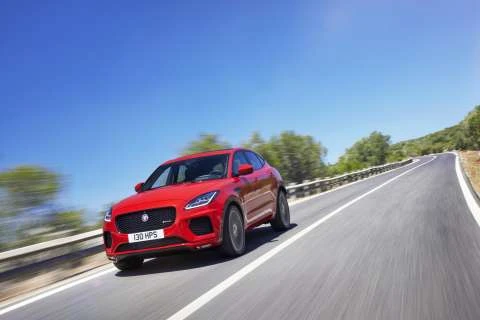
Jaguar also says: “Configurable Dynamics gives the driver even more control with individual settings for the throttle, automatic transmission, steering, and, where fitted, the Adaptive Dynamics suspension system. Adaptive Dynamics senses driver input, body and wheel movements and pre-emptively loads the suspension and chassis and adjusts the damping for improved roll control and agility in all conditions. “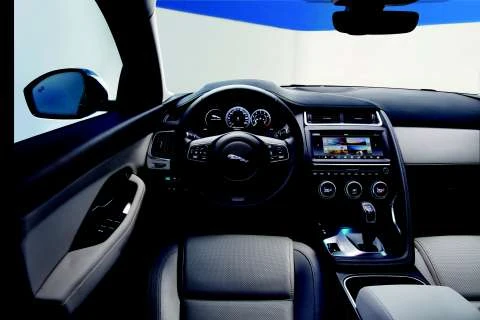
Pricing is currently slated to start from just under $50K plus on roads. Jaguar Australia will confirm pricing and specifications closer to launch.
Private Fleet Car Review: 2017 Suzuki Swift GL Navigator
When a car company has a car that becomes an icon, any update or redesign has the company at risk of stuffing that up. Suzuki is such a company; the Swift has etched itself into history and for the model update released in 2017, the exterior redesign has raised a few eyebrows. However, it’s what’s under the skin that counts and Private Fleet finds, after well over 1200 kilometres of driving, including a forty eight hour trip to the heart of astronomy in Australia, that the Suzuki Swift GL Navigator, at least, should be welcomed with open arms. The range opens with the GL, then the GL Navigator. The next steps are the GL Navigator with Safety Pack and the top of the range GLX Turbo. AWT briefly sampled the GLX Turbo and found its main attraction is the lusty turbocharged three cylinder engine. A downside is the overly hard ride. There was also a lot more road noise than expected.
The GL Navigator comes with a CVT and 1.25 litre DualJet four. Peak power is just 66 kilowatts at 6000 revs, with peak torque of 120 Nm coming in at 4400. The auto has a Sports mode which proved to be an ideal addition on the longer country straight roads. The 2017 Swift is as compact a small car as you can get; overall length is just 3840 mm, with height topping out at 1495 mm. Breadth is a total of 1735 mm including mirrors and in the back there’s just 242 litres of cargo space with the rear seats up. Wheels are 16 inch alloys, with 185/55 Ecopia rubber.
 In between the front and rear is a wheelbase of 2450 mm, meaning overhang is minimal. Crammed inside is a fueltank, some would say a fuel thimble, of 37 litres. Suzuki Australia‘s website only quotes consumption for the six speed manual as found in the GL, however we finished on 5.7L/100 with a best of 5.5L/100 km seen. Bear in mind this was with two adults, two children between seven and eleven, and with a couple of good sized overnight bags.
The Big Drive.
A last minute change of circumstances had me free for the weekend. In need of a destination, Australia’s dark sky capital, Coonabarabran, was selected, with a visit to Siding Spring, Australia’s home of astronomy, scheduled. The route? West to Lithgow, then north to Mudgee, Dunedoo and a more direct route north from there rather than the tourist drive to Gilgandra. What became immediately noticeable about the Swift was how well sorted the CVT is. Compared to the average CVT in the Ignis, this car had almost immediate response, if lacking in outright acceleration. Sports mode is selected via a toggle switch on the transmission lever and works when the revs are above 3000. On long stretches, this aided immensely in overtaking slower and bigger vehicles such as caravanners or B-Doubles. Because of the relative lack of oomph, careful planning is required. Having the easy to read satnav on board (hence the GL Navigator name) provided plenty of forewarning of the straights needed. The CVT itself is well and truly one of the best of its kind available, with quicker response to the throttle and a distinct lack of lag compared to the CVT in sister car, Ignis.
 By no means is it a neck snapper, however. Even with one aboard, acceleration is…leisurely. It takes time to do almost everything from a standing start, however once the three and three zeroes on the tacho are reached the little engine that can becomes a different beast. Even without the electronic kick given by Sports mode, it’s zippy, peppy, and reacts even more to the right foot. Between Lithgow and Dunedoo, on the flatter and straight roads, this shows the ability of the 1.2L.
 What was a standout was the ride quality. For such a small car, it told the roads to “suck it up, buttercup”. It was only on the joins between tarmac and the concrete for bridge surfaces where the suspension would crash to the bump stops, otherwise it simply bounced through the travel once and settled back to flat and taut. On undulating roads it was unflustered, coposed, and again would setlle to a flat ride as soon as it could. Even on a rutted and ripped gravel road (yes, a gravel road) it was relatively chop free and surprisingly noise free.
 The razor sharp steering rack backs up the chassis perfectly. It reacts to the softest touch and is ratioed so at speed it won’t go beserk, it’ll move gently, but will also tighten up quickly at slow speeds for easy car parking and manouvreability.
 It’s the long drive that shows what a well sorted chassis can do but that’d come to naught if the interior of the car also doesn’t play ball. The cloth covered seats were near nigh spot on, with support where needed, and resulted in stepping out of the pocket car with no sense of weariness. Bearing in mind, too, that the Swift was driven in a cold environment and the seats aren’t heated. Speaking of heating, the interior of the Swift GL Navigator features old school style dials and slide for fresh/recirculate. It warms up the interior quickly but did seem to not push air through to the feet efficiently enough when that mode was dialled up. This is vital when you exit a hotel room to see ice, not frost, on a Swift roof.
 Around “Coona”, as it’s called locally, the Swift works well as a city car….well, a town car. Coonabarabran has a population of under 4000, and takes just a few minutes to travel through. There’s life in the place yet, however signs of decay, such as a collapsing car wash, are tell tale signs of a town teetering on the edge.
 Want scenery? It’s this, and Siding Spring Observatory, overlooking the volcanic remains that form the Warrambungles Range, that bring people to the region. The climb up to the observatory is a four kilometre hike on some fairly steep and narrow roads, with the added attraction of passing some planetary markers.
  By using the observatory as the centre of the solar system, you’re able to gauge just how far apart planets are once you pass the asteroid belt and how close they are inside. The CVT is so well sorted that it never struggles to haul the car and four aboard upwards.
 A tour of the venue is a must, as it climaxes with a visit to the uppermost point of the mountain the observatory complex (there’s over fifty separate telescopes) sits upon and gives a breathtaking vista in a full 360 degrees, including the picturesque Warrumbungles themselves. On the way down the transmission exhibits yet another welcome quirk; there’s a selectable Low gear that helps brake the Swift without always aiming for the stop pedal. The brakes themselves, disc up front and drum rear in all but the GLX, are a mixed bag.
 There’s too much initial pressure required to get bite but once they do they’re measured, positive, confident in the retardation. You can judge to an nth the amount of pressure required to haul up the Swift time and time again.
 The exterior design of the Swift has also changed and, for A Wheel Thing, it’s not a change that sits well. Taking a few moments to look at it at various stops highlight the now blunter front end, the somewhat out of place headlight design, the protuberant tail light cluster aka Baleno, and the now embedded in the C pillar door handle. From Private Fleet’s point of view, it’s no longer the sleek and attractively well rounded machine it was, it’s now looking visually heavier and not as aerodynamically attractive.

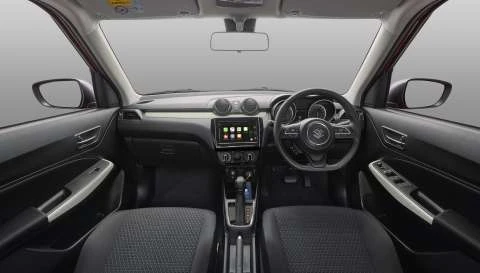
 Inside is a different story. It’s comfortable, as stated, plus has a real look of being updated and modern. There’s the familiar four quarter touchscreen (with no DAB available at this level) with the typically clean interface Suzuki has endowed its screens with of recent times. Ergonomically, it’s a treat with everything cleanly laid out, easy to use and read with the added virtue of the main air vents being as basic yet efficient as they get.
 Where the Swift falls down, and sadly its not alone with this, is the lack of truly useable sunshades. They’re too short, lacking extending inserts, and not deep enough, as when moved to block sunlight throught the windows, simply don’t come down far enough to be of any real use.
What was useful was the overall driveability of the Swift Navigator. The aforementioned climb up to the Siding Spring Observatory, complete with breathtaking views but few opportunities to stop in true safety, tested the ability of the little hatch for both driving and handling. Tick the box for “Pass with Flying Colours”. Pootle around town? Too easy. Stretch the legs on the highway? Natch.
 The voyage home (to pinch a Star Trek title) was via the barely hanging on hamlet of Binnaway (yes, true name), with a stop at the site of the Black Stump, then east to Merriwa, before heading south east for lunch in Denman.
 All through here, with varying road surfaces, bends, straights, dips and hollows, hill climbs and descents, the Swift simply blinked and carried on. The final part of the return trip was via the sublime Putty Road, complete with turns and curves that work so well for lovers of the two wheeled transport variety. Even though ostensibly not a sport chassis, the Swift acted as if it had one, with the MacPherson strut front and torsion beam coil sprung rear providing tenacious grip. Again, there’s plenty of point & squirt driveability when the revs were around 3000 rpm. Being one of the more user friendly CVTs revs were between 1700 to 2000 when in cruise mode, easily flicking up to 4500 when needed and so responsive even the lightest pressure on the accelerator would see corresponding movement on the tacho.
 One thing that really stood out over the two days or so was the sheer amount of dead kangaroos and foxes roadside. One red devil had a luck escape, dashing out in front with barely inches between he and the front wheels as we passed but the visual carnage suggests that far too many were just that little bit too slow. With the size of some of the grey bodies, it was cause to be thankful for the six airbags on board, as no variants have a driver’s kneebag.
At the End Of The Drive.
I had to admit to reservations about the capability of the Swift to deal with such a drive prior to departure. Now, the Swift can be highly recommended as a long distance tourer for a family of four for a couple of days away. Luggage space curtails anything longer but would be ideal for a couple as the rear seats folded offer up the extra space needed for more luggage.
What one will get for the well spent money ( Pricing is sharp: the GL will kick off at $15990, the Navigators will be $17990 and $18990, and the top of the range GLX is $22990) is a car that’s thoroughly capable of a long drive to the country, a car with the goods needed to provide a wonderful drive experience and the economy required to not break the bank whilst away. Here’s the link for more info: 2017 Suzuki Swift Range information
A huge thanks to Suzuki Cars Australia.
It's Swift For Sure As Suzuki Updates An Icon.
Suzuki‘s brand new Swift has landed in Australia and Private Fleet will be able to provide reviews of two members in the range in July. Here’s a look at what’s now available.
There will be a four model range: GL, GL Navigator, GL Navigator with Safety Pack and the top of the range GLX. There will be two engines available with the GLX receiving a 1.0 litre direct injection turbo and the other three a 1.2L DualJet multipoint injection powerplant. Power for the former is 82 kilowatts with the 1.2L rated as 66 kW. Importantly, torque for the three potter turbo is 160 Nm between 1500 and 4000 rpm, with the 1.2L receiving a peak figure of 120 torques at 4400 rpm.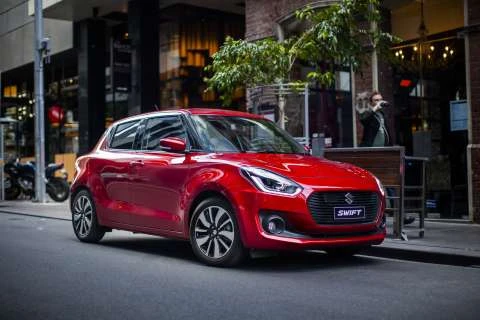 The entry level GL will power down via a five speed manual, the Navigators will use a CVT, and the GLX Turbo is fitted with a six speed auto. There’s currently no word yet of a Swift Sports model. Economy, unsurprsisingly, is frugal. The GL is rated at 4.6L/100 kilometres, the GL Navigator twins at 4.8L/100 km, and the GLX is 5.1L/100 km (combined cycle). The variances come from the weights, at 870 kg, 900 kg, and 915 kg (kerb weights).
Pricing is sharp: the GL will kick off at $15990, the Navigators will be $17990 and $18990, and the top of the range GLX is $22990. The GL will roll on 15 inch steel wheels, the others will be on 16 inch alloys and the GLX will have polished alloys to boot.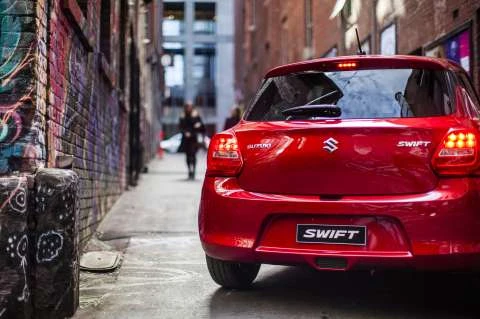 Feature wise all but the GL will receive Apple CarPlay and Android Auto, digital radio, Cruise and Adaptive Cruise Control for the GL and GL Navigator & GL Navigator Safety Pack and GLX, plus the Navigator duo and GLX get satnav (hence the Navigator name). The difference in safety between the two Navigators is simple but marked. All cars will get teh standard electronic aids plus airbags, however the Safety Pack adds in Automatic Emergency Braking, Lane Departure Warning, Weaving Alert plus the non Safety Pack Swift gets Hill Hold Control as well.
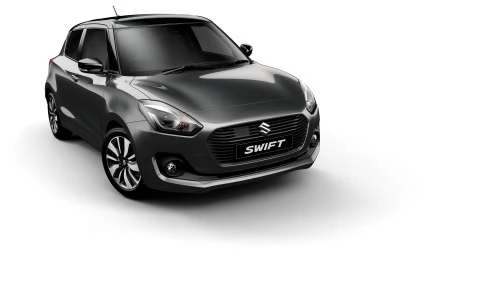
 The exterior has been completely refreshed and strengthens the family look with the bigger Baleno. In profile there’s some carry over with the window line, but it’s the flanks, headlight and taillight design, grille, and rear pillar that mark the difference. The headlights are more angular and sweep into the front guards plus the GLX lamps are LED. The Navigators have conventional halogens and LED driving lights are fitted to the bumper. At the rear the GLX is distinguishable from the GL range by virtue of having LED brake and tail lights and have a distinctive C shape.
 Size wise the newly redesigned chassis is thirty kilos lighter and the new Swift is shorter, has a longer wheelbase, and sits lower overall, with the seating positions also lowered. There’s no compromise though in regards to overall space, with the cargo area up 32L to 242L. The redesign covers the interior as well, with a D shaped tiller, restyled dash and console, a better look and feel to the plastics, and a more ergonomic look throughout.
Outside there’s an improved colour palette, with Burning Red Pearl Metallic and Speedy Blue Metallic being added to the existing Super Black Pearl/Mineral Grey & Black Roof/Premium Silver Metallic/Pure White Pearl options. 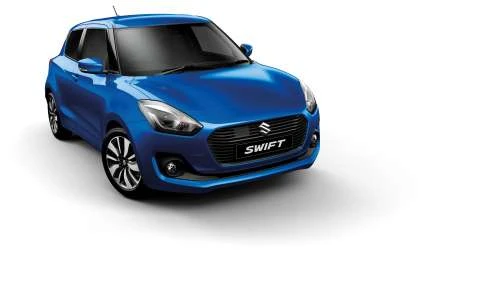 The new 2017 Suzuki Swift range is available for oredr and test drives now at your local Suzuki dealership. Head to Suzuki Australia for information and to book a drive.
Private Fleet Car Reviews: 2017 Holden Astra RS manual hatch
Holden’s move to bring in its range of vehicles from Europe has already paid off with the fully European sourced Astra. With an all turbocharged engine range, the 2017 Astra family, which starts at $23990 driveaway, offers power, performance, and plenty of tech, as A Wheel Thing drives the 2017 Holden Astra 1.6L RS manual. It’s the 1.6L four here, with an immensely handy 280 torques between 1650 to 3500 revs and rolls off to the 147 kW peak output at 5500. So far it’s a numbers game, including six, six being how many forward ratios in the manual transmission supplied. It’s a delight, this transmission, with a beautifully progressive clutch pedal and a pickup point that feels natural. The gear selector is also well weighted, with no indecision in the close throw and tautly sprung lever. Reverse is across to the left and up, easily selected by a pistol grip trigger on the selecter’s front. It’s a delightfully refined package, one worth investigating, and a prime reason why we should move away from automatics as our primary transmission. Economy? A Wheel Thing finished on a sub 7.0L per 100L of 95 RON from the 48 litre tank.
 It’s a sweet looking machine too. A sharp yet slimline nose, with striking silver accents, rolls into a steeply raked front window, with good side vision before finishing with a somewhat odd looking C pillar design incorporating a pyramidical motif. There’s a black sheet between this and the roofline and there’s further eyeball catching with the deep scallops in the doors. Beautifully styled tail lights finish off what really is a handsome vehicle.
  Inside you’ll find a well sculpted office. There’s piano black highlights that contrast with charcoal grey black plastic and cloth trim on the seats in a checkerboard pattern. The dash design itself is organic, flowing, and evokes the design ethos of higher end luxury cars. The pews front and rear are wonderfully supportive and have just the right amount of give and bolstering. Rear seat passengers get enough leg room for comfort also and there’s no problem with head room for front or rear with 1003 mm and 971 mm respectively.
  The driver and passenger do not get electric seats, though, however there is DAB for the high quality audio system that’s part of the GM family’s MyLink set. There’s Apple CarPlay and Android Auto compatibility along with streaming apps. For those that like to carry kids and shopping, there’s 360L pf cargo space with the seats folded up, cupholders front and rear, USB charger point, seatback pockets, and door pockets as well.
 The driver and passenger do not get electric seats, though as they’re reserved for the RS-V, however there is DAB for the high quality audio system that’s part of the GM family’s MyLink set. There’s Apple CarPlay and Android Auto compatibility along with streaming apps and the leather clad tiller has audio and cruise controls that are pure GM in their ease of use. For those that like to carry kids and shopping, there’s 360L pf cargo space with the seats folded up, cupholders front and rear, USB charger point, seatback pockets, and door pockets as well.
 It’s its road manners and driveability where the Astra RS really shines. The six speed manual is fluid, smooth, and completely complements the torque delivery of the 1.6L powerplant. What makes the Astra RS a delight to drive is the beautifully balanced suspension. It really is one of the best ride packages you’ll find. Period. The suppleness of the suspension is deft in its ability to change with road surface changes, whilst it firms up to provide a sporting feel when required. Rubber is from France, with lightning bolt 17 inch alloys wrapped in Michelin 225/45 tyres.
 From smooth freeway surfaces such as those found in western Sydney where some areas have been freshly resurfaced, to gravelled and rutted entrance roads, the Astra RS feels comfortable and poised across these and every surface in between. Thrown into off camber turns the hatch sits flat and under control and rarely does the rear end feel as if it’s not attached to the front. The steering itself is weighted just so, with a fine balance of effort versus connection to the front. There’s a bare hint of understeer being a front wheel drive car and while hint ar torque steer when the go pedal is given a hard push from standstill.
 Holden will give you a three year or one hundred thousand kilometre warranty, which, given the levels of warranty offered by others is starting to look a little dated. However they do offer Lifetime Capped Price Servicing plus you can take the car for a twenty four hour test drive to make up your own mind. Yes, you’ll find driver aids on board and the RS gets Automatic Emergency Braking in the suite of aids.
At The End Of The Drive.
The RS Astra, priced in the mid twenty thousand dollar range, is perhaps one of the most complete packages you can buy as a driver’s car. A torquey engine, a slick manual transmission, a comfortable office and with enough tech on board for emjoyment and safety, plus a beautifully tuned chassis add up to provide one of the most pleasureable drive experiences available. And that price makes it a competitive package in regards to value as well. Go here to check it out plus look at the new sedan: 2017 Holden Astra hatch range
 Level 2, 9 Help Street