

Author archive
Tips To Cope With Congested Traffic
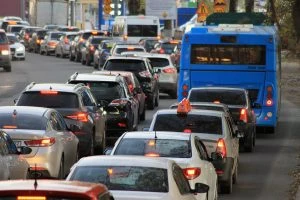
We’ve all been there, locked in grid traffic. And it’s always a bit tempting to slip past slower traffic, cutting back in front to get a little closer to the next set of lights before anyone else does. Yes, you’re with me!
These sorts of tedious, testing journeys may occur every day when you’re coming back from work or going to work. Traffic jams can occur after an accident has taken place or when people are heading away for the holidays all at once. It might be the popular school run, or it could be that everyone is dispersing all at once from the stadium car park after a big win for the Green and Golds. These phases of our journeys can be made to feel a little bit easier when you have planned well in advance and if you can keep an open mind that it won’t last forever. Being a little more flexible and giving yourself more time to get to your destination means that you can breathe a little easier and relax behind the wheel.
When the roads are busy, take your time and be aware of what’s happening around you. Try and give other road users the respect they deserve, too. There are others trying just as hard as you are to do the right thing and get to work on time. Yes, and they may not be as confident behind the wheel as you, so cut them some slack and don’t cut them off! If you keep a decent gap between your car and the car in front of you, you can look ahead and see what the traffic is doing, slowing gradually to maintain a nice steady flow with fewer sharp stop and start scenarios. It also helps to negate the all too common nose to tail accidents.
The same goes for merging lanes. Problems show up when some drivers stop in the merging lane to wait for a gap. Then there are those who would rather speed up and get ahead of another car in the line. Both of these styles aren’t cool, and both styles cause the traffic flow to come to a halt. Giving each other some space and time keeps the flow moving steadily, which is really what we all want anyway.
When you’re travelling home from a lazy day at the beach, or towing your caravan, or when maybe you just want to revel in the moment and soak up the scenery by travelling along at 70–80 km/h, well, that’s cool, but do keep in mind that there are other road users that have to make an appointment or who need to get to the start of a school rehearsal. Not everyone can travel this slow below what the open road limit allows, so use those mirrors and be aware of who needs to get past you. Show them respect because you are holding them up, and they are getting more and more frustrated at being dictated by you choosing to travel at a slower pace on a perfectly good piece of road with a much faster speed limit. Pull over and let them pass as often as you can, and don’t be the cause of a crash. Especially don’t be that driver who drives slowly along the windy bits or the parts with double yellow lines, then speeds up to the limit as soon as a passing lane or a clear straight comes along.
We all need to be prepared to react to someone’s mistake, poor judgement, or poor decision, whether the roads are busy or not. Keeping ourselves fresh and aware on the road while being courteous and respectful of others helps our journeys to be safe and enjoyable.
Ideas to help you stay calm:
- Play the right sort of music through your sound system – nothing too aggro. You don’t have to listen to soothing spa music, but anything that gets you on edge should be avoided.
- Practice diaphragmatic breathing, in through the nose and out through the mouth, trying to breathe with all of your torso.
- Remind yourself that all the other drivers are probably in the same boat as you and you all want to get home or to work. Maybe smile at some of the other drivers near you.
- Put on a really enjoyable podcast or audiobook. With a really good one, you might not want the journey to end!
- If the traffic is absolutely gridlocked and doesn’t look like it’s moving soon (e.g. if the road closes after a major accident), switch off your engine if applicable and move around while you’re waiting. Or get out your phone or laptop and do what you can for work. Just be aware of when the traffic starts moving again!
Hydrogen-Fuelled Hiace Van Tested for Light Commercial Duties

Fancy a new van for the business? Like, I mean a really cool new van that runs on hydrogen… Well, this fancy might just be getting fulfilled a little sooner thanks to some Australian business owners who have been given a Toyota Hiace with a hydrogen-powered internal combustion engine (ICE). Yes, that’s right – hydrogen ICE – like the old school ICEs but with new technology that can allow for the cleaner burning hydrogen fuel to be burned as a much cleaner option.
Toyota’s Hydrogen Hiace Van has been undergoing testing by local businesses to see how the hydrogen ICE performs and fulfils its role for powering the Toyota Hiace van while it carries out its daily duties in the real world. If the testing goes well, showing that Toyota’s new Hydrogen ICE is a goodie, then the legendary car manufacturer will set about putting these sorts of vehicles into production.
Let’s start with what’s under the bonnet?
Toyota has designed and built the van’s hydrogen ICE, which is based on the V6 turbo-petrol ICE used in the Land Cruiser 300 model series. The LX600’s 10-speed automatic transmission has been retained in the test van, but it runs with rear-wheel-drive rather than the Land Cruiser’s all-wheel drive system. In petrol form, the V6 is able to pump out 305 kW of power and 650 Nm of torque. In hydrogen form, with the relatively minor changes, the motor puts out a decent 120 kW and 354 Nm. Toyota engineers deliberately matched the 120-kW output found in the standard Hiace 2.8-litre turbodiesel that is currently for sale. The diesel unit provides 66 Nm more torque; however, the new hydrogen ICE prototype’s output and torque sounds pretty decent for a Hiace van, which will be used primarily in business logistics and, obviously, as a trade van, which is classed in the light commercial segment.
The hydrogen fuel is stored under the van’s floor in three tanks, which is good for a range of up to 200 km. What about the emissions from the exhaust? Tailpipe emissions amount to a little bit of nitrogen oxide, and that’s it.
So why hydrogen instead of an EV Hiace?
There is the lack of emissions, but also the fact that a hydrogen Hiace van can theoretically be put into production quickly without any major changes to Toyota’s supply chain, which make the hydrogen alternative desirable from a cost and logistical point of view.

There is also the fact that Toyota gurus, and other tests, have shown that electric vehicles lose a significant amount of range when they are fully loaded up, working hard, or used for towing. Add in the fact that the van shape isn’t the most aerodynamic outline on the market, then we can see why an EV van starts to look a bit sketchy in the real world. Hydrogen, as a fuel, is far more suited for a van that will work hard with heavy loads on board, run against headwinds, or be used for towing. With hydrogen, the driving range is not as significantly impacted as what it is in an EV alternative, so the panic of running out of battery range in between jobs won’t be a concerning issue for your typical tradie – or the person waiting for the plumber to turn up to fix the loo.
Toyota is likely to bring out an Electric Hiace anyway, but they would also like to be able to provide a hydrogen Hiace in the future as well; obviously not straight away, but for when the infrastructure for hydrogen refuelling does become a reality.
On all accounts, it seems that it the prototype Toyota Hiace Hydrogen Van is capable of doing its job well, and really could be all ready for action at the drop of a hat or once the hydrogen infrastructure arrives.
The Nissan Hyper Force Concept Car

There would be little debate over whether a Nissan GT-R is a legendary supercar or not. It has been one of the most exciting cars of the last two to three decades, having even set a record on the Nürburgring racetrack of 7:08.68 min in 2013, which was achieved by the Nissan GT-R NISMO.
Recently, the Nissan Hyper Force concept car stunned the crowds at a car show in Japan. Could this concept potentially be the next new Nissan GT-R supercar?
The Nissan Hyper Force is an all-electric beast with a seriously brazen design suggesting time warp speeds! In the car’s layout is an application of some clever revolutionary solid-state batteries that enable the supercar’s output to power up to 985 kW. That’s almost 600 kW more than the current GT-R! It’s also good to see that solid-state batteries are starting to break out of the laboratory and into actual vehicles, as they have better safety performance. However, these solid-state batteries are inside something that’s got that little hit of adrenaline. This electric vehicle is electrifying.
With this level of output, the Nissan Hyper Force Concept car is carefully aerodynamically designed to ensure the air is pushed over the car to force it down on the road. In order to achieve the required levels of downforce, there are active winglets up the front end of the car to help channel air over the car, as well as a massive air scoop in the lower bumper, and an array of active fins for air manipulation. If you look at the back of the vehicle, the telltale twin LED taillight clusters are very typical of the Nissan Skyline GT-R. The massive wheel arches on the AWD machine look really spectacular, hiding what must be some serious rubber tyre profiles. If I were making a Batman movie, I’d cast this vehicle as the latest iteration of the Batmobile.
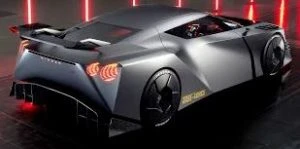
The doors open upwards and forwards in a gullwing-like action. Once the doors are opened, the onlookers are presented with a stunningly wild interior, featuring Lamborghini-crazy styling that is incredibly futuristic, offering sizzling red LED lighting vibes for high-speed driving modes. Gentler GT modes light up the interior in a blue colour. There are plenty of information displays and stylish graphics, as you’d expect. The interior styling continues the edgy, angular diagonal lines of the exterior, giving a Batmobile vibe. And did I see harness style seatbelts in there?
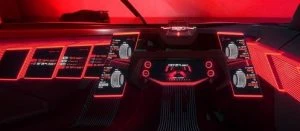
The Nissan Hyper Force concept was at the Japanese car show to inspire people, and to give them a taste of what a new roadgoing Nissan supercar (potentially GT-R) of the future might look like. This is seriously cool! Here’s hoping that we’ll see some of the ideas trickling down. I particularly like the idea of the ambient lighting changing with the driving style, so I hope that we see that one in upcoming Nissan models. I’d also like to see the harness-style seatbelts making their way into regular cars, though they’d take a bit of getting used to, especially for a women (but they could easily be an improvement over the three-pointers we’re used to).
Find out more and have a drool in the official promo video from Nissan:
Paying For The Roads We Drive On

Across the Tasman, there are plenty of people getting annoyed at the increase in large, damaging potholes that have developed over the last few years on NZ’s tarmac road surfaces, even on main State Highways. Over there, for quite some time, EV owners have been getting a free ride on the coattails of motorists using an internal combustion engine (ICE) vehicle and who pay their fair share of road user chargers (RUCs) and/or a large portion of tax levied on the fuel at the pumps for the roading upkeep. This got me thinking about how should we be fairly introducing EVs to the masses while maintaining our roading systems? I realize it’s likely to be a bit contentious, but it’s not a question just for New Zealand’s new government to answer; it is also worth giving a bit time to thought and discussion here in Australia.
In Australia, we pay quite a lot of money into the pool of government funds that is received on yearly vehicle registrations. According to the Australian general insurance provider, GIO, the average cost for a family car is likely to be around $1240 per year. The excise tax (an indirect tax charged by government on the sale of a particular good or service) on the common fuels used in Australia (as of 1 February 2022) is $0.442 per litre. Introducing a direct road user charge as a replacement for fuel excise tax is something that has been bandied about at various high levels of government in Australia. The idea gains extra weight particularly when you consider the seemingly imminent transition from fossil-fuel and the ICE to electric vehicles (EVs).
A transition from ICE vehicles to EVs changes the maths and raises eyebrows for those harbouring the more philosophical questions involving fairness and equality for all socioeconomic groups. Without some form of direct user charge for the EV motorist, they would otherwise make no contribution to the roads’ upkeep.
If, in the future, we do end up going entirely electric, the current $12 billion or so of annual revenue from fuel tax will need to be replaced from some other scheme or source. It seems quite economically sound to simply charge for owning and using cars on a scale according to the number of kilometres driven.
Adding another aspect to your discussion on this topic down at the pub might earn you a free drink, so how about considering the damage caused to roads according to the weight of the vehicle driving over it? A UK report carried out by researchers at the University of Leeds suggested that EVs can damage roads at twice the rate of an equivalent-sized ICE vehicle. According to the data, the average EV adds 2.24 times more wear and tear to roads than an ICE vehicle of similar size. They also think that battery electric vehicles (BEVs) with a mass of over 2000 kg contribute 2.32 times the rate of road deterioration.
So could the fuel excise could be scrapped altogether, and all vehicles should be taxed via a user pays system based on the weight/mass of a vehicle? This sort of deal might actually help lower emissions in the long run because the lighter the car, the more frugal it is, EVs, hybrids, and ICEs all included. The cost of road repairs is also related to the CO2 emissions as well, so the fewer road repairs are required, the lower the emissions emitted – well, in theory anyway. What do you reckon?
 Level 2, 9 Help Street