

Author archive
Korea Progression Part 2: Hyundai Drops Elantra In Australia, Becomes i30 Sedan.
Hyundai has revealed the seventh generation Elantra at a broadcast from a Hollywood studio site. In news more relevant to the Australian market, that long-running nameplate will be dropped, with the slightly bigger vehicle to be known as the i30 Sedan.
There’s been some substantial changes to the look as well. A redesigned front end has what appears to be Hyundai’s new signature look, with the turn signals more integrated with the headlamps and bonnets structures. Hyundai employ what they call “parametric-jewel body surfaces” for a more distinctive look and on-road presence. In profile a distinctive wedge shaped set of lines gives an impression of speed whilst stationary. The roofline extends rearward to give a more coupe styled impression and includes a thicker C-pillar. The rear deck is flatter and now has more visual cues to give a wider look. The roofline and the redesigned lights now also join together to provide a “H” signature look as viewed from the rear.
The seventh generation Elantra/i30 sedan is longer, lower, and wider than the previous model. Length goes up by 56mm, with a corresponding 20.3mm wheelbase increase. Width goes out by an inch or 25.4mm. Height is lower by 20.3mm and the cowl point at the windscreen moved by 51mm. Interior dimensions have increased though.
There’s some solid changes inside apart from the measurements. Hyundai have given the driver’s section an aeroplane like cockpit feel with a wrap-around design. There is also a pair of 10.25inch touchscreens. utility, driver assistance and navigation. The optional infotainment system displays a wide variety of useful information across its 10.25-inch split touchscreen, such as a bird’s-eye view in navigation maps, and drivers get connected routing depending on marketplace such as the U.S. or Europe. Connected routing provides multiple navigation options and real-time route updates. Server-based routing makes the onboard navigation experience similar to current smartphone navigation apps. Naturally Apple and Android apps will be available. The i30 sedan will also see what promises to be more common in cars. Dual Bluetooth streams allow phone calling and for audio interfacing simultaneously.
Voice activation will be available for the American market. This feature will be more for climate control and allows a user to say Climate on/off, Air conditioner on/off, Heat on/off, amongst others. Hyundai’s Digital Key, a smartphone app to allow keyless entry and exit plus starting the engine, should also be available.
It’s not yet known when the i30 will arrive in Australia apart from a current estimate of between July and December, 2020.
Korea Progression: 2020 Kia Sorento
Korea’s Kia has loaded up and fired broadsides in the battle to win a buyer’s heart in the thriving SUV passenger vehicle segment.
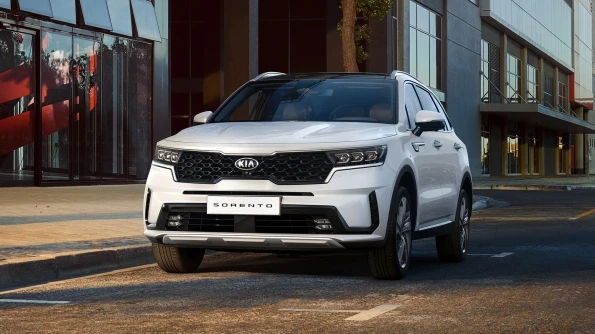 Kia Sorento.
Currently scheduled for an Australian release sometime mid-year, the updated Sorento has been given a substantial makeover. Key changes are to the exterior, particularly to the rear lights, front lights, and sheet-metal. There is a re-interpretation of the signature tiger nose grille, with a wider design that encompasses the headlights. The headlights have also been re-imagined with what Kia calls a “tiger eye” LED DRL, said to evoke the lines around a tiger’s eyes. The lower air intake is bracketed by a pair of wing shaped intakes that assist in funneling air around the sides of the 2020 Sorento.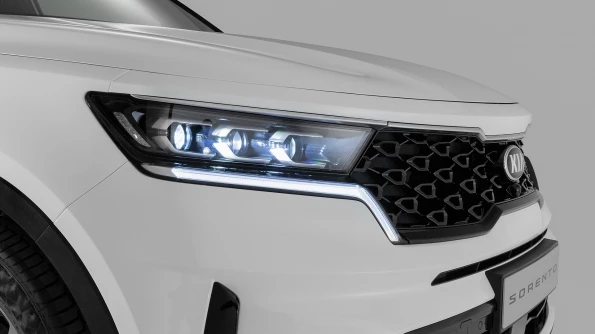 Kia’s added 10mm to the width taking it to a flat 1,900mm. It’s also longer by the same amount taking it to 4,810mm. The overhangs have been trimmed to give an impression of extra length and this has been helped by an increase in wheelbase length, up to 2,815mm from 2,780mm. Those changes hide the small 10mm increase in total height. Visually, the A-pillars have been pushed back making for a longer bonnet and a character line that draws the eye rearwards to the completely new rear lights. These are a more vertical styling and echo those seen on a premium U.K. brand, particularly with a three bar vertical theme. Underneath is a valance insert that gives the appearance of quad exhausts.
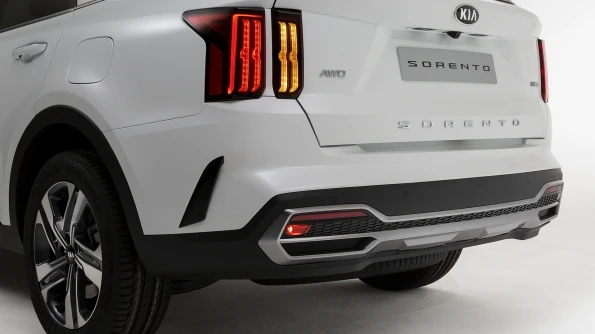 Recognisable Sorento design cues and new ones are here. There’s the broad D-pillar at the rear, the poly-carbonate clad wheel arches, and the more modern “shark fin” window insert on the C-pillar. Sharper body mould crease lines also feature. Australian spec Sorentos will have a choice of seven exterior colours and four wheel sizes, from 17 to 20 inches in diameter.
Head inside and Kia’s designers have gone up a notch here. There’s an ultra-widescreen look for the driver and infotainment system, with a 12.3-inch digital driver instrument cluster paired with a 10.25-inch touchscreen infotainment and navigation system. The engineers have placed a new haptic feedback system to assist in controlling some key features including the climate control. A new look has been applied to the centre stack too.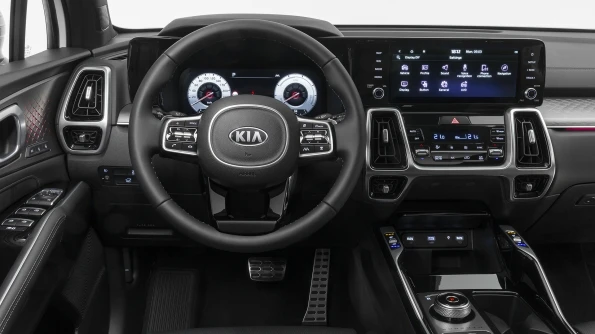 Ambient lighting is now part of the mood-setting system for the interior. There is downlighting from underneath the dash and inside the door trims. Bose supply the sounds and smartphones have a wireless charge pad. Metallic look trim complements and contrasts with Nappa leather, embossed black cloth, or cloth and leather trimmed pews for a higher quality, more luxurious feel.
The new Sorento is based on Kia’s new third-generation ‘N3’ midsize SUV platform, providing superior space for people and cargo through more intelligent packaging. That platform is classified as a large car platform for Australia, by the way. The result is one of the most versatile and spacious cars in its class. It also allows a new range of engines including hybrids to be fitted to the engine bay. A PHEV, or Plug-in Hybrid Electric Vehicle, will also be available.
“Smartstream” is the name given. It will be a 1.6L turbo petrol engine, with a 1.49 kWh lithium-ion polymer battery pack and 44.2 kW electric motor. The new platform has the battery pack located under the floor below the front seat passenger. Peak torque is rated as 350Nm. Power is rated at around 170kW. Part of this power comes from Kia’s new Continuously Variable Valve Duration (CVVD) technology. This works on regulating valve opening time according to driving conditions, instead of operating on a fixed opening time. This boosts performance at low-to-mid engine speeds by between 2 and 3%, and enhances fuel efficiency by up to 3%. A diesel will be available for European markets and is currently yet to be confirmed for Australia. Transmission for the hybrid is a six speed auto and an eight speed for the diesel.
The new chassis has given more cargo space as well. Kia says an increase of 32% for the seven seater version and with all seats in use, up to 187L or 179L for the diesel or hybrid versions. There is also extra head, shoulder, and leg room. There’s more slide room for the second row, with an extra 45mm, and the third row armrest now has a smartphone tray.
Details and pricing will be confirmed closer to the expected release date.
2020 Nissan Patrol Ti: Private Fleet Car Review.
 This Car Review Is About: Nissans largely overhauled Patrol. The big machine has two models, a refresh inside and out, and comes only with a petrol V8. That’s an interesting move given its legendary competitor, Land Cruiser, is diesel V8 only now. Patrol has Ti and Ti-L as the models available. There’s a distinct sense of which market this car is intended for and it’s not millenials or baby boomers…We pilot the Ti for a week.
How Much Does It Cost?: It’s cheaper than what you may think. $75,990 for the Ti and $91,990 for the more upmarket Ti-L. They’re the Manufacturer’s Suggested Retail price. The Nissan website at mid-March 2020 says $85,606 as a starting point on a drive-away price, with the Ti-L from $102,646 drive-away.
Under The Bonnet Is: a massive 5.6L V8 producing 298kW and a hefty 560Nm of torque. That latter figure comes at 4,000rpm but there is no lack of urge below that. Exploit that urge and you’ll easily exceed the quoted (combined) figure of 14.4L/100 from the 140L tank. On our typical suburban drive loop it’s been hovering around 15.5L/100km. There’s a simple reason for that. Tare weight, the weight before adding passengers, fuel, etc, is a whopping 2,715 kilograms. That’s marginally heavier than the Land Cruiser with a diesel engine. Not unexpectedly there is no manual transmission, rather Sir or Madam can specify a seven speed auto or…a seven speed auto. It’s cogged perfectly to deal with the rev ranges for peak power and torque. And for those that can afford the petrol, towing is 3.5 tonnes.
On The Outside It’s: Big. The proverbial block of flats on wheels, to be precise. You step up and across to the seats, and it feels as if the head is ten feet above the surrounds. The external revamp has the front end virtually brand new yet, oddly in our opinion, doesn’t have the Nissan face as seen on the company’s other vehicles. That means no angular headlights and chromed Vee grille. Actually, that’s not quite true. There is a Vee but as it has to spread across a wide space it’s nearer a U with a flat bottom. Overall width is 1,995mm with a height close to that at 1,940mm for the Ti. Add another 15mm for the Ti-L. Length? 5,175mm and a wheelbase of 3,075mm. Wheels on the Ti are 265/70/18 with rubber being Bridgestone’s Dueler. The restyled front lights are the same basic shape as the chromed Vee (or U), flipped ninety degrees though. LED powered they make for a clean white light and crisp amber indicator. The rear lights are redesigned and have a classy look. The body itself is squared off, blocky, a three cube design if you will. It’s an imposing sight especially when coated in a deep Hermosa Blue.
On The Inside It’s: As roomy as you’d expect from the exterior dimensions. And not only is there plenty of centre row leg room, (yep, that’s right, centre row) it’s an eight seater. That in itself is unusual given most vehicles of the sort pack seven. And it is is with the Ti-L, by the way. The seats are leather clad but neither heated nor vented. For a premium vehicle and priced accordingly that’s a shocking oversight. The next hit to the nerves is the realisation that digital radio is not supplied in the Ti either. In order to source a digital station one must use Apple CarPlay or Android Auto. Or Bluetooth streaming. Otherwise there’s old school AM/FM, and a CD player. That’s in keeping with the woodgrain trim that is inserted into the two arches ahead of driver and passenger. It also emphasises a little more the sense of marketplace the Patrol Ti has in mind.
For the driver it’s a pair of analogue dials in a binnacle that has the tabs for accessing the various information sets. However the screen used is a tiny one and in black and white, not colour. That’s a complete 180 degree switch from expectations. The starter button is high up on the left side of the steering column, and easily spotted. That’s a good sign. The layout of the buttons for audio and aircon are easy to read and follow. The design and layout shows thoughtfulness here as it’s elegant and smart. The 8.0 inch touchscreen is similarly planned with good layout, a map screen that reads like the “old” paper versions, and a 360 degree camera display that’s crisp and clear. In the centre console is the drive mode selector. There’s a specific on-road tab, along with Sand, Snow, Mud, and a jog switch for low and high range. Hill Descent Control is here also.
 Although the audio system in the Patrol Ti is not DAB, it’s better than good enough. There’s enough low and high end to ably complement the mid-range vocals. The aircon is the same. The four vents up front had backup with a centre and rear seat vent system, and there are separate controls for the centre seat passengers, meaning an all-round balance is easy to achieve.
Room wise, well, that massive body and wheelbase ensure plenty of head, shoulder, and leg room for the first two rows, with the third row perhaps a compromise for the legs. Due to the ride-height, 273mm by the way, passengers step up and there’s no need for anyone under six feet in height to duck the head. That extra height and wheelbase allows for a departure angle of 26.3 degrees and an approach angle of 34.4 degrees. What About Safety?: Heated wing mirrors are a smart safety choice for cold days. Tyre Pressure Monitoring is standard and a full suite of other features such as Intelligent Emergency Braking, Intelligent Forward Collision Warning, Rear Cross Traffic Alert, Intelligent Cruise Control and Intelligent Lane Intervention add to the package. Lane Departure and Blind Spot Warning shake hands with Intelligent Blind Spot Intervention.
On The Road It’s: A sheer experience, an expression of what was expected didn’t eventuate. The Patrol has double wishbone front and rear suspension, but it’s the addition of Nissan’s Hydraulic Body Control that makes moving the Patrol Ti around in a suburban environment a far better than expected experience. To say it’s nimble is an understatement. Yes, it has a big turning circle but it’s not a “heavy” car to drive. The steering is as light as a system in a car half the size, the ride quality on tarmac, its natural home, is excellent, and acceleration is surprisingly rapid.
It’s expected that a four wheel drive capable vehicle would be spongy, roly-poly, and soft in the absorption. The Patrol Ti is the complete opposite. It’s tight, and one could equate the ride to almost sports car like, such is the tactile feel the driver experiences. Handling is set so the mass, and it’s noticeable in some circumstances, feels less that what it actually is. It was on wet roads that the front end felt as if it may nose away, even with that off-road suitable rubber. That was when that mass made itself felt, and on one particularly notorious downhill left-hander, the superb brakes were utilised to ensure just the right velocity was driven at. Getting the Patrol Ti underway is as easy as blinking. The usual start procedure of foot on brake, press starter has a quick whirr of the starter and a whiiish as there’s an injection of fuel. There’s a muted but noticeable V8 rumble from both ends. Engage Drive and a gentle squeeze has the machine slide away without fuss. Need to get a hustle on? No problems here. The engine and transmission mesh perfectly, and the 100 number appears in a time that has to be somewhere around the six second mark.
Around town it’s a quiet experience, and one easily controlled by the gentle press of either pedal. The brakes, as mentioned, are superb, and allow a finely tuned judging of where the pedal needs to be in relation to hauling up 3,000 kilos. That light steering is a miracle worker in tight spaces such as car parks for shopping centres, and the thought quick driveline makes it easier to readjust when a second in/out to correctly align is needed. And that body control means that it’s stable, confident, sits flat where it should. We regret that circumstances precluded a proper off-road test. We’ll take it as said it would be fine.
What About Warranty And Service?: 24/7 roadside assistance is part of the warranty package. There is capped price servicing for the first six which are required at every 10,000 klicks or six months. The rate ranges from $376 for the first to $860 for the fourth. Nissan now offers a five year and unlimited kilometre warranty.
At The End Of The Drive. The 2020 Nissan Patrol Ti’s revamp makes a blocky and solid machine look less intimidating that what it could be. The changes to the front end particular visually remove what the mind perceives as mass and heaviness. It’s also a far more elegantly styled front end to boot. It’s in profile that a true sense of its “bigness” reach out and slap the eyeballs. Then there’s the opening of the doors and seeing that TARDIS like space whilst realising it’s roomy because it’s big. What came as a pleasant and welcome surprise was just how easy it was to drive. Yes, there were times where an eye on the mirrors or cameras were required thanks to the length and cornering requirements, but there’s some serious hustle, some adept handling, and that background V8 tone to tickle the eardrums. For us, the lack of DAB audio isn’t a deal-breaker but it’s a surprising omission, as were the seat heaters/vents. The woodgrain trim isn’t to everyone’s taste either. And the monochrome driver’s info-screen is at odds with the rest of the presentation too.
Our lasting impression is that the Patrol Ti is not a vehicle for millennials, nor is it one for baby boomers. It gave us an impression that it’s one for people that live in rural areas and have a certain amount of income, to be polite. Although it proved it can live in the urban jungle, the Patrol Ti, like Land Cruiser, is better left to roam the wild outside of cities. More on the 2020 Nissan Patrol can be found here.
Covid-19 Strikes Formula 1, Melbourne's Round Gets Cancelled.
A statement from motorsport’s governing body, the FIA, has confirmed that the Melbourne F1 event, and all of the support events, has been cancelled. This link has the relevant information as of 10.45am March 13.
Update: it seems that the FIA may have had its hand partially forced by Mercedes. The team has advised the FIA of their desire to not participate in the scheduled first round in support of McLaren’s decision to withdraw after a member of their team was found to be Covid-19 positive. There is also the common sense part of this, with Mercedes stating as part of their notification: “We share the disappointment of the sport’s fans that this race cannot go ahead as planned. However, the physical and mental health and wellbeing of our team members and of the wider F1 community are our absolute priority. In light of the force majeure events we are experiencing with regards to the Coronavirus pandemic, we no longer feel the safety of our employees can be guaranteed if we continue to take part in the event. We empathise strongly with the worsening situation in Europe, most especially in Italy, and furthermore we do not feel it would be right to participate in an event where fellow competitors such as McLaren are unable to do so through circumstances beyond their control.”
It does appear that another and as yet unconfirmed reason was a decision by two drivers to depart Australia prior to the official announcement.It can only be presumed that their teams had notified the FIA of their intent if this is in fact the situation.
Comments from drivers include veteran Valtteri Bottas and rookie Nicholas Latifi. Bottas said via Twitter: “All I want to do is race. But safety and health comes first. Hope to be racing soon again! Stay safe everyone 🙏🏼” whilst a disappointed Latifi said: “It goes without saying that I was extremely excited to finally make my debut in Formula 1 this weekend but it will have to wait. The safety and well being of everyone involved has to be the priority. Stay safe everyone and hopefully we can go racing sometime soon.”
Australian hopeful, Daniel Ricciardo, echoed those thoughts with: “I’m devastated I can’t compete at my home GP here in Melbourne & get the season started. Ultimately though the right decision has been made & I think everyone can understand this is something we’ve never seen before. Sorry to all fans who came out for the support. Much love.”
The issue for many is the timing. Up until around 9am on Friday morning, March 13, it appeared that the day’s schedule would run, but unbeknownst to many and including F1 commentator Martin Brundle, the decision to cancel had in fact already been made, it simply hadn’t been communicated effectively.
The fallout from the decision is expected to be huge.
 Level 2, 9 Help Street