

Author archive
Audi RS Adds Spice TO Q3 Range And Hyundai Gets Xtra Active

2020 Audi RS Q3 Sportback
Audi’s performance badge, RS, has been added to the Q3 range, as has the model’s first Sportback. Two of the most powerful Q3 derivatives have arrived in Australia to redefine the premium compact SUV segment: the all-new Audi RS Q3 and first-ever RS Q3 Sportback. Powered by a 294kW five cylinder with turbo, the pair are priced from $89,900 for the RS Q3 and $92,900 for the RS Q3 Sportback. Peak torque is spot on for the compact SUV, with 480Nm on tap and belting RS Q3 to 100kmh in 4.5 seconds. Audi’s fabled quattro AWD underpins both models via a seven speed S-tronic auto.
There will be little to ask for in the RS Q3, as 21 inch wheels, the RS Sport exhaust, a pair of RS bespoke drive modes, and an RS Sport suspension system are standard. Damper control, wheel-selective torque control, and a progressive steering ratio are also standard. Visual spice comes from a rejigged three dimensional looking grille, a bespoke blackout package, metallic paint, and matrix-LED headlights with RS specific surrounds for the indicators.

Passengers will sit in Nappa leather seats with honeycomb stitching, and stay warm or cool via three zone climate control. Cargo space has 40:20:40 split fold flexibility on sliding second row seats. Safety has a 360 degree camera, lane departure, rear cross traffic alert, and adaptive cruise plus AEB. Tech levels come in with an RS menu on a 12.3 inch screen for the virtual cockpit, a B&O 680W sound system pound tunes through 15 speakers, a wireless charge pad and smart app compatibility. 2 USB ports for both front and rear seat passengers allow charging on the go along with Audi connect plus services.
Buyers can select eight exterior colours, a matt aluminuim style package, a RS extended design package, and two service plan packages. There are three years or five years, and priced at $2,320 or $3,420.

“The all-new RS Q3 range is unique in its segment, combining its award-winning engine with exceptional design and incredible performance. The arrival of the first-ever RS Q3 Sportback extends on Audi’s high-performance portfolio range and debuts as the first vehicle to be offered within the compact SUV segment – an entirely new segment of vehicles that we are delighted to offer our customers.” said Paul Sansom, Managing Director at Audi Australia.
Deliveries start from July 24 and orders can be placed online via audi.com.au

2020 Audi RS Q3 Sportback
Hyundai’s popular Santa Fe has been given some extra oomph with the addition of the Active X. Powered by a 3.5L petrol V6 or torquey 2.2L diesel, it finds a home between the entry level Active and mid-spec Elite. Transmission is an eight speed auto driving the front wheels in the petrol, and all corners for the diesel. Pricing starts from $47,020 plus on-roads for the petrol and $50,050 plus on-roads for the diesel. Premium paint is $695, and buyers can specify for the Active X a dark beige interior at $295.
Standard features are extensive: 18 inch alloys underpin the Active X, with extra safety from front parking sensors incorporated into the standard Safety Sense system. Comfort comes from leather appointed seats, dual-zone climate control (with auto de-fog), rain sensing wipers, and cooling inside the glovebox. Puddle lamps and courtesy lights add both safety at night and visual appeal, and handy tech from folding mirrors and Smart Key access.
Exterior colours are seven, with the interior trim having a premium finish dashboard, fabric A-pillar covers and melange knit headlining. Black is also available for the interior as an option. extra value comes from a tyre pressure monitoring system, smart app compatibility, privacy glass for the rear occupants, and Smart Cruise Control with auto stop/start.
“Santa Fe Active X expands our award-winning family vehicle range, offering customers desirable features and technology at a price point that makes it unique in the large SUV market,” said Hyundai Motor Company Australia Chief Operating Officer, John Kett.
Capped price servicing applies to a 12 month or 15K drive cycle, and is $330 for the petrol for years 1,2, and 5, with $390 for years 3 and 4. The diesel is $435 for all years except year 4 at $499. The warranty is five years and unlimited kilometres. Roadside assistance is available for the first 12 months and when servicing with Hyundai, customers will also receive a 10 Year Sat Nav Update Plan, a Roadside Support Plan for up to 10 years and more.
Contact Hyundai Australia for availability and to book a test drive.
2020 Suzuki Swift Sport Manual: Private Fleet Car Review.
 This Car Review Is About: The latest in the long running Swift line from Suzuki. The Sport has been placed as the crowning part of the range and for the 2020 version, has received some minor updates. They’re safety features only so the mechanical package remains untouched. That’s both a minor pity and not a bad thing.
How Much Does It Cost?: In plain Pure White Pearl, it’s $29,990 for the Manual. Metallics are $595, and the optionable two-tone scheme, as fitted to our review car, is $1,095. These are drive-away prices.
Under The Bonnet Is: Suzuki’s quite decent 1.4L Boosterjet turbo four. 103kW (5,500rpm) and 230 torques (2,500rpm to 3,000rpm) drive the front wheels through a well sorted six speed manual. There is an auto available for those bereft of enjoyment in their life. For the hybrid followers, the European spec model has been given a 48V system, and it’s possible that variant will make its way to Australia in 2021. The manual itself is a down and to the right lockout for Reverse, with perhaps a little more notchiness in the way it moves through the gate needed. Otherwise it’s an easy shifter and well paired with the light clutch mechanism. There’s a centimetre or so of initial movement before the pickup point engages, and once in the driving mind, the shifter can be moved rapidly and with confidence. get the pickup point just right and the engine’s rev drop off is minimised, making for less of that manual “lurch” and more for a smooth progression in forward motion.
Being a small car, it gets a small tank at just 37.0L. Suzuki quotes a combined consumption figure of 6.1L/100km. It would be nice if somehow Suzuki could engineer in a change to allow for a larger tank though, as our around town cycle was close to 7.0L/100km. The dash display allows for kilometres per litre or the more common litres per 100km. The car had its setting as the former and lead to momentary consumption confusion, with the gauge showing 14.5km/L. This translates to 6.9L/100km but for the unaware it could bring in a question about the engine’s performance in that area. On The Outside It’s: Unchanged from the previous model yet there is one area that could do with a change. There is a reverse camera fitted and it’s awkwardly placed in the niche where the rear number plate is located. As such, when Reverse is engaged and the camera switches in, the top section of the view is truncated, almost like watching a movie at home and laying a towel over the top quarter.
Otherwise it’s a smart, almost handsome looking beastie, especially with the 17 inch alloys fitted and clad in grippy 195/45 rubber. The front has an assertive look with the flared housings for the driving lights, and the touches of faux carbon fibre on the chin and door sills hint visually at the sporting intent. There’s some at the rear as well, adding a nice finish to the profile.
The review car is in the optionable two-tone, with a black roof and Flame Orange main body. It’s a good looking combo and not one likely to age as quickly as other colours and combinations have. On The Inside It’s: Got a new display screen for the driver. It’s a 4.3 inch LCD and shows speed, G-force, turbo pressure, torque and power, amongst others. It’s operated via a tab on the left of the steering wheel, with the phone tabs on a separate outrigger below that. The seats were manually operated and don’t have heating or cooling. Support is good and the actually comfort level is high. Power windows have just the driver’s as a one touch up/down and this makes sense, given such a car is likely to be more occupied by just one or two.
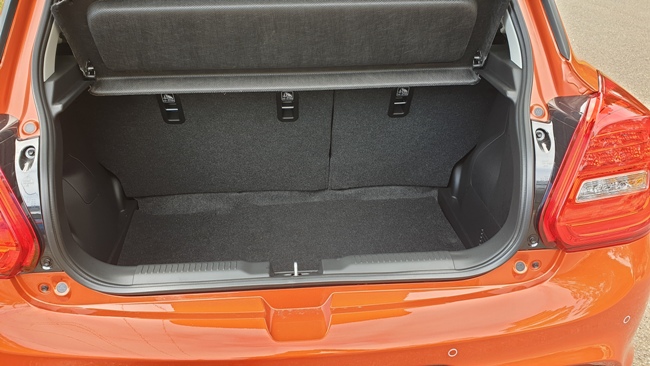
Audio is AM/FM only though, a truly odd oversight in a vehicle set as the lead of its range. Although the Swift Sport is Bluetooth equipped, along with auxiliary inputs and smart-apps, DAB nowadays in a top ladder vehicle is expected to be a normal feature.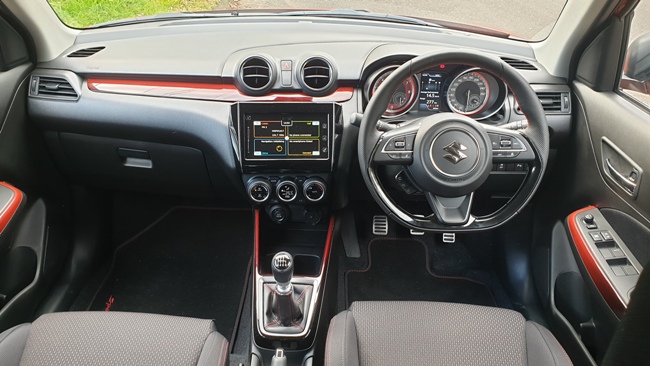 265L is the count for the cargo space, whilst 579L is the count when the rear seats are folded. It’s not a great deal of space by any measure however the Swift has never been intended to be used as a family car. The Baleno or Vitara from Suzuki is where families would look.
 On The Road It’s: Widely regarded as a bundle of fun. Lightweight, low centre of gravity, a short rectangle wheelbase and track (1,510mm track front and rear, with a 2,450mm wheelbase) endow the Swift Sport with a tenacious amount of grip. As mentioned earlier, it’s also fun due to the transmission and shifter, plus the close set ratios mean the Swift Sport manual can really be rowed along with a quick dip of the left foot and wave of the left arm.
The pickup point of the clutch is towards the top of travel, and there’s only a slight amount of sponginess before the pedal takes up pressure. With a little bit of practice, getting the synchronisation of gear selection and pedal travel right means a more progressive and linear acceleration when required, less lurchiness and more utilisation of the torque also.
That torque figure is also why the economy could improve, in our opinion. The transmission is geared so 100kmh is spinning the Boosterjet at around 3,000 to 3,100rpm. Not only is it somewhat noisy, it’s above the peak torque figure and having the engine require a bigger need for fuel. A set of longer ratios from 4th to 6th, to drop 6th down to 2,500 or so, would make for a more flexible drivetrain and better economy. However, there’s no lack of poke, with a drop to 5th bringing in the torque, or simply an extension of the right foot that has noticeable if not rapid acceleration from 6th.
 Suspension wise it’s mixed, with a bang crash at slow speeds over some items, a measure of suppleness elsewhere, and a well tied down set at speed. The ups and downs of freeways are quietly absorbed, whereas there were times at suburban velocities a simple road marking had the Swift Sport feel as if a flat tyre had occurred and it was banging on the rim. Steering wise it’s spot on, with that just right feel and a a little extra weight as the wheel loads up left and right. Naturally braking is spot on, with minimal travel before the pads bite and a message of just how much pressure is needed for the required stopping distance.
What About Safety?: Rear parking sensors, that partially blanked off reverse camera, and the new Blind Spot and Rear Cross Traffic alerts bring the Swift Sport’s safety level up a notch. Six airbags still and there is no hill start assist for the manual. That may seem a bad thing however Suzuki’s appeal is in making cars that are ideal for new drivers, and learning a hill start with no assistance is or should still be mandatory in driving lessons. There is a Forward Collision Alert system too, and it’s pernickety at times. It would beep at teh driver as a warning (great) for a vehicle at a driver determined safe distance (not great). What About Warranty And Service?: the Suzuki website has a page where an owner can submit their car’s build details. the Swift Sport comes with a five tear warranty, and with unlimited kilometres. They’ll cover commercial applications such as ride share for up to 160,000 kilometres. Sericing is 12 monthly or 10,000 kilometres for turbo cars such as the Swift Sport, and have capped price servicing for five years or 100,000 kilometres. The first service is $239, followed by $329, $239, $429 then $239.
At The End Of the Drive: As a former car sales employee, Suzuki was a brand that AWT was heavily involved in, and alongside another Japanese brand at the particular dealership, the Swift was the preferred choice of Mums and Dads that were looking for Junior’s first car. Some migrated to the manual versions that were available after finding their feet with the auto. With the 2020 Suzuki Swift Sport now available in dealerships and available in both manual and autos, the brand continues to deliver a car with genuine appeal, good looks, a decent level of features, and good enough economy. Book your test drive here.
Nissan Ariya: A New Charge For 2021
Nissan is on the move, charging forward. They’ve unveiled a new electric SUV and a new logo. The sleek looking Ariya is a completely electric vehicle and Nissan says the release is part of the brand’s change: enriching people’s lives. There is a renewed vigour in the Japanese company, one that recognises that the stagnation it experienced needs to go, so a second look at the company and its strengths has been performed and both battery and SUV will be part of the language. Nissan’s CEO, Makoto Uchida confirms, with: “Combining our strengths in EVs and crossovers, it’s a showcase for Nissan’s new era of excitement and design. “We created the Nissan Ariya as an answer to the aspirations and practical needs of today’s customers.” The plan is to roll out in the next 18 months a dozen new models, and aim for a mix of EV and “e-Power” models to hit one million sales by 2023, plus bring in Nissan’s own autonomous driving tech throughout 20 countries. This backs up part of the company’s renewed look at servicing its customer base by providing the new technology in areas such as electrified cars and self-driving vehicles.
 Launched as a centrepiece of a digital presentation from Yokohama, the Ariya will put front and forward the restyled Nissan logo. It’s a not quite subtle yet not quite extravagant change, with links to the now former circle and cross centre label brought into a future focused design. Uchida-san said: “It defines what matters to Nissan, represents what we stand for, and embodies the essence of who we are: a passionate, innovative challenger.”
 With a key characteristic of fully electric vehicles being that instantaneous delivery of torque, the Ariya instantly promises easy driveability, sporting manners, and a choice for the budget. Both two and all wheel drive, called e-4orce in Nissan’s terminology, will be available, along with a pair of battery sizes at 65kWh and 90kWh. In the Ariya e-4orce, each end will have its own separate motor, a configuration that’s becoming more and more common for EVs. By providing twin motors, an EV can be better balanced for driving in areas such as torque vectoring, and handle more driving conditions such as heavily wet tarmac.
Power as such is rated as 160kW and 178kW for the Ariya 2WD’s battery pairs, with the e-4orce proffering 250kW and 290kW. the 2WD torque figures level at 300Nm whilst the all wheel drive will have 560Nm and 600NM. This will enable the two drivetrains to see 100kmh in 7.5 seconds or either 5.4 or 5.1 seconds. Top speed will see a v-max of 160kmh or 200kmh. The range expectations are currently seen as “up to” 450km or 600km for the 2WD, and 430km or 580km for the e-4orce. These are subject to verification and Japanese government sign off. And by placing the battery into the floor structure, more space is unlocked, adding even more comfort for passengers. Electric tech has extra advantages for the driver. Nissan’s ProPILOT 2.0 is their proprietary advanced driver assistance system, and brings in the ProPILOT Remote Park and e-Pedal features. Ariya will feature as standard the Safety Shield system that includes Intelligent Emergency Park, Intelligent All Around View Monitor, and Intelligent Forawrd Collision Warning. There will also be Rear Automatic Emergency Braking technology.
A form of AI in the human-machine interface allows for passengers to use a natural speaking voice for interaction with the Ariya’s on-board settings change facilities, whilst updates for software will be the ever increasing “over the air” service. Nissan’s also signed an agreement with Amazon for the Alexa voice interface to be used. The Ariya is a proper mid-sizer at 4,595mm in length and packing a wheelbase of 2,775mm. Width is 1,850mm and height a trim 1,655mm. Depending on model weight is said to be either 1,900kg or 2,200kg. Aero alloy wheels will be wrapped in 235/55/19 rubber as standard or can be optioned to be 255/45/20.
At the time of the release news, the Ariya will only be available in Europe, North America and China by the end of 2021.
Bronco Busting: Ford Resurrects A Legend.
Jeep Wrangler, watch out! Ford has brought the Bronco back to life and the Blue Oval has its sights set firmly on the iconic machine from Jeep. The 2021 Bronco will come in two or four door shapes, or, if you will, three and five door. Soft and hard tops will be available. What won’t be will be anything other than either a four cylinder or V6 petrol engine for movement. But there’s no lacking for model choice with Ford U.S. releasing seven. 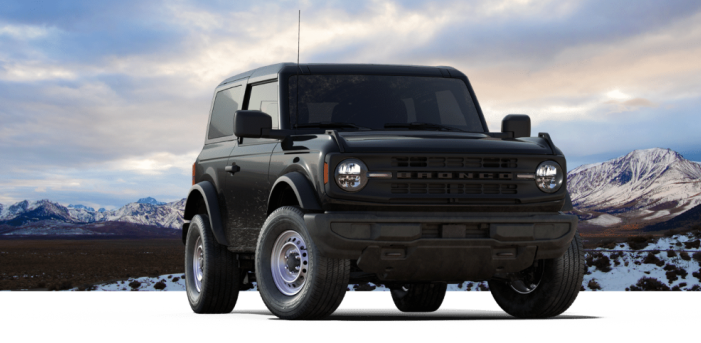 For the U.S. there is the entry level named, smartly, Base. Big Bend, Black Diamond, Outer Banks, Badlands are followed by a name more familiar to Australia, Wildtrak, and a limited run First Edition. Prices will start from $29,995, with Wildtrak at $50,370 whilst the First Edition starts from $60,800.
A four cylinder petrol engine and V6 will be joined by a hybrid at a later stage. For now, we see a turbocharged 2.3-litre that makes 201kW/270hp horsepower and 420Nm/310 lb-ft of torque. The other option is a twin-turbo 2.7-litre that generates 231kW/310 horses and 542Nm/400 lb-ft. Ford says these will be good enough to push the Bronco through close to three feet of water and have a ground clearance of just under 12 inches.
The Base brings a seven speed manual transmission, with a normal six plus a crawler gear for serious off-road chops. A ten speed auto can also be specced.There is a two speed and three mode transfer case as well. Standard is a hard top for the two door and a soft roof on the four. A nifty feature is a upper dash mounting point for smart phones and action cameras. Big Bend gets a little extra luxury with a leather bound steering wheel cover, heated seats, and is the first of the range to offer alloy wheels. Black Diamond aims for the off-roader with marine grade vinyl trim, seven G.O.A.T. drive modes (Goes Over Any type of Terrain) and a standard rear locker diff plus underbody bash plates. Outer Banks has LED headlights and integrated turn lamps, black alloys, powder coated tube steps and a B&O sound system for when the noise of the outdoors isn’t enough.
 Badlands goes up a gear with front and rear locking diffs, Bilstein monotube dampers, disconnecting stabiliser bar, and a choice of 33 or 35 inch AT rubber. Trim can be easy clean vinyl through to full leather. Wildtrak offers a Sasquatch Package that includes 35 inch rubber and 17 inch diameter black painted alloys with a beadlock function. Black roofing and grille also feature. 3,500 First Editions will be released and combine the Badlands mechanicals, Outer Banks interior, and Wildtrak looks.
Production is currently slated for the Australian autumn of 2021 however it’s not yet set for an Australian release.
 Level 2, 9 Help Street