

Author archive
2020 Citroen C3 Shine: Private Fleet Car Review.
This Car Review Is About: A car from a brand with a reputation for being innovative and quirky, but not necessarily at the same time.
Citroen’s C3 has been part of the legendary French brand for some time and has morphed from a rounded hatch to a flatter looking mini-SUV. A variation on the theme is the Aircross which once had plastic panels fitted with air-filled pockets, yet no longer does. The C3 itself, though, has a set of four small panels called AirBump, one for each door. The front has five pockets, the rear just two.
The idea is to provide some sort of very low speed impact protection from marauding shopping trolleys, however if this seemingly otherwise good idea were actually that good, we would see it on every car. It’s worth noting that Citroen themselves once had these panels covering all of the door, not just a small section… How Much Does It Cost?: In real terms, it’s a bit ouchy. Call it $28,990 drive-away for a car the size of a Mini, however there is the currency exchange rate to consider. This price was, at the time of writing, available for cars delivered by November 30, 2020. In comparison, Kia’s Cerato hatch and sedan were on a drive-away offer (October 30, 2020 end date) of $23,990.
Metallic paint, such as the Platinum Grey and white roof combo fitted to our test car, is an optional cost of $590. The C3 comes with a body and roof combination range of Opal White and Red, Almond Green and Black, Perla Nera Black and Red, Ruby red and Black, and Cobalt Blue and White.
Under The Bonnet Is: Another of the back pocket sized 1.2L turbo three cylinders proliferating in smaller cars. The addition of a turbo has breathed new life into these, adding much needed torque. There is 81kW and 205Nm. The auto is the EAT6 and matches the thrummy 3 cylinder perfectly. It’s a sipper, too, with 6.1L/100km seen on our 70/30 urban/highway cycle. The official combined cycle figure is 4.9L/100km.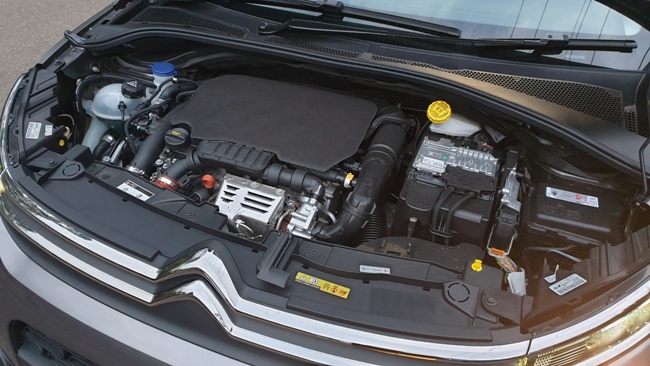 On The Outside It’s: Soft and round, with nary a sharp crease to be found. Ovoid is the term, with the body, roof, front and rear lights, all curvy. The straightest lines, somewhat ironically, are the plastic panels containing the air pockets…unless you count the delineation in colour between roof and body. It’s designed so the LED driving lights look like the headlights, the headlights sit slap bang in the middle of the bumper, and above the halogen driving lights.
 The roofline slopes gently downwards from the A-pillar and slightly protuberant tail lights. 205/55/16 Michelin Premacy 3 rubber and simple eight spoke alloys finish the package. It’s compact at 3,990mm in total length but packs a very decent 2,540mm wheelbase, meaning minimal overhangs for the front and rear. Height is petite too, at just 1,470mm.
On The Inside It’s: A mirror, on the door trims and door handles, of the exterior airbumps. The dash is a flat and slabby affair, with the dash standing out from the door joins rather than flowing into them. Plastics lack that sense of tactile appeal, unfortunately. The airvents also mirror the ovoid motif. Audio is AM/FM, with no DAB. The touchscreen is a 7.0 inch affair and has both Apple and Android connectivity.
 For the driver’s it’s a standard dual dial design in the binnacle with a separate monochrome info screen. The tiller has the slightly squared off bottom end and is leather clad. The seats are comfy, and clad in a black, grey and orange stitched mix. Gears are selected by a “J gate” style lever with leather surrounds.
  The cargo section has a low floor but isn’t especially capacious at 300L. 922L is the figure with the 60/40 rear seats folded. Supplementary storage and equipment is minimal with small cup holders, slightly oversized bins for the doors, along with auto headlights and wipers but manual seat adjustment.
 On the Road It’s: Always fun to drive. Three cylinder engines have a massive appeal due to their aural presence. There’s an off-kilter rumble, one that never sounds rough or wrong as revs climb, rather it becomes a more sonorous sonic hello to the eardrums. Suspension tune is erring to the soft side but stopping short of bouncing the body off the bump stops. Steering feel is also slightly woolly, with no real conversation to the driver’s hands but weighted so three point turns are an easy trick.
Torque deliver brings a patient rise in speed, but also one that isn’t overly lax in performance. It’s no rocketship, true, yet there is enough verve and oomph in the engine’s mid-range delivery to provide that just-right go around town.
Stop-Start is fitted and confuses the engine sometimes coming up to a stop sign; the brake pedal has that borderline pressure required to engage it or not, and occasionally it would shut down the engine just as the foot would lift from the pedal. This leads to that hesitation that interrupts acceleration just as it’s needed. the auto also had the occasional dose of indecision, mostly at light throttle, banging between lower gears before settling on one as the speed rose.
What about Service And Warranty?: 5 Year Free Scheduled Service, 5 Year Unlimited KM Warranty & 5 Year 24/7 Roadside Assistance.
What About Safety?: Minimal, in relation to others. AEB is fitted as are six airbags, rear sensors, lane departure warning, and reverse camera, but that’s about it.
At The End Of The Drive: Citroen is up against with the C3 Shine. Price is one thing, perceived value is another. It’s a fun little car to drive, a cute little car to look at, but when put against cars such as the Picanto, Mazda’s 2, or the VW Polo, the Shine fades. The stylish quirks of the airbumps have disappeared from the C3 and C5 Aircross, and the forthcoming C3 loses four bumps, offset by a small increase in size.
If slightly oddball French chic is your thing, find out more here.
Peugeot 2008 Ready To Roll For Australia
 Peugeot has released details of the soon to be released, for the Australian market, 2008. It’s the baby SUV the company has had overseas for a few months, and for Australia it will come in a two tier range, Allure and GT. A third model, presumably called GT-Line, is due in early 2021.
Engine. The Allure and GT will share a 1.2L three cylinder petrol engine with turbo. The Allure has a six speed auto to match the 96kW/230Nm spec, with the GT getting an eight speed auto and 115kW/240Nm powerplant. Economy for each will be similar, with 6.5L/100km for the Allure, and 6.1L/100km for the slightly more torquier GT. That’s important as the Allure, at 1,247kg, is 40kg lighter than the GT. Tank size is 44L. The drivetrain for the Allure is intended more for those of the “let’s have fun” group”, with the Advanced Grip Control programmed for Mud, Sand, and Snow. Body. The grilles give away which model is which. The Allure has horizontal strips, the GT has verticals. The front end has a sharper look that the previous 2008, and features redesigned headlights, with the GT notable for the three vertical strips that match the blade LED driving light as seen on the gorgeous 508. The lower air intake will house the forward facing sensor for the adaptive cruise control and AEB. Active Blind Spot Monitoring for the GT is standard, as is Adaptive Cruise. The GT also has an advantage over the Allure with the AEB being low-light capable for both pedestrian and cyclist. Eco/Normal/Sport driving modes are also GT specific.
 Wheel size is 215/60/17 and 215/55/18 for the Allure and GT, with inserts to provide different looks. Both cars will have a 16 inch space saver. For the sides, a pair of triangular creases joing the front and rear, and the rear lights have the familiar triple claw look now housed in a slimmer casing. Both are 4,300mm in length, and share a 2,605mm wheelbase. They stand 1,550mm tall and are 1,770mm in width.
 Above the rear window is a black spoiler for the GT, a body coloured unit for the Allure. the wing mirrors will be the same. For the GT, a full glass sunroof can be optioned. A small and interesting note: the 2008 badge has the 00 linked together in an infinity sign, a symbol that Peugeot embodies as never-ending development.
Equipment. 180 degree parking cameras, climate control, and heated mirrors are common to both, as are electric parking brakes. Over the Allure, the GT has front and rear sensors, semi-auto aprk assist, a different gear selector, and paddle shifters. The GT also has alloy pedals and 8 colours for the LED ambient lighting. Luxury gets a bump with full grain, perforrated, leather for the steering wheel and gear selector.
For the fronts eats the Allure has a 7.0 inch touchscreen, the GT gets a 10.0 inch unit. Wireless charging is standard for the GT and there are a pair of USB ports up front; one is the USB-A and the other the smaller USB-C. There are two USBs for the rear seats. In between the front ports is a folding cover that reveals the nook for the charge plate, with the door having a small ridge to rest the phone on for a widescreen orientation. Android Auto and Apple CarPlay is standard for both. For the driver both have a 3D look display screen, with a unique design bringing information “forward” in the way it looks. The GT has a full Nappa leather interior. On The Road. The GT has the better feel on road, with a sense of more energy, and just that little bit more grip. That’s a seat of the pants feedback, as the footprint for both is identical, so put it down to the slightly smaller sidewall on the GT’s rubber. The steering in both is well weighted, as you’d expect. The eight speeder in the GT makes for a better overall response to the throttle, with a Sport mode adding extra pep. And of course, the brake feel is spot on.
 Our time with the Allure and GT was part of the media launch held in the northern area of Sydney, with drive time in each just over an hour. Depending on availability, AWT hopes to be able to spend a week with one or the other in early 2021.
 Pricing is currently set as $34,990 MLP for the Allure and $43,990 MLP for the GT. That price disparity accounts for the GT being fully loaded and with essentially only a glass roof and a choice of seven exterior colours including three pearlescent paints as options.
2021 Volvo XC40 R-Design PHEV: Private Fleet Car Review
 This Car Review Is About: Volvo’s SUV entry into the hybrid world and specifically the Plug-in Hybrid Electric Vehicle world. The R-Spec sits at the top of the mid-range for the XC40 and looks an ideal way to get the Swedish brand into the market for hybrid SUVs.
How Much Does It Cost?: Volvo provided, as always, an extensive information sheet. The manufacturer’s list price is $64,990. As tested, the vehicle supplied was $69,760. Metallic paint is a premium price here and double the asking cost of nearly everyone else in the segment at $1,150. A powered folding rear seat headrest and cargo protection net is $230. A Climate Pack which consists of heated wipers, heated front seats, and heated tiller is $700. A big tech item is the 360 degree camera is $990, with tinted rear windows at $700. For the heated rear seat that’s $350 with Park Assist Pilot at $650.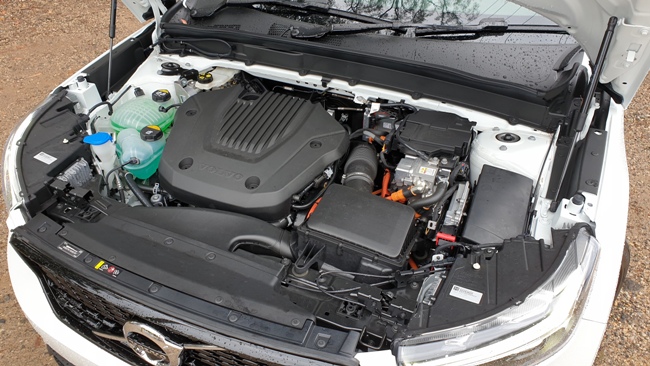 What’s Under The Bonnet?: A combination of a three cylinder 1.5L petrol motor and battery powered engine. The petrol motor is 1.5L in capacity, and generates 132kW of peak power and 265Nm of peak torque. This is backed up by the 60kW and 160Nm from the electric motor. Consumption is quoted as 2.2L/100km for the combined cycle and that is eminently achievable. We saw nothing worse than 4.6L/100km, meaning a theoretical range of around 1,000km. It also reduces emissions, with 50g/km the quoted figure. Tank size is 48.0L. 0-100kph time is quoted as 7.3 seconds and a top speed of 205kph.
 On the Outside It’s: Unchanged from the “normal XC40” bar the addition of a port fitted for the battery pack on the left forward flank. To see our original review, click here for more.
On The Inside It’s: Also largely the same. The virtual dash has the addition of Hybrid in the right hand dial, and the main touchscreen, which swipes left or right for submenus, now has the addition of a “Charge” tab, to engage the engine whilst driving to add charge to the battery pack. A zipper bag is included that houses the charge cable. A simple clip ensures the bag stays in place whilst driving. The airvents have a whiff of 1950s elegance and an alloy trim plate brings class to the dash ahead of the passenger. The cargo area is of a very good size but has a flat floor, losing the more effective folding floor that opened to storage pockets underneath. On The Road It’s: An interesting drive. In our experience, hybrids start off quietly, get to around 20kph, and then, regardless if a EV Mode is selected, overrides that and kicks in the petrol engine. Here it’s the opposite, with silent electric driving UNLESS the accelerator is mashed to the floor. The three cylinder engine is isolated to the point of invisibility aurally, and is so well integrated in the drivetrain that any physical sensation is virtually free of being felt.
 Range on battery alone is estimated at 40 kilometres, and the dash display shows this along with the consumption. There is a regenerative change that collects kinetic energy and feeds it back to the battery. And when engaging the petrol engine to recharge that battery it’s that same seamless switch from a silky smooth electric run to a barely perceptible thrum from the three cylinder. However, it’s a two mode system and cannot be adjusted. There are drive modes, one of which is Pure. This locks the drive into only battery powered motion and when the battery runs dry, automatically switches to petrol power. Power mode hitches both electric and petrol to the drivetrain, and emulates the heavy right foot drive style needed when that just right break in the traffic comes along.
 It’s an ideal cruiser too, with the combined torque propelling the 1,760kg XC40 along the freeways and highways effortlessly. It’s a serene experience, with only hints of tyre and noise getting through to the cabin. That’s an impressive feat considering the 245/45/20 Pirelli P-Zero rubber. With such a sizeable footprint, more noise would be reasonably expected. They also provide, not unexpectedly, more than ample grip, with cornering a confidence-building event and with virtually zero body roll from the MacPherson strut/multi-link rear.
  The ride is perfect, with compliance and a sporty tautness exactly where they should be. The same applies to the steering; it’s light but not overly so. There is weight when needed but nor is it excessive or applied at the wrong time.
Braking is the area that needs work; that beautifully tactile feel has changed to a grabby and non-intuitive bite. There’s a lack now of gentle and smooth progression, it’s now a situation where it’s semi-soft before grabbing the discs and lurching the XC40 to a halt. It’s more than a niggle especially at traffic lights and stop signs where there may be a vehicle ahead, and that lurch is enough to raise the eyebrows and push the pedal harder to avoid contact.
What About Safety?: Plenty, of course. It’s what Volvo is built on. Here’s the list: City Safety: Pedestrian, Vehicle, Large Animals and Cyclist Detection, Intersection Collision and Oncoming Mitigation with Brake Support; Steering Support; Intellisafe Assist: Driver Alert; Lane Keeping Aid; Adjustable Speed Limiter function; Oncoming Lane Mitigation; Intellisafe Surround: Blind Spot Information (BLIS) with Cross TrafficAlert (CTA), Front and Rear Collision Warning with mitigation support; and Run-off road Mitigation. Hill start assist; Hill Descent Control; Park-assist Front and Rear; Rain Sensor; Drive mode with personal powersteering settings; Emergency Brake Assist (EBA); Emergency BrakeLight (EBL); Frontal Airbags, Side Impact Protection System (SIPS)with airbags in front seats, Inflatable Curtains and Whiplash ProtectionSystem; Driver’s knee airbag; Belt Reminder all seats; ISO-FIX outerposition rear seat; Intelligent Driver Information System (IDIS) complete what is an obviously extensive list.
 What About Warranty And Service?: Five years and unlimited kilometres. The battery has an eight year warranty excluding expected efficiency losses. Volvo has a three year capped price service plan and for the XC40 it’s $1,595.
At The End Of the Drive. Hybrid technology for the automotive world is increasingly seen as a better option than purely electric and hydrogen. The bigger the charge from the battery the more assistance it provides to the petrol engine, and the better the range. And then the range anxiety that still worries people with a purely battery only vehicle is largely alleviated, and petrol running costs are reduced significantly.
In XC40 R-Design form, hybrid tech provides an ideal opportunity to sample it and in a car that is an award winning vehicle. There is plenty to like here, and it’s a car worthy of investigating to place in the driveway. Here is some information from Volvo.
Full Speed Ahead: Mustang Mach 1 Returns.
It’s a blast from the past for fans of the Blue Oval as the Mustang Mach 1 is readied for a 2021 Down Under release date. Sharing features from the Mustang Shelby GT350 and GT500, the Mustang Mach 1 is suitable for the track as much as it will the road.
Aero aids, the famous Mach 1 badging, and a 345kW 5.0L V8 under the long bonnet are part of the appealing package. There is a Tremec six speed manual or Ford’s ten speed auto to play with, and the manual has rev-matching technology for better changes. A heavier-duty oil cooler can be specced for both, and a software upgrade for the auto to optimise road and track based performance.
The Mach 1 rolls on a bespoke suspension tune with MagneRide 1 dampers and bespoke springs, along with rejigged anti-roll bars and bush specifications to deliver improved control and response under high cornering loads. 19 inch alloys will be uniquely designed for the Mach 1. Body colour and external trim combinations number five, and bonnet stripes and body styling evoking the original 1970s version. Each vehicle has its own identification badge for the chassis number.
The engine benefits from an open air induction system, 87mm throttle bodies, and a manifold shared with the North American specification Shelby GT350. The engine’s management system has been tweaked to allow high and low pressure fuel injection to match the engine revs. Peak torque, by the way, is 556Nm at 4,600rpm, with the 345kW at a high 7,7500rpm. Keeping the engine’s oil cool is the job assigned to the Shelby GT350 unit, bolted on via a redesigned mount to ensure a proper flow under any load. It also means that te only engines noises a driver should hear exit via a quad set of 4.5 inch tips via the Active Valve Performance Exhaust system.
“Following the success of Mustang BULLITT and Mustang R-SPEC, we are very excited to introduce this highly capable, track ready Mustang to our Australian Mustang fans. The unique styling, which pays homage to the original model, is more than worthy of its legendary badge,” said Andrew Birkic, President and CEO, Ford Australia and New Zealand.
A twin-disc six speed manual or a ten speed auto are the transmissions. The manual has a rev-matching system that momentarily blips the throttle, matching the engine speed to the selected gear. For those that like a sporty feel, flat shifting is also programed in to be usable. And as a track capable machine, there is an additional cooling system fitted to the limited slip diff rear axle.
Aero changes see the Mach 1 having 22 percent more downforce than the Mustang GT. A rear diffuser shared with the Shelby GT400 pairs with a longer undertray fitted with air directional fins for brake cooling. A change to the shape of the front splitter sees an increase in aero grip too. This is all balanced by a specially designed rear decklid spoiler.
Ride and handling see the MagneRide magnetic suspension recalibrated for the Mach 1. Stiffer front springs and recalibrated roll bars are partnered with Mustang Shelby GT350 and GT500 subframes and toe-link components. Braking is improved with a higher spec booster with discs inside a set of five spoke 19 inch wheels.
There will be a choice of five body colours, complete with bonnet and side stripe combinations. Available will be Fighter Jet Gray2 with Satin Black/Reflective Orange stripes, Shadow Black and Oxford White with Satin Black/Red stripes, or Velocity Blue and Twister Orange, with Satin Black/White stripes. To add extra spice, an optional Appearance Pack will also be available exclusively with Fighter Jet Gray, featuring orange accent seatback trim, orange brake callipers and satin black and orange hood and side stripe. Mustang Mach 1 upper and lower front grilles are finished in gloss black, and the iconic Mach 1 logo appears on the rear deck-lid and on each front wing. Interior trim will be an Ebony colour scheme and an aluminuim trim called Dark Engine. Metal Grey is the colour for the stitching in the seats, with Recaro seats available to option. Each Mustang Mach 1 features a unique dashboard badge featuring the Mach 1 logo and chassis number, complemented by unique sill plates and a new start-up display on the 12-inch digital instrument display cluster. Sounds will pump from a 12 speaker Bang and Olufsen system, and internet on the go comes courtesy of FordPass Connect 5.
In addition to a five-year, unlimited kilometre full factory warranty, the Mustang Mach 1 is eligible for the Ford Service Benefits program that includes Service Loan Car, Auto Club Membership, including Roadside Assistance and Sat-Nav map updates. Furthermore, maximum service price is $299, including GST, for each of the first four A or B Logbook services at a participating dealership for up to 4 years / 60,000kms, whichever comes first, for eligible customers.

$83,365 is the manufacturer’s recommended list price for both manual and auto, with premium paint at $650, Recaro seats a lazy $3K, and the Appearance pack just $1,000.
“Mustang has won the hearts and minds of Australian drivers, and Mach 1 is one of the most thrilling Mustangs to date. This head turning model not only looks the part, but it has all the hardware to delight Mustang enthusiasts, offering on-track excitement and on-road driving pleasure.” added Birkic.
 Level 2, 9 Help Street