

Author archive
Blue Oval Blues: The Demise Of An Icon.
October 7, 2016, just before 10 am in Melbourne, Victoria. We knew it was coming, we tried to deny it was coming but, inexorably, it arrived. The final Australian built Ford was rolled off the assembly line and the factory fell silent.
91 years. Three million, eight hundred and fifty three thousand, four hundred and thirty seven Falcons later, the last being an blue XR8 Sprint (an homage to the nameplate from the late 1960s), it’s over. Prior to the Sprint, there was a white Territory and a blue XR6. These cars were sold at an auction, raising money for charity. The FG-X Falcon XR6 sold for $81500, the ute XR6 went for $81000 and the Titanium Territory was passed to its new owner for $68500. However, there were three cars that Ford built without ID plates, making them unsaleable and will be kept by Ford for display in their museum.
But there’s much more to Ford in Australia that the events of October, 2016. It’s not commonly known that Ford Australia was founded as an outpost of Ford Canada, a then separate part of Ford USA, as Henry Ford had granted manufacturing rights to Commonwealth countries, except for the UK, to Canadian investors. The very first cars built were assembled from CKD (complete knocked down) kits imported from Canada. These were built in a disused factory from June of 1925, just three months after Ford USA announced that Geelong would be the home of the Australian outpost. The car? The famous “Model T”.
Australia’s Ford history can be tied into innovation; it’s widely accepted that the first coupe utility, or “ute” as it’s best known, originated in Australia and built on a Ford chassis. It’s said that a farmer or farmer’s wife needed a vehicle which could be used to church on Sunday and transport livestock the next. Released in 1934, the design of Louis Bandt, an engineer with Ford, was also born out of economic neccessity. Banks during the Great Depression would not lend money for cars but would for work related vehicles. The coupe utility fitted the bill.
Motorsport has played a huge part in Ford Australia’s history, although in the last couple of decades that gloss has faded. Such was the pride Aussies had in their largely homegrown cars, that a win on Sunday translated into a sell on Monday mentality. The brutal XY GTHO found itself a place in history when it became the fastest four door sedan (or saloon) in the world and had a moment in time frozen forever when Wheels magazine ran a story with the now infamous picture of the car’s speedometer showing 140 miles per hour in a blast on the Hume Highway, running between Sydney in the north, through to Melbourne in the south, in 1971. With Ford’s 5.8L Cleveland V8 sitting under the “shaker” air intake, feeding a four barrel carbie, a plastic chin spoiler and rear deck lid wing, the “Hoey” not only looked the part, the sounds it made when pushed in anger added to the presence.
In the late 1990s, Ford unveiled the R7, a concept car. A large SUV, with rounded and smooth body panels, it would be finalized into production as the Territory and has since bene regarded as one of the best of the Australian made cars. Ford Australia also utilised turbocharging, with their alloy blocked 4.0L six cylinder, which replaced the archaic 4.1L iron blocked engine, finding itself a home inside a range of sports themed cars with the XR nomenclature. The XR6-T and its Ford Performance Vehicles (FPV) siblings would also create their own niche in history, as would the name, Tickford.
Although Australia has flirted with hard top two door cars in a mainstream selling environment, sometimes they’ve proved hard to shift and motorsport has helped out in the background.
Legend has it that some four hundred odd XC Falcon coupes were proving hard to shift and a marketing decision was made to repaint them. With a white body and blue striped look, the Cobra was born and it’s now history that two of them finished in a one two formation at Mt Panorama.
It’s fair to argue that some of Australia’s best looking locally manufactured cars were of the two door design. Chrysler had the Valiant Charger, with a distinctive advertising campaign involving two raised fingers. Holden had had the Monaro from the late 1960s and the two door LC/LJ Toranas before a body swap to the LH/LX and UC Torana.
Ford had had the XM and XP coupe, a beautifully balanced design before leaving that area and revisiting with the coke bottle flanked XA Falcon. The next model, the XB, had a slightly more muscular look with the redisgned front and tidied tail lights but the XC was destined for world wide fame, thanks to a cop in black leather…
Mad Max not only showcased the stark and barren beauty of the Outback, it allowed George Miller to share the evil and demonic black painted, supercharged, dual 44 gallon drum equipped monster that was the XB Falcon coupe and Max’s ride. Sadly, the next model, the XC Falcon would be the final Ford Australia factory produced “tudor”.
Ford’s also made decisions that have backfired in a sales sense; they cancelled off V8 engines in the early mid 1980s, leaving their primary opposition, General Motors Holden (at the time) to run away with the market when it came to these powerplants. It would be some years before Ford Australia once again slotted V8s into the cars, in 1991. They were also Canadian sourced, and somewhat different to the engines made and used in the United States.
Holden and Ford had also gone head to head when it came to luxury cars. Ford had the Fairlane and LTD, with Holden matching up with the Statesman and Caprice. In December 2007 Ford deleted the Fairlane and LTD, citing lack of sales as being unviable, again leaving the market door wide open for Holden to continue.
Depending on the Falcon car they were based on, the Fairlane and LTD were long, large, and imposing vehicles, all the way from their launch through to the BA Falcon, where that commanding and majestic look disappeared, along with their buyers.
Ford Australia also manufactured cars in other locations to Geelong; between 1981 and 1994, the Laser (one of many cars Ford shared as a platform with other makers such as Mazda) was built in Homebush, the site for the 2000 Olympics. The Ford Anglia, Cortina, and Escort, were built in Australia and based on the cars from the U.K. Mazda donated the 626 which would become the Telstar until Nissan’s Pintara became the Ford Corsair.
Perhaps, though, Ford Australia’s history can be seen by many as stemming from the Ford Falcon of 1960, effectively a right hand drive conversion of the American Falcon. Designated the XK, the range would see the introduction of utility and panel van bodies, however Australian roads, particularly in rural areas, soon proved to be the car’s undoing and subsequent engineering work saw the release of the XL. 
 In 1964 the XM Falcon was unveiled, with the first fully Australian designed Falcon body. A year later the XP was released and introduced the Fairmont name. The XP was also the model that concreted teh Falcon into Australian sales, with then deputy manager, Bill Bourke, conceiving a plan to demonstrate the cars durability. A fleet of cars would drive for 110,000 kilometres at over 110 kmh at the You Yangs proving grounds, successfully showing the Australian engineering had improced thecar substanionally over its forebears.

In 1966 the car moved from a smooth and curvy look to a sharp edged, blocky design based on the third generation US Falcon. It was also the first model to have a V8, the 4.7 litre or 289 cubic inch powerplant. The long running 144 ci engine from previous models was deleted, leaving the once optionable 170 ci engine as the standard engine. The XR covered all bases, with Falcon, Falcon 500, and Fairmont sedans, Falcon, Falcon 500, and Fairmont wagons, Falcon and Falcon 500 utilities, and the Falcon Van all being made available.
As the American Falcon had strong ties with the Mustang that had been released in 1964, Ford Australia capitalised on that by unveiling the XR Falcon GT, packing a 225 horsepower or 168 kilowatt 4.7L V8. The XR was updated to the XT in 1968, offering a new V8 at 302 ci or 4.9 litres, plus a new 3.1 litre straight six or 3.6 litre six.  A rework of the external design had the 1969 XW Falcon looking more muscular and hard edged, plus the soon to be legendary 5.8L 351ci was added. Again sourced from Canada, the engine offered, as standard, 291 horsepower or 217 kW, exiting through a dual exhaust and breathing in through a bonnet mounted airscoop for the GT variant. It also saw the introduction of the now iconic “Superoo” decals for the sides of the car.
August of 1969, just days after Armstrong and Aldrin had walked the moon, saw another memorable moment in time. Australia was given the GT-HO. Initially using the “Windsor” V8, it was soon changed to the “Cleveland” pumping out 300 horsepower or 221 kW. There was also an uprated suspenion, hence the HO or “Handling Option” part of the name.
That legend continued to grow with the introduction of the XY nameplate. With only minor styling changes it was the the “Shaker” air intake that many would identify the XY with. Top speed would be generally recognised as 141.5 miles per hour, or just under 228 kilometres per hour. The name “Phase 3” is also strongly identified with the XY GT-HO.
Ford America ceased production of their Falcon in the very early 1970s, with Ford Australia’s design and engineering team producing the XA. It’s the model that reintroduced the two door configuration and is also identified as one of the three cars associated with the “Supercar scare”, with the mooted Phase 4 seeing, allegedly, just three examples being produced.
The XB and XC updates saw some notable external changes and with the XC, a redesign of the dashboard, the “crossflow” head design for the six cylinder engine, and Australia’s first suspension built around using radial ply tyres, known as “Touring Suspension”. 
 The XC is also the model that saw Ford utilise the last remaining two door bodyshells, as mentioned earlier, which gave the Australian motoring public the Cobra. They were individually numbered, rolled on 15 inch diameter wheels with a design intended to help brake cooling and motorvated by a mix of 302 ci and 351 ci engines, painted in that now iconic blue and white colour scheme.
Ford Au would move to a Ford Eu influenced design with the introduction of the XD. The 4.1L would gain an alloy head, increasing fuel economy and power slightly. 
 The XE gave the Falcon a more angular front and the XF of the mid 1980s saw a softening of the design, with a rounded nose and more integrated tail lights. The XE would also be the first Falcon in over a decade to outsell its main opposition, the Holden Commodore, also a Euro based design. It was also the the last model to see the V8 for some time.
 The XG nameplate was applied to the two commercial derivations, the ute and panel van, and saw the introduction of a new powerplant, the slightly downsized 4.0L six, the loss of the archaic three speed automatic transmission associated with the Falcon for decades and a new five speed manual. The range was built on the XF platform whereas the Falcon had transitioned to the ovoid shaped EA and EB. Even the XR6 nameplate, seen in the EB, was brought in.
 The Falcon had updated to the EF in the mid 1990s, with a slimline look to the front end, sleekly integrated headlights and a more curvaceous styling. The 4.0L engine was upgraded to an electronic ignition system and power saw an increase to 157 kW. The EL was a facelift, externally, however the standard six was refitted with the distributor ignition system previously deleted.
Ford Australia’s great hope, the AU Falcon, was released in 1998, utilising Ford’s “New Edge” styling. It was almost immediately condemned for its looks, and changes to the original look were implemented quickly with the April 200 series 2 and September 2001 series 3 updates. They included changes to the grille design, a raised bonnet and bigger wheels.  September 2002 and a half billion dollars later, the BA Falcon was released. A flatter, less rounded and edge oriented design, inside and out, the BA went a long way to reversing the sales drop the AU had brought and won the Wheels magazine Car of the Year award. The BA’s interior was a more cohesive design and saw the introduction of the LCD screen Interior Command Screen. There was also the introduction of the “Barra” range of sixes, including the weapons grade potency of the turbocharged 4.0L. Throwing out 240 kilowatts and a massive 450 Newton metres of torque, it was just 22 Nm shy of the standard 5.4L US sourced alloy V8 also used.
2004 had Ford release the Territory, Ford’s entrant into the burgeoning SUV market and an immediate sales success. It was based on the BA’s floorplan, complete with the independent rear suspension that Falcon’s handling prowess had been lauded for in predeceding years. The BA would also be followed by the facelifted BF before a heavily revised external FG series was released in 2008. The range saw the dropping of the Fairmont and Futura name, the latter a name resurrected from the 1960s for the AU. Modifications to the turbo six saw torque reach an astounding 533 Nm.
The final Falcon, the FG X, was also the first Falcon with a three letter nomenclature and again saw a substantial external redesign. Criticism of the car centred aound the almost unchanged dash even though the abilities of the electronics had increased since the BA. But in a nod to history, the X refers to the history of Falcon, going all the way back to the 1960 XK.
Although Ford Australia has ceased to be a manufacturer, it will still be heavily involved with the world market. Research and Development, R&D, with the legendary You Yangs proving ground, will continue to be part of the global network. It also allows Ford Australia to source some of the world market cars; the Mustang has made a huge impact in the world market and especially in Australia, partly though, to the detriment of the final runs of the Falcon and derivative models.
Hyundai i30 SR: Private Fleet Car Review
Hyundai‘s i30 has quickly become a staple on Australian roads, taking the fight up to Ford’s Focus, Kia’s Cerato and Toyota’s Corolla. It’s an award winning car and for good reason, with a high quality level of fit and finish plus Australian tuning for the ride. Hyundai’s bundled everything into one package for the manual i30 SR and it comes out the other side holding its head up high. What a buyer will find in the near 1300 kilo SR is Hyundai’s non turboed Nu 2.0L gasoline direct injection engine, with peak power and torque of 124 kW and 201 Nm. Naturally, both come in at high revs, with 4700 of them needed to see peak torque. The transmisson is a six speed manual and it’s here, in the car provided, that something didn’t feel right. The gate mechanism is loose, sloppy, undefined, and changing from second to third to fourth and back feels as if the selector is moving up and down, not left to right to left.
 The clutch itself seemed initally quite soft and lacking in any real spring pressure, with a seemingly indeterminate pickup point on the travel, with the subsequent revving of the engine past where a normal pickup would bring them down telling the story. When it all gels, however, it’s smooth and usable, it just lacks a real presence.In amongst all this is a frugal powerplant, with a combined total, from the 50 litre tank, of just 7.0L per 100 kilometres. If you’re in freeway mode, 5.5L/100 km is what Hyundai quotes and around town is where a lighter foot may be needed, at 9.5L/100 km.
 The test car was painted Brilliant Red, matched by the Start/Stop button’s surround. Otherwise, the interior is standard i30, save for red additions and stitching to the seats, and alloy pedals. There’s a seven inch full colour navitainment touchscreen, sans RDS, a peculiarly Korean thing. There’s an impressive list of tech: Apple CarPlay is on board, as is Bluetooth audio, auto head lights, rain sensing wipers, dual zone climate control air conditioning, and auto windscreen defogging.
  There’s a reverse camera, hidden under the boot mounted badge that folds out and in. It’s a tad noisy and momentarily distracting. Behind the tail gate is 378 litres of usable cargo space, expanding to just over 1300 when the 60/40 split rear seats are folded.
 Outside there’s LED DRLs in the front, an SR badge on the rear along with two on the front flanks, gorgeous gunmetal grey tuning fork style alloys at 17 inches in diameter, shod in 225/45 Nexen rubber. It’s Hyundai’s fluidic design in profile with the headlights flowing back into the guards, bracketing the newish corporate grille that is a one piece design. It’s cohesive, good looking and suits the colour the test car was covered in.
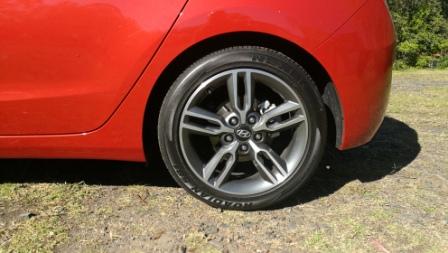 It also cuts a fine figure on the road. Hyundai’s engineered a wonderful road holding chassis, with tenacious grip, a beautifully weighted steering feel using the Normal mode (it feels too artificially heavy in Sports, too light in Comfort), a ride quality that balances front and rear in the way the SR rebounds from bumps and undulating roads, thanks to revalved dampers and retuned springs.
  Even on unsettled and broken surfaces, it ducks and weaves through them with aplomb, exhibiting a high level of body control. And although it’s a normally aspirated engine, there’s enough pluck in the powerplant to provide enough performance without seeming underpowered. Rev through the numbers and there’s a steady pull through the range without running out of puff at the top end.
At The End Of The Drive.
The SR raises the i30 above the entry level and sits comfortably below the Premium, offers a well thought out feature list and priced from $25590 plus ORCs it’s a good value package. On the road it’s a solid handler, with a willing enough engine, with the weakspot being the lacklustre gear selector. Work around that and the i30 SR stands out as a suitable alternative to the Japanese big sellers. Go here:Hyundai i30 SR for more info.
HSV Clubsport R8 Track Edition: Holden Special Vehicles Goes To Bathurst
There’s a calling that emanates from a relatively innocuous hill in the central west of New South Wales. But this bump in the earth’s surface, just to the south of the former gold mining town of Bathurst, is home to a road that doubles as a race track and, once a year, becomes the home of “The Great Race“. That calling, to a place known as “The Mountain”, to Mount Panorama, entices the faithful and the dedicated with their almost tribal allegiances to a driver or a team, and since the 1990s, has coloured their blood red or blue exclusively. You’re either a Holden bloke or a Ford bloke, such is the barrier. Holden Special Vehicles, HSV, was born out of the breakdown in the relationship between car manufacturer, Holden, and its formerly favourite son, race car driver Peter Brock. Brock had taken over the running of the Holden Dealer Team and had formed an after market division, which eventually lead to Holden breaking off their supply deal. In 1987, Holden signed an agreement with Scottish born driver and businessman, Tom Walkinshaw, forming a joint venture that was named Holden Special Vehicles.
 One of the first products of that union was based on the Holden VL Commodore; HSV fitted an aerodynamically tested body kit, painted in a silver with hints of blue. Known colloquially as “The Batmobile” due to the add ons, the Holden VL Commodore SS Group A SV would set the tone for many of the following products.
 In 2016, HSV unveiled two limited edition models. Using the Clubsport as the donor, there is the Limited Edition SV Black, available in both sedan and ute bodies. The other is a car that harkens directly to the history of motorsport and was driven in Bathurst, the HSV Clubsport R8 Track Edition. Clad in “Sting” red paint, with yellow AP Racing brake calipers visible through gunmetal grey “Blade” alloys at 20 inches in diameter, the Track Edition makes for an ideal way to nod at Australia’s diverse and rich motorsport history.
 Mount Panorama is unique amongst the world’s motorsport circuits; its peak is 874 metres above sea level and there’s a height differential of 174 metres between the peak and the lowest point of the track, the starting straight. There’s slopes as tight as one in six and a corner said to have the highest tyre load of any race circuit in Australia plus the fastest corner in touring car racing. There’s a couple of cold facts.
 What isn’t cold is the warmth the place generates for the fans of motorsport that make the annual pilgrimage “out west”. There’s good natured rivalry, with supporters of the red and the blue sharing campsites, gags, memories and, importantly, a love of a good V8.
 The Track Edition packs a 340 kW/570 Nm 6.2L LS3 V8, pinched from Chevrolet. There’s a real transmission, a six speed manual, with an almost too light clutch. It’s unlike older cars, where the joke ran along the lines of being able to tell a HSV owner due to the size of the calf muscle in the left leg. It’s easy to push and balance on the throttle when required and it helps that the gear selector is couched in a definitive feeling gate mechanism. There’s a satisfying snick/snick/snick as you change up or down, as satisfying as the sound of a cold one being opened in the camping grounds.
 It’s a big heart, the LS3 V8. There’s a bore of near as dammit 104 mm, a stroke of 92 mm, with a free revving nature to boot. That peak power comes in at a typically high 6000 rpm, and the peak torque at 4600 rpm. It’s a gentle upwards slope for that torque, though, with just over 400 of them waiting to be told what to do at just 1000 revs. Just like the denizens that pack The Mountain every October, it’s easy going, relaxed, unfussed…until it’s pushed. Leave it in sixth at legal speed and press the loud pedal. It’s called the loud pedal for a good reason. There’s a low, long, subterranean, growl that builds and builds and builds from the front, as the induction system sucks in litres and litres of air, mixing with dinosaur juice and spitting out the remains via the quad exhaust.
 That quad exhaust is linked to a dial in the humble looking cabin. There’s a choice of Touring, Sport and Performance. Leave the dial on Touring and at idle you’d be pressed to say the engine’s running. Move it to either of the other two and a pair of baffles open in the inner banks of the mufflers, opening the throat of the LS3 and letting the world know it’s an eight in a vee. From a standing start and driven the way a muscle bound car should be sees license goodby speeds reached in a few seconds, a roaring, chest thumping snarl from both ends as you pluck the gears, easily finding each cog as the beautifully weighted selector falls to hand and the clutch and accelerator dance in unison. At Northern Territory legal speeds, the engine is barely ticking over at 2000 rpm.
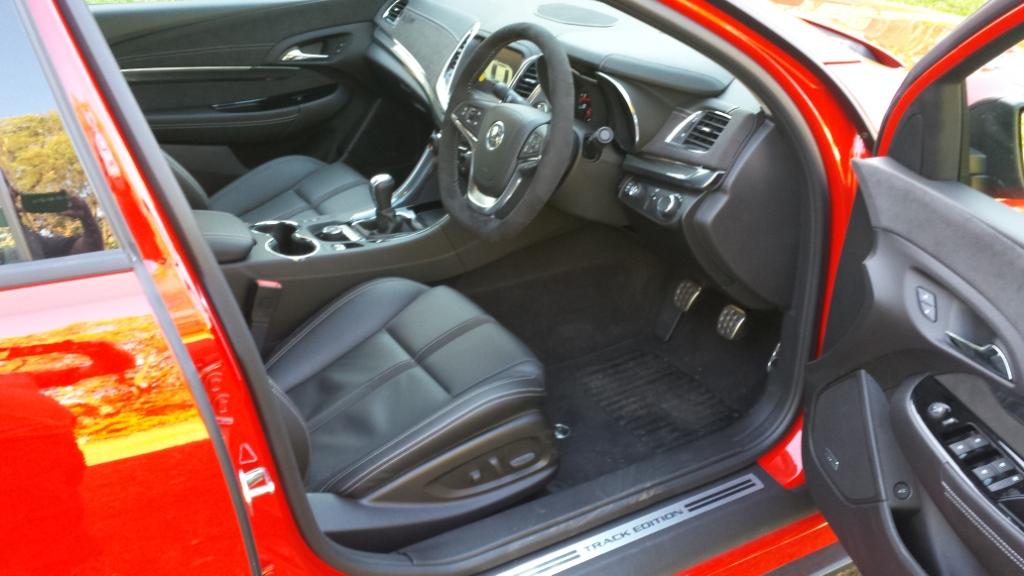 The MacPherson struts up front and multilink rear end are sprung with linear rate coil springs and for a car weighing over 1800 kilos it’s adept, comfortable in the ride, eats unsettled surfaces and totally undermines any perception that a muscle car should be uncoordinated in the way it drives. Even the electrically augmented steering is light, two fingertip light and responds instantly, changing the direction of the red machine instantly, as the Continental 275/35/20 tyres grip at either end of the 2915 mm wheelbase.
 The suspension is taut, specially engineered to give an intoxicating mix of Supercar inferring ride, a superbly flat stance into corners and that slow in/fast out response a track aimed driver expects. In fact, the whole package is genuinely one your gran could drive, it’s that docile to use when not exploring the outer limits of the ability the Track Edition has. The car industry uses the term “surprise and delight” to describe certain aspects of a car and that applies to the way the HSV flows on the road.
 Inside, the lack of visual differentation is a surprise and not entirely a delight. HSV eschews the fabric stitched into the centre line that the donor vehicles have but has stayed with the dash mounted fabric found in the Holden SS. There’s the standard dash plastic and layout, with Holden’s MyLink touchscreen systen with Pandora and Stitcher apps. HSV’s EDI, Electronic Driver Interface, didn’t seem to be enabled in this car. There’s a thumping Bose sound system, beautiful in its clarity buck lacking a DAB tuner.
 It’s hard to suggest any changes however as 2017 beckons and with it the knowledge that Australia’s Own will close the doors as a big car maker down under.
 It’s an engine of many personalities, the LS3, just like those found around the camp sites at The Mountain, especially those at the top, called Skyline. A Wheel Thing commentated from the tower there in the mid noughties, alongside the great Barry Oliver, with an enduring memory being watching Army helicopters doing aerobatics…below the level of Skyline.
  It provides a sweeping vista north, across the circuit, over Bathurst itself and east to the western fringe of the Blue Mountains. Regulars will have their campsites setup with heaters, fencing, signs, and the obligatory ambers on ice. There’s jackets adorned with badges, faces adorned with beards, and kids faces wreathed in smiles when the HSV R8 Clubsport Track Edition visits the top of The Mountain.We’ve got the dial set to Touring, so as to not draw the ire of the campers as we seek a suitable site for some pictures. Photo session over, it’s into the campsite and espy a site with both the blue and red colours on the flags. Photographer Scott grins and says he has an idea. Moments later the rear of the red car is up against the fenceline, with a horde of the curious swarming over the car. They note the working bonnet air vents, the lack of visual identification that it’s a Track Edition outside, door sill and centre console the only places Track Edition is mentioned.
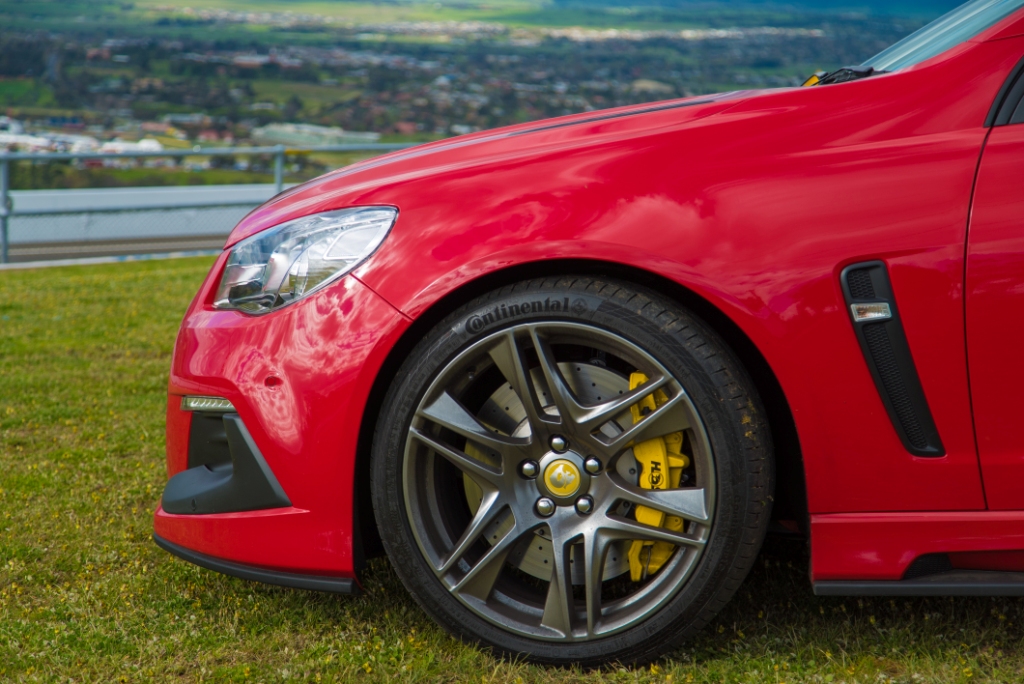 There’s an eyeballing of the body coloured and black wing, the contrasting black inserts in the front bumper against the red and the slim black skirting along the sills of the near five metre long machine…a Ford bloke nudges his Holden mate and points towards the yellow six piston calipers from AP racing with HSV embossing, visible through those “Blade” alloys. Comments are made about the gloss black highlight of the bonnet badge, with the consensus being that it looks wrong. “Where’s the chrome?” asks one. Another in the crowd asks “Howsitgomateorright?” A nod, a smile and then the inevitable question…”Can we check out the donk?”
 The aluminuim bonnet is lifted and instantly the population around the car doubles, as does the number of cameraphones. The engine’s being quietly idling in the background, feeding the dual zone aircon a steady flow of cooling air inside, across the non heated or cooled leather seats and suede wrapped steerer.
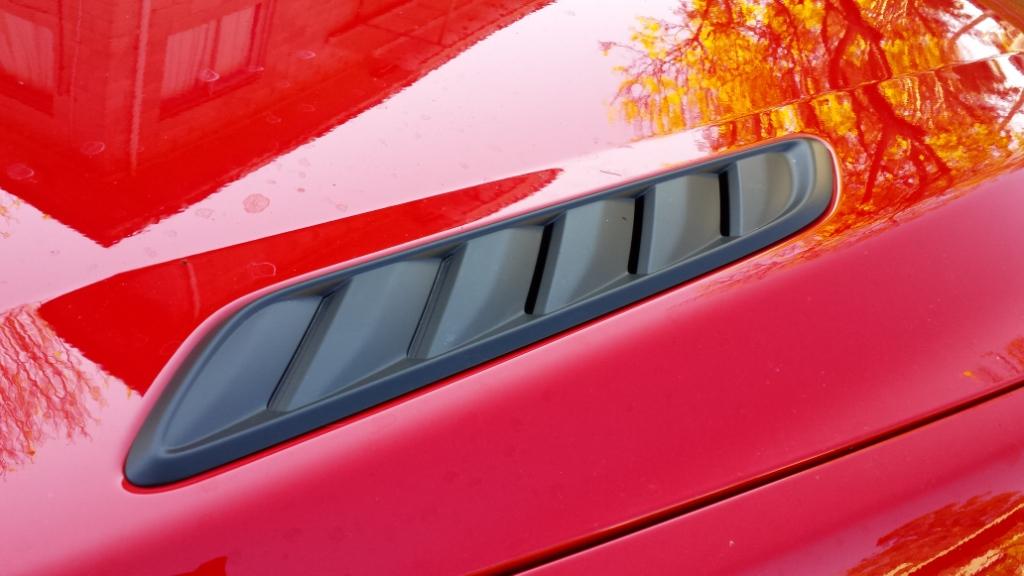 It takes only a moment’s breath before “Goonmategiveitago!” The 6.3L alloy block snarls in response, effortlessly sending the mechanical needle spinning past the over emphasised numbers on the tacho, eliciting a cheer from the red lion faithful, an appreciative nod from some of the blue oval brethren, before one grins, walks away, and starts up his blue oval badged V8 to answer the challenge issued by the HSV. It’s no contest, say many, the red car sounds best.
 There’s a price to pay for that exuberance. You can’t call 6.2 litres of Chevrolet’s finest economical, unless you own Saudi Arabia. Even those few stabs on the throttle have shifted the fuel needle, as fuel is sucked in from the 71 litre tank, nestled near the 496 litre boot.. The LS3 prefers a liquid diet of 98 RON unleaded and will show nothing less than 12.0L of liquid gold being consumed for every 100 kilometres covered, and that on the return trip from The Mountain on a greasy highway after light rains.
 The crowd have dispersed, with many words of thanks, plenty of pictures taken, and thoughts turn towards the coming weekend of endurance racing at the Mountain. HSV is inextricably linked with the history of the place, with Tom Walkinshaw himself having raced in a Jaguar XJ-S. The Track Edition, at $68990, is a wonderful nod and counterpoint to The Great Race, with Holden Special Vehicles building just 150 of the car for Australia and six for New Zealand, making it a rarity, unlike the variety of characters found around Mount Panorama.
 HSV was born, in a way, of The Mountain, so it was fitting to take the Track Edition there. The place is iconic, there’s names etched forever into the history of Mount Panorama and motorsport runs deep in the souls of those that journey there every year for their annual pilgrimage. That’s the allure of The Mountain and the allure of HSV.
Go here for the latest in HSV’s range: www.hsv.com.au
A Wheel Thing thanks Damon Paull at HSV and Scott Richardson for photos.

Private Fleet Car Review: 2016 MY17 Subaru Levorg GT & GT-S
Subaru has gone back to the future for the 2017 MY (model year) Levorg. It’s a name from the past applied to a modern mix of turbo charging, boxer engine, all wheel drive. Available in GT and GT-S spec with manufacturer’s pricing of $42990 and $48890 plus ORC (plus an optional Spec B configuration package from $52890 plus ORC), A Wheel Thing drives the Subaru GT Levorg and Levorg GT-S. First impressions are of from the front. Looks like a WRX, complete with angular headlights, low set indicators, LED backlit DRLs surrounding the headlights and air intake in the bonnet looking like a whale shark skimming plankton. At the rear it’s a blend of Forester and Outback and a slightly heavy looking bumper, dragging the rear visually close to the tarmac whilst the roofline tapers gracefully downwards. Front and rear bumpers on the GT are not fitted with parking sensors however.
 In profile, there’s tidy looking 18 inch alloys wrapped in 225/45 Dunlop rubber for the Levorg, in full alloy for the GT and black painted machined alloys on the GT-S. There’s an odd choice of exterior styling for the window trim, with a sole strip of chrome on the lower window line whilst the rest is blacked out. The GT-S follows a similar styling theme and it’s not entirely cohesive in look. Personal choice would be to have all blacked or all chromed. There’s a bit of aero design in the rear flanks, with a crease from the rear door handles to smooth air flow.
 It’s elegantly packaged overall, with a balanced proportion in look, with a total length of 4690 mm giving the Levorg a low and slinky look thanks to the 1490 mm height. An overall width of 1780 mm makes interior space cosy, with enough room on the rear pew for two passengers comfortably but a tad tight for three. Dry weight is 1538 kilograms.
 Inside it’s standard Subaru in the GT; cloth covered manually adjusted front seats, the GT-S goes leather with blue piping plus heating up front with two memory seats, sunroof and heated wing mirrors. There’s the triple screen display in dash and console, dash dials limned in a brilliant aquamarine, push button Start/Stop and a surprise.
 A Wheel Thing has long bemoaned the seeming wacky choice of lighting the button that says Dual for the aircon but it’s lit when actually only operating as a single zone. This has finally been rectified. Huzzah! For portable device charging and music playing there’s USB and Aux up front and a USB port for the rear seat passengers.
 The GT misses out on some of the touchscreen features the GT-S gets; satnav, for example, is not fitted and also dips out on Blind Spot Detection, Lane Change Assist and Rear Cross Traffic Alerts. There is a reverse camera and you’ll still get the side/front/curtain and knee airbags plus the mandatory assortment of electronic driver aids and that marvelous Eyesight forward collision avoidance system. Safety rating, as a result, is five stars.
 Subaru’s made sure the Eyesight system is easy to use. There’s a tab on the steering wheel to adjust how far ahead the system scans for traffic and will beep stridently when it senses an object plus will apply braking force if the computers deems the human component is not reacting fast enough. It’s a brilliant system but sometimes a tad fussy when sensing stationary objects. At least the alarm keeps the driver on their toes. The GT-S adds a visual element by fitting a series of red LEDs in the dash where one might find a HUD.
The tiller also has the SI Drive buttons; these offer three driving modes, with the more user friendly being the Sports, the in between mode ahead of Intelligent. This sharpens throttle response and engages the Lineratronic CVT noticeably quicker and imbues the transmission with a more traditional auto change feel. Sports Sharp (S#) takes it a step further; the dash shows the gear ratios, not just D, and further improves the gear change feel. It’s also this mode that the paddle shifts become relevant, as there’s now eight preset gear points to play with, and makes this gear perhaps not the one for most.
A Wheel Thing is not a massive fan of CVTs and this doesn’t escape scrutiny. There’s lag sometimes between engaging Drive from Reverse, sometimes a lag between hitting the accelerator and having forward motion engaged. That indecisiveness off the line is frustrating and potentially, in the wrong situation, dangerous. When it’s underway and hooking up, it’s a different story.
From a standstill, the Sports # is the pick for seeing 100 kmh in the quickest way….6.6 seconds, thank you. The brakes were up to the task, with a smooth bite and feedback almost from the moment of touching the pedal. Given the newness of the GT (built in May 2016) there was more than a hint of brake pad smell around town, with the stop/start traffic flow.
Moving to the rear and we’ll see the raison d’être for the car and where the Levorg shines. There’s 60/40 split fold rear seats, operated by both a pull knob on the seat’s corner and in the cavernous 522 litre cargo section, a simple pull switch to the left and right of the cargo wall. This drops the seats flat and opens up the cargo area to a whopping 1446 litres. There’s the lift up floor to access the spare wheel which is a space saver and hides a couple of extra storage pockets.
 Up front and below the gaping air intake is the square bore and stroked (86.0 mm x 86.0 mm) boxer four with turbo. It’s an engine that sings its best party tunes between 2500 and 4500, especially when at velocity. The lightest of extra pressure on the throttle sees the turbo boost gauge creep upwards however the numbers of kilometres per hour climb faster as a seemingly endless push in the back is applied.
Subaru quotes peak power and torque as 197 kilowatts @ 5600 rpm and 350 torques between a table top flat 2400 – 5200 from the 2.0L engine. Economy? Well, this was an engine with around 1600 kilometres on the clock when tested in the GT, so would still be bedding in. Final economy was 9.5L of 95 RON from the 60L tank for every 100 kilometres covered and this was in a driving environment of 95% urban. Given Subaru quotes 11.9L per 100 km for the urban, 6.9L/100 km on the highway and 8.7L/100 km, that’s come out quite well. When punched hard, there’s the hint of turbo whistle from the front. It’s a sound that’s been virtually eradicated from production petrol turbo cars, sadly, and even some diesels now miss out on that. There’s the thrum of the boxer engine and the almost silent whoosh from the twin exhaust tip. There’s no doubt some aftermarket companies will already be working on replacements.
 It’s a typical turbo delivery, with that feeling of “here it com………there we go!” and is only slightly hobbled by the characteristics of the CVT. There’s that slipping clutch feeling before the system grabs hold of the engine’s torque and then makes full use of it. Again, the CVT works best when everything is already happening, especially when at freeway speeds.
Road holding was, as expected, superglue in its grip. Point, shoot, apply throttle, brake, and the Levorg did as asked. You wear, rather than drive, the Levorg. Unexpected was the variance in ride quality. Subaru have fitted the Levorg with two suspension setups: for the GT there’s KYB and for the GTS, Bilstein is the supplier. Bluntly, speedhumps are not the friend of the GT and to a lesser degree the GT-S, with front and rear crashing into the bumpstops even at low and appropriate speeds. The chin would bang the tarmac and the rear would bang around, moving the spare wheel assembly and tools audibly. The GT-S was a bit tighter but disappointed in not matching expectations. Compared to Skoda’s Octavia wagon, the suspension was softer, less accommodating of undulations and bumps, less tight and taut. The rear still felt soft, bouncing more than expected coming off speedbumps, and whilst the front in the GT-S was tighter than the GT, the Octavia felt more settled and composed as a package. There’s also some clunks from the driveline in parking and turning, as the all wheel drive system deals with the input the sensors send to the onboard computers.
Underneath the Levorg are coil springs and McPherson struts up front, while the rear sits on double wishbones. The combination keeps the Levorg flat and level on the freeway, adding to the perception it’s a sports car with a big boot. Steering is a rack & pinion system, with electric power assistance. It’s firm, well weighted, and doesn’t feel over assisted regardless of slow, parking, acceleration or highway velocities.
Included is three years worth of road side assistance and three years warranty with unlimited kilometres. Service intervals are six months or 12500 kilometres. For towers, the Levorg is rated at 1200 kilos, enough for a small trailer, for who’d want to tow a caravan with a sports wagon?
At The End Of The Drive.
The Levorg offers a quality alternative and fits well into a niche, Subaru’s forte. A medium sized, non diesel, roomy, non SUV vehicle with good looks, punchy performance and efficient in its simplicity stands it in good stead. With Subaru expecting to shift somewhere in the order of north of 250 units a month, it’ll add to Subaru’s already well stocked arsenal. The GT’s Achille’s heel is the overly soft suspension in the real world or car parking and road based speed humps, leaving the GT-S to look as the winner but not by much, with both dealing with a CVT that seems to need more polishing. For A Wheel thing, it’s a case of Levorg, Lelike, not LeLove.
Subaru can help you book a test drive and provide information here: Subaru test drive link
 Level 2, 9 Help Street