

Author archive
Kia Stinger To Come Down Under & Kia Picanto Gets A Facelift.
A talking point of the North American International Auto Show in Detroit event before the doors have been thrown open, the new Kia Stinger has been confirmed for Australia.
The sleek, powerful rear-wheel drive GT fastback sports sedan is expected to make it into Australian showrooms by the end of the third quarter this year.
“This is a car you cannot help but be excited by,” Kia Motors Australia Chief Operating Officer Damien Meredith said. “It has all the attributes to appeal to the Australian enthusiast: exciting design, a high-tech performance engine and gearbox combination and rear-wheel drive. “The Stinger is the right car to take Kia, and the brand’s perception, to the next level in Australia. It is the type of car to add desire and excitement to Kia’s core values of style, reliability and value.”
The Stinger will arrive in Australia with the 3.3-litre V6 twin turbo driving the rear wheels through an eight-speed transmission. While final specifications are still to be settled the Stinger is expected to produce 272kW of power at 6000rpm and an impressive 510Nm of torque from 1300rpm through to 4500rpm. There is an expected 0-100km/h sprint of 5.1 seconds.
“Those are the sort of performance figures which will give the Stinger credibility in any company and add an emotional element to the already compelling practical reasons: 7-year warranty, 7-year capped price service and 7-year roadside assist, for considering a Kia,” Mr Meredith said. Designed in Kia’s European studio in Frankfurt under the hand of Kia’s head of design Peter Schreyer and developed over extensive testing on the grueling Nurburgring under the watchful eye of KMC’s performance and engineering guru Albert Biermann, the Stinger is an uncompromising rendition of the true gran turismo ethos: nimble and fast, luxurious and quiet, with the perfect balance of ride and handling.
 “I think for the Kia brand, the Stinger is like a special event,” Biermann said. “Because nobody expects such a car, not just the way it looks, but also the way it drives. It’s a whole different animal.”To further define the car for Australia, the KMAu ride and handling team will refine the suspension and tuning to ensure Australian buyers are presented with a local tuning package which best suits Australia’s testing roads.
  This news comes on the back of the release of information for the revamped Picanto, Kia’s entrant into the almost micro car class.
Created by Kia’s design centres in Namyang, Korea and Frankfurt, Germany, the new Picanto brings youthful and energetic character to the A-segment. The new model – revealed in Kia’s sports-inspired ‘GT-Line’ specification – conveys a more assertive stance through bolder body lines and subtly sculpted surfaces. A 15 mm-longer wheelbase (2,385 mm to 2,400 mm) also pushes the wheels further out into each corner for a more confident appearance. The Picanto’s colour palette is more vibrant than ever, with a choice of 11 bright paint options designed to make the car stand out. Inside, Picanto’s suite of high-tech comfort, convenience and safety features is underscored by a modern and refined new cabin design. At the heart of the cabin is a new ‘floating’ touchscreen infotainment system, making the latest in-car technology available to occupants. The Picanto offers greater potential for customer personalisation, with buyers able to choose from a range of colours for trim and upholstery.
 Buyers of the all-new Picanto will enjoy smarter packaging efficiency than ever before, with more cabin and cargo space than rivals in the segment. In spite of its extended wheelbase, the Picanto retains its characteristically compact dimensions. With a shorter front overhang and longer rear overhang, the all-new model is the same length (3,595 mm) as the car it replaces.
 Kia will reveal the all-new Picanto in public for the first time at the 2017 Geneva International Motor Show in March, and will go on sale in Australia in the second quarter.
(With acknowledgement to Kia Australia for information.)
2017 Volvo V40 D4 Inscription Polestar Enhanced: Private Fleet Car Review.
 Volvo are advertising that they one of the fastest growing luxury car makers. There is no doubt at all that they are well and truly on the march upwards when it comes to their luxury aspirations and they’re also bringing along their Polestar compatriots for the ride. But how does the Volvo V40 D4 Inscription with Polestar enhancements work?
When one thinks of a luxury car, they’ll think of features, comfort, and perhaps the word “cossetting”. They may even tie that word to the ride quality and handling, where one may “waft” along, with the road seemingly endlessly flat and without bumps.
This is not what the V40 D4 Inscription Polestar Enhanced delivers. It rides on wonderful looking 19 inch alloys, shod with superb Pirelli 235/35 rubber. Herein lies the problem. 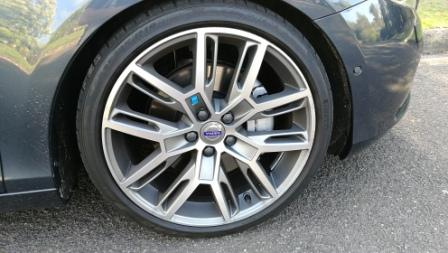 Combine ultra low profile tyres with sporting suspension (Polestar adds bespoke coils and shocks) and the result is a rock hard ride that magnifies every crevice and expands every pebble. Harsh is one word that can be used. Comfort can not, nor can cossetting. Then there’s the steering rack ratio; it’s en pointe when out on the road, but try a three point turn and it feels as if there’s something blocking the rack either side.
Outside it’s nearly standard V40, a five door hatch and a reasonable 4369 mm long, bar the Polestar supplied alloys and two winglets mounted just where the hatch’s hinge is. There’s Volvo’s signature “Hammer of Thor” headlights, a nicely sculpted profile, dual exhausts sitting under a sharply sloped rear and bracketed by two tail light structures that will catch the eye of following motorists.
 The car itself was painted in a metallic grey, a colour that melded perfectly into the roads around Sydney during storms. Volvo fit a Polestar diffuser at the rear, the alloys and roof spoilers, and go gloss black with the wing mirror covers.
Under the pedestrian friendly snout lies Volvo’s diesel 2.0L four, with 140 kilowatts and a stonking 400 torques on tap. That’s available from 1750 through to 2500 revs and there’s plenty available once you pass the higher number. Although it hesitates for a moment for the engine to spin around to 2000 and beyond, it comes on strongly enough below 1750 for the front driven wheels to imitate a canary.  Once the traction control steps in, the front Pirellis hook up and then allow the eight speed Geartronic auto to do its thing, and do its thing it does nicely. Those eight speeds contribute to the claimed 4.5L/100 kilometres (combined) from the generous 62 litre tank; A Wheel Thing saw a best of 6.2 in mainly residential style driving. They’ll also whisk you to 100 kph in just over seven seconds on the way to a claimed top speed of 210. Emissions? 118g/kilometre.
Light throttle input has the setup slurring through, albeit with more than a hint of change. Crack the throttle and there’s some decent acceleration, a muted diesel thrum from the front and the LCD screen flicks away with a smoother change underneath. Silky smooth it is and allows the driver to pick and choose also, thanks to paddle shifts and the Sports mode manual change. Good? And then some. It really is one of the better changers out there, especially dealing with a torquey 2.0L diesel.
Inside it’s standard looking V40, complete with floating centre console, the LCD dash, leather covered seats (lacking cooling but had heating), storage trays to the left and right of the rear seats, a somewhat tightish rear leg room thanks to the compact dimensions of the V40, with Polestar adding the door sills, gear knob and sports pedals to the interior. 
 Although it’s a comfortable enough environment, it is starting to show its age. Also, the multitude of buttons on the console coupled with the screen’s layout are fading as an area of attraction. The cargo space at 324 litres (smaller than Golf, A3, and A Class) barely coped with a week’s shop but there is the ever present folding rear seats.
 Airbags? Seven, sir, including kneebag for the driver. Other safety? Emergency brake lights, sir, with hazard flash. Anything else? Auto headlights and auto wipers, sir, plus reverse camera and parking assist. Bendy headlights? Does Sir NEED to ask?
 It’s typical safety first with the V40, with a bewildering array of acronyms stating the comprehensive list of features on board. DSTC, WHIPS, EBA and EBD are in there or, in longer form: Dynamic Stability & Traction Control, WHIplash Protection System, Electronic Brake Assist and Electronic Brake Distribution. There’s also fitted to the test car the Driver Support Pack and Convenience Pack, comprising BLIS, DAS, ACCCW, VGA, Keyless Entry and Drive with PCC. Confused? BLind spot Information System, Driver Alert System, Adaptive Cruise Control with Collision Warning, Volvo Guard Alarm, and Personal Car Communicator. Got it? Good. The Convenience Pack also incldes the heated seats (but no cooling for hot markets like Australia) and comes at a cost of $1500, on top of the $4K for the Driver Spport Pack. The Polsetar Performance Pack is a lick under $10K, taking the list priced car as tested from $44990 to $60472.50.
Being a diesel, the mid range pull of the D4 is stupendous. At freeway speeds, the tacho on the LED screen is showing around 1600 revs, just below peak torque. “Sink the slipper” and you’ll see the revs climb right along with the numbers that spell “license losing”, very quickly. The chassis is fitted with anti-dive and anti-squat componentry and my, don’t they work well! It’s flat on the road, flat enough to make a pancake stop and doff a hat in admiration. Although heavily weighted at low speeds, the steering talks back to you, answering the questions you put to it and responds adroitly at speed. Together the chassis and engine deliver a totally dynamic package.
At The End Of The Drive.
Bar the dating interior and lack of turning circle, there’s not a lot to dislike in the Volvo V40 D4 Inscription with Polestar’s extras. Except the ride. Compliance is not a word that that sits inside this car’s dictionary and when you can count how many ripples there are on the face of a coin you’ve just run over, then the luxury part of the equation is missing.
The range starts from $36k and with this test car asking $60K, a fair ask, it’s a fair question to ask, this one: is it worth it? If you like a hard ride, a smallish cargo area, but need something that pulls like a train, then this is your car. Here is where you can find more information:http://www.volvocars.com/au/cars/new-models/v40
Claw Marks: The Jaguar Driving Experience.
Many car companies offer buyers of their products a driving school experience. Jaguar is no different in that respect. Where this fabled British car company does differ is that…well….you get to drive Jaguars. Sydney Motorsport Park is the venue in NSW and I recently had an opportunity to do a session with the Jaguar Drive Experience. The afternoon session kicks off with a catered lunch, before an introduction to the team and instructors. There’s no doubt as to the qualifications of the drivers, with V8 Supercar driver Tony D’Alberto and GT driver Nathan Antunes amongst them.
Each session is planned to be timed down to the second; that includes a video presentation, a rundown of the history of Jaguar, and splitting attendees into teams and being identified into numerical order for the driving sessions. The cars on display give a good insight into what Jaguar is all about: a choice of supercharged V6 and V8 hardtop F-Types, the supercharged V6 XE, and the limousine with a machine gun, the supercharged 5.0L V8 XJ.
For many, this will be their first time on a dedicated race track’s surface. The people are all Jaguar owners with many of them new to the brand. The car park is full of Jaguars belonging to the drivers that have, as a result of their purchase, been invited by Jaguar to find out just how their cars can be driven. At speed. Safely.
There’s a couple of sighting laps for each team, but before that, some basics. Seating position (low and with arms and legs bent, not straight.) Why? In a full frontal impact the kinetic energy is directed through the chassis and will be transmitted along straight lengths, like arms and legs, and terminate in the hard spots, like shoulders and pelvis. A high incidence of injuries are of these types due to people being seated too far from the seats and having their legs ramrod straight. Position of hands on the tiller? Nine and three, thank you, not ten and two. It makes it easier to reach those funny sticks that make ticky noises and causes lights to flash on the car’s corners or to engage the wipers when that strange wet stuff comes from the sky. Oh, and it’s also where the companies that use “flappy paddles” tend to put them, too.
Being driven in the cossetting surrounds of a top spec XJ, with narration from your instructor as he points out marker cones where you’re looking to line your car up when it’s your turn to drive, interspersed with terms such as double apex and off camber curves, is an unusual feeling.  Now, it’s time to drive. First up? The sweeting looking and brutally powerful F-Type V8. It’s a snug fit, especially when wearing the mandatory helmet. My instructor, Andrew, ensures that the helmet is correctly fastened before covering off some points about the car and, more importantly, emphasises the safety factor the sessions are intended to further imbue Jaguar drivers with. It’s also pointed out that the rear vision mirror inside is pointed towards his position in the passenger seat. Why? So for the…more conservative driver…he can see following traffic and advise said conservative driver to clear the racing line.
The starter button is prodded, an instinctive check for traffic and D is selected. There’s an intoxicating burble from the four exhaust tips as the revs climb, a crackle from the pipes as brakes are applied in corners, a nicely weighted steering wheel responds to input as cones on apexes are lined up and…two laps later, the first run is done. The other three drivers, including Melissa from Penrith, who had taken delivery of her first Jaguar, an XE, earlier in the year, and had the widest smile possible, take their turns. If it were possible to have a smile that encircled the entire head, she’d have it.
Next up, the biiiiiiiig XJ R-Sport. It’s a long car at over five metres in length, and with a wheelbase close to three metres it offers leg room enough to please a giraffe. Andrew explains that a different driving style is required due to the sheer size of the vehicle, yet, being largely constructed of aluminuim, tips the scales at under 2000 kilograms. This has the effect of making the XJ surprisingly nimble and easy to easy to punt around the fast and fluid Sydney Motorsport Park circuit. There’s a subtle yet noticeable difference in the exhaust note, a subconscious recognition of the extra space behind you and the fact that the car does indeed handle like a smaller car. It’s the back to back comparisons that make doing such a course so utterly important in the greater scheme of safety on the roads. One of the factors here is the instruction to look ahead, to plan your entry and exit. What this does is have the driver look at where they can get their car to go but, crucially, where to go in the event of an issue further ahead. It’s human nature to pick out an object and the brain momentarily focuses on that. But, in an emergency situation, what a driver should be looking out for is the road out, not the tree, the sole tree, next to that exit, as all too often single occupant fatalities have been caused by the car hitting the only object around, such as a tree or pole.
The other part of using a race circuit to conduct driver education is showing how a fluid and smooth movement is safer than a sudden sideways wrench of the wheel. Far too often a car has rolled simply because of drivers suddenly veering left or right, primarily becuase of inattention and suddenly realisied the truck in front is a whole lot closer than expected. Indicator stalks are placed at fingertip’s end and designed to move at a soft touch as the wheel is turned gently when changing lanes. The instructors are at pains to point out that a smooth and fluid handling car responds to smooth and fluid drivers far better than those that are not. The end result? A safer driver and safer journey. The final session covered off two distinctly different driving examples. The first was the XE V6 for our group and our last car. Andrew points out the flashing red Start/Stop button and mentions off handedly that it’s a heartbeat, the timing of the flashes. That heartbeat is 66 times per minute. Why? It’s the heartbeat of a jaguar, at rest…
Both in this and inside the XJ we were given three laps and it was here that a stretch of the legs was really undertaken. The subtle wail of the supercharger bolted atop the V6, the imperceptible change of the auto’s gears, and seeing the speedo hit 160 kilometres per hour in a legal environment is one thing. By now there’s more familiaraity with the track and the laps feel quicker, the braking points become more instinctive, the apexes get closer and the points between acceleration and braking become shorter. Being taken for hot laps by the instructor? Another thing entirely.
Andrew checks the helmets straps and nods towards the V6 F-Type. They call the hot laps “The Instructor’s Revenge” and is mainly because of the people that see themselves as a better driver than they really are. Going quick in a straight line? Sure. Hitting the apexes whilst experiencing a car for the first time? Well done sir. But here’s the reality check.
Fire and brimstone, lightning and thunder, Thor’s hammer meets the awesome power of Superman. That’s just the basic 250 kilowatt V6 F-Type. Bump it up to 280 kW for the F-Type S or go full metal jacket for the bellowing 404 kilowatt 5.0L V8. Torque? “Just” 680 of them. We’re in the F-Type S, with the 280 kW V6 and 460 torques from 3500 revs. There’s noise, a sweet sound to a Jaguar fan, of a restrained and angry machine wanting to pick a fight with an ill educated driver but Andrew controls the beast.
There’s moments of sensing the car about to lose contact with the track as the F-Type goes sideways but it’s a controlled movement, a pucker moment here and there as the chassis squirms around under power. The traction control kicks in and out, obeying the commands of the computer which itself is obeying the commands of the organic computer sitting a couple of feet above the seat cushion. Snarls from the front, a surge as the accelerator is pressed, the snap of the exhaust as spent dinosaur juice is expelled.
There’s flicks of the wheel, left, right, but never are they a sudden movement in response to panic or fear. Andrew holds the F-Type in his grip and the car fights back but recognises who its master is. And that master is what we’re and they’re to get a glimpse of: a properly educated driver that understands what a car can do and just how much can be extracted from the car in the right hands. It also shows just how undertrained and woefully dangerous other drivers are as the chief instruction is left ringing in our ears when the sessions wrap up.
“You’ve had your brain recalibrated. Remember that when you leave.”
We’ve spent the last few hours travelling, in a safe and legal environment, at speeds that just a few hundred metres away would be deemed dangerous and illegal and license losing, and it’s here that the great safety conundrum again rears its head.
On my way to the circuit, I passed a clearly marked police car. It was on my left and nestled in one of those little spaces roadside. Ostensibly they’re there for safety and we’re told they scan numberplates for stolen or unregistered cars. Scarcely two hundred metres away, on the opposite side of the freeway, there was a four car nose to tail pileup. This incident was inside a line of single lane traffic waiting to enter a congested road, were some distance away from the traffic light controlled intersection and it would have been impossible, absolutely impossible, for those crashes to have occured at anything more than sixty kilometres per hour. You should be able to appreciate the irony here.
It’s fact that most nose to tail crashes happen at or below the posted speed limit and are a massive contributor to insurance and hospital costs. Yet we have speed cameras in odd locations and they have simply failed to have an impact on saving lives, irrespective of the propaganda governments would have you believe. A solid indicator of that failure is the simple and sheer amount of revenue these devices deliver to governments. They’d tell you that they’d be happy to have no revenue from these devices, inferring that no speed, no pay. This ignores the fact that if they weren’t also revenue raising devices then the government wouldn’t attach a revenue raising amount to them along with the demerit point system.
It’s also a fact that at the velocities we were travelling didn’t kill us. The cynical would say it was because we were on a race track. This overlooks the fact that race drivers, the most highly trained and experienced drivers on earth and who regularly travel at illegal road speeds (on the race circuit), have a death rate, world wide, of a miniscule fraction of one per cent of those Australia has per year on the roads. The cynical would say it’s because we’re on a race track and not surrounded by other drivers. Again, race drivers are at higher velocities and surrounded by drivers doing similar high speeds.
The Jaguar Driving Experience has shown that it’s possible to travel at high speeds but, vitally, it’s shown how to travel at high speeds and corner properly, SAFELY. And that is the crux of any driver training and the crucial part that isn’t seen as essenially worthwhile by governments.
(With thanks to the Jaguar Driving Experience and The Formula Company.)
2017 Mahindra XUV500 Auto: Private Fleet Car Review.
Mahindra is not a name known to many car drivers in Australia and for those that are aware of the brand, the mention of it elicits a range of responses, with most of them not entirely positive. That suggests the brand has a lot to do to both be more visible here and to overcome the negativity surrounding that. The company manufactures a number of different vehicles, predominantly of a workhourse utility style. However, there is an SUV in the range, called the XUV500, and until recently available only with a manual transmission, limiting its appeal somewhat. To that end, Mahindra has fitted a six speed auto, sourced from leading Japanese transmission maker, Aisin. Now available as a four level range, with 2WD and AWD for the manual and auto, the Mahindra XUV500 starts at $29900 and tops out at a reasonable $34900, with which Private Fleet spent the week.
 Tagged the W8, there’s a 2.2L diesel up front, with a rated fuel economy of 7.4L per 100 km on a combined cycle. Powerwise it delivers 103 kilowatts and a healthy 330 torques between 1600 to 2800 revs. The Aisin six speed has a good spread of ratios and is definitely worth the investment. It’s smooth in its shifting, with no discernable hesitation between ratios and also doesn’t hold a gear unneccesarily on descents. However, off the line the ratios also don’t do that torque any justice, as acceleration is not the car’s strong point. The 1915 kilogram kerb weight is no doubt a major contributor and also explains the plus ten litres per hundred consumption for the urban cycle.
The transmission itself has a manual change option and it’s here the list of “umm, why” for this car starts. Rather than offering a paddle shift setup, or a rocker motion for the selector, there’s a small rocker switch fitted to the selector’s knob. Although admittedly it’s not difficult to use, it’s counter intuitive and doesn’t exactly feel comfortable. Does it make the XUV500 any quicker? More on that, later. Another niggle is the shift from Drive back to Park, with the usual slide through the gate (it’s a jagged, not straight gateway here), requiring a momentary pause at Neutral in order to then go through Reverse to Park. Again, not a deal breaker but an ultimately pointless thing in the frustration it brings. On tarmac the XUV500 is reasonably tied down. The rear is softer, though, with more rebound than expected and it certainly doesn’t match the more taut feeling up front. Being a seven seater, perhaps Mahindra have gone a little too soft in the expectation there’ll be seven aboard every time the car goes out. Also, the steering is heavily weighted whilst under way but there’s a noticeable feeling of slackness, a sense of disconnection between the wheel and the mechanism itself. Tyres are from Bridgestone and are 235/65 on nicely styled 17 inch alloys. There’s more than a hint of tyre squeal from this lot, with a blocky, all road/all weather tread pattern and that high sidewall profile working together to create that.
 Inside, the Mahindra delights with a comfortable set of seats, albeit manual only at the front, and some interesting design cues. Of note, and one that won’t please all, is the decision to use a font not unlike that seen in the banner for the movie “Lethal Weapon” on the tabs. It’s somewhat out of place and frankly the size is too small. Otherwise, it’s cleanly laid out, has double redundancy (controls are duplicated on the touchscreen) and have a soft touch with just a hint of click underneath. The same applies to the audio controls on the steerer; soft with a bit of click. Rear leg room is surprisingly spacious and would be suitable for almost all styles of passengers.
 The dash plastic has a print style many would be unaccustomed to; again, not unattractive, just different. There’s a pair of gloveboxes in front of the passenger seat, with one looking as if it’s a cooler box. The level of the door was a few millimetres higher than the surrounds, but this was the only apparent misalignment of material inside. Being a seven seater, Mahindra has gone to great pains to simplify what some other makers make difficult: raising and lowering the rear seats. A simple lever action mechanism on the back of the seat is all it takes and is brilliant in its simplicity.
 Tech wise you get satnav, a seven inch touchscreen (as mentioned, but there’s a picture rather than a blankness as a background), curtain and side airbags, super bright LED interior lighting, door mounted safety lights, plus an AWD system that’s engaged at the push of a button. However, there’s no noticeable difference on tarmac and the only indication you get is a tiny glowing backlight on the tab itself. You do, however, get Hill Descent Control.
 Externally, the Mahindra design crew have taken inspiration from other companies. There’s hints of Mitsubishi Pajero, a touch of Toyota RAV4 and older Mitsubishi Outlander. There’s oversized wheel arch extensions that head north and intrude into the panels. At the rear the tail lights curl upwards into the rear quarters, meeting the swage line from the front. The headlights have a sinuous S-Curve embedded into the design and mirror the similar look embedded in the driving light structure. They bracket Mahindra’s signature grille design, which will not appeal to all, being a rather toothsome look. Also, you’ll get an unusual look for the door handles. Not unpleasant, just different.
 Back to that manual switch for changing gears; short answer is yes but it’s a qualified yes. There is a subtle but noticeable change in how the ‘box changes but it’d require a camera and someone with a stopwatch to accurately determine if acceleration is actually any quicker. There’s a seat of the pants feeling that it is, but…
 At The End Of the Drive.
First up, A Wheel Thing must say thank you to James Halliwell at Mahindra Automotive Australia for the opportunity to review the XUV500.
Looks wise, it’s a standout because of its unusual styling. It’s certainly not to everyone’s taste and perhaps it could be seen as a case of trying too hard to look different in order to be seen as different. Personally, a name change would be in order, as it’s a generic and also Road Runner and Wile E. Coyote Acme naming.
Where the car works is on road, as it should. This may read as stating the blindingly obvious, Sybil, however as an unknown, people will have certain expectations to be met. There’s little to question in the way the car rides; it’s compliant enough, needs a tightening at the rear to match the front but is predictable in its handling.
A diet wouldn’t be a bad idea, as people have an expectation that a diesel is economical.
Inside, it’s reasonable enough but could do with a lift in regards to the general presence. The font and size of that, as mentioned, for starters. A move towards a “traditional” manual option for the transmission in having a rocker motion for the lever, not a switch, is another. Electric seats are almost mandatory for a top of the range vehicle yet not seen here.
The touchscreen itself was easy to use but, again, the use of something such as a picture, which looked like a field of flowers, just didn’t quite gel with the overall presentation.
Outside, well here it’s a matter of personal choice and A Wheel Thing would like to see a scaling back of the overt attempt to make the XUV500 stand out. Again, it’s not unattractive, it’s just a little too different for comfort.
Where the car does win is in the price. 35K isn’t a bad ask and seems to adequately reflect the perception many stated of the vehicle.
For more information and to look at booking yourself a test drive, go here: Mahindra XUV500 SUV
 Level 2, 9 Help Street