

Author archive
Alternative News: The Hyperloop.
Any sufficiently advanced technology is indistinguishable from magic. Famed and distinguished author and scientist Sir Arthur C. Clarke has this as the third of his three laws, much like “The Three Laws of Robotics” his equally distinguished fellow writer Isaac Asimov postulated. To that end, Elon Musk is offering something that could almost be seen as magical because of the technology involved and if it comes to fruition will change the way mass public transportation is undertaken. Welcome to The Hyperloop.
In actuality, the technology is the hard part, the concept is simple. In essence, it’s a pod that will contain passengers (or cargo) that will be inside a tubular structure, with that tube largely evacuated of air and with the much talked about magnetic levitation system to propel the pod.
The basic idea has been around for some time, perhaps two hundred years, however Musk reinvigorated the idea in 2012. A concept of design was shown in 2013, paralleling the highway in California between Los Angeles and San Francisco. The distance between the two is something around 560 kilometres and the concept estimated a travel time of just over a half hour, meaning travel speeds would be in the order of over 950 kilometres per hour. Top speed would be 1200 kph, so that travel time would allow for the initial acceleration process, travel, and deceleration.
Musk first raised the idea at an event hosted by a website dedicated to technology, in Santa Monica, in July 2012. Describing it as a “fifth mode of transport”, Musk said the Hyperloop (so named because it would be a closed system in a loop) would be “a cross between Concorde, a rail gun, and an air hockey table”. He also pointed out the benefits of such a system, being it would be a 24 hour, all weather, collision free, system.
The original concept had the pod riding on a cushion of air barely 2 millimetres in depth, with each pod having an air transfer system, moving high pressure air as speed built up, to the rear. By moving to a very low pressure setup, the transfer system was deleted. A set of linear induction motors would propel the pods and because of the vastly reduced friction, the pods would be able to coast along without losing much forward velocity. The pods themselves would be around seven and a half feet in diameter, enough to comfortably have a two person side by side configuration.
Musk threw open the design rules and in 2015 his SpaceX group announced a one mile test loop close to their main facility. Several university groups have joined in, including MIT, which unveiled their concept in mid 2016. With the T in MIT standing for Technology, MIT went on to demonstrate, for the first time in the world, a working prototype in January of 2017.
As mentioned, the concept is not new. A British engineer named George Medhurst took out patents in 1799 and wrote a book in 1812 detailing propelling people and goods through air-tight tubes. The fabled Crystal Palace building in London had a railway, using fans 22 feet in diameter to move a module in a tunnel, whilst in America an underground tube system was trialled for three years in the early 1870s. Rocketeer Tobert Goddard described a system, vacuum trains, in 1910, and physicist Gerard O’Neill wrote a fictional book which incorporated trains on magnetic levitation in tunnels with almost 100% vacuum inside…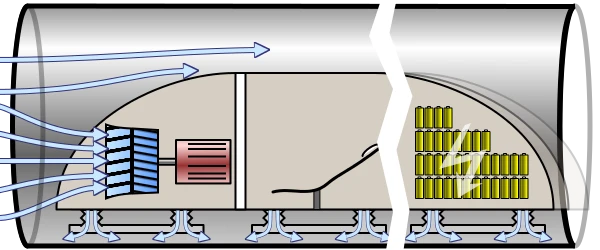
Naturally cost is a factor, including some plans for having a terminus outside of the final destination, neccessitating a further transportation method. One costing had $20USD of a one way ticket being enough to cover the costs over twenty years for the mooted SanFran-LA route. That presumed 7.4 million riders per year, however some have already questioned that that cost would be suitable. Some figures of $100 billion USD for the initial system have been mentioned, with a proportion of that cost being pylons to raise the Hyperloop above the surrounding area.
Apart from cost, the Hyperloop system does, in fact, seem feasible, with many engineering studies confirming the validity of the concept. For Australia, the eastern seaboard would be, much like the U.S., a like location, between Melbourne and Sydney, perhaps via Camberra, and from there to Brisbane with, again, perhaps a stop at Newcastle and Port Macquarie or further. Much like the much discussed Very fast Train proposal, however, it’ll need a true visionary and an economic commitment to reduce our reliance on four wheeled transport and aircraft.
2017 Renault Megane GT & Renault Megane Zen: Private Fleet Car Review.
Renault‘s Australian renaissance continues to build momentum, with the all new Koleos and Megane range attracting plenty of positive comment. It’s fair to say that the GT and Zen Megane cars should be on your radar, and here’s why, as Private Fleet drives the Renault Megane GT and Renault Megane Zen.
 The Megane is a sweet looker, with a curvy overall shape and an extra bit of sheetmetal at the rear to emphasise the profile. Both have LED running lights in a hockey stick shape, LED rear lights and the GT takes that further with LEDs powering the main front lights. It’s compact outside, at 4359 mm in length and runs on a 2670 mm wheelbase, which offers 180 mm of rear seat knee room.
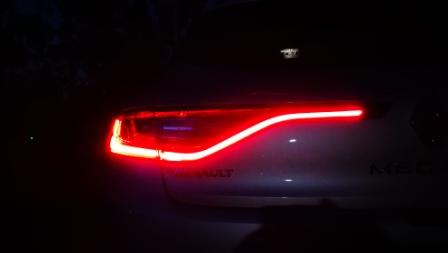
 Shoulder room for the 1814 mm wide (mirrors folded) pair is 1441 mm up front and 1390 mm in the rear. Front and rear track are almost identical at 1591 mm and 1586 mm. It’s a slightly bigger car, this fourth generation Megane, than the previous version, with the wheelbase 29 mm longer for an increase in overall length of 57 mm.
 Up front there’s a duet of petrol engines, with the Zen packing a mere 1200 cc four cylinder, with 97 kilowatts and 205 Nm. The turbocharged GT has 151 kilowatts at 6000 and a hefty 280 torques at 2400 rpm from a 1.6L powerplant. Both run on standard 95RON and power down via a seven speed dual clutch auto. From the fifty litre tank, Renault quotes a combined fuel consumption figure of 5.6L/100 km and 6.0L/100 km. Around town it’s just 6.8L/100 km or 7.8L/100 km.
 The GT is marked as 4Control, with subtle badging on the B pillars. This makes one wonder if it’s four wheel drive; no, it’s four wheel steering, with a rear wheel steering setup adding to the amazing agility of the five door hatch. It’s engineered so it’ll turn the rear wheels in the opposite direction to the front at either 80 kph or 60 kph, depending on which drive mode you’ve selected.
 Above those speeds the rears will turn in the same direction as the front. Does it work? Oh yes sir, it does. So do the brakes, in that unlike too many there’s real feedback, real bite, as soon as the pedal is touched. Distances between you and the car in front can be more finely judged with a variation of pressure, not relying on something to happen with a depression of an inch or so before action happens.
With the car riding on GT specific springs, dampers, and roll bars to the rest of the range, and combining with a super responsive steering system, lends the GT a sporting prowess that isn’t at odds with its seemingly cheapish $38K price. Turn in is crisp, sharp, and understeer is relegated to the file marked “No Longer Applicable”. This is thanks to a computer system that analyses steering angle and input 100 times per second. Not only is the GT a sharp handler, it rides better than the Zen.  The lower spec car has 16 inch alloys, the GT rolls on 18s. Rubber is 205/55 for the Zen and 225/40 for the GT. The GT is sometimes jittery, but rides across imperfections better than the Zen, with the Zen more prone to bump steer and road intrusions, plus just that little more float from undulations. It’s by no means a bad handler in its own right, but backed against the wall by the brawnier GT, the differences are apparent.
Naturally the GT is better at getting underway, particularly with the dual clutch auto’s habit of thinking momentarily before engaging Drive from Reverse or from a standstill. Having said that, the Zen gets up and runs well enough for its engine size once the transmission has hooked it. There’s a faint buzz from the drivetrain as it does, the sound of the engine rising and falling along with the almost imperceptible changes, and suddenly you’re well and truly at highway speeds. Then the GT takes that and increases the grin factor with Launch Control… Rorty is a word used to describe a mechanical noise that emanates from the engine bay and also the exhaust. The GT has it in bucketloads. As good and as enjoyable as the Zen is in its driveability and handling, the GT amplifies that, enhances it, sharpens it, to the point that the smile you have becomes a grin of sheer enjoyment, visible from Mars. Turn in is precise, accelaration is electics, the aural sensation is sexy, the support of the blue trimmed bucket seats is amazing, and all come together to provide a drive experience for the senses. The Zen isn’t off in the aural caressment stakes, though, with enough of a growl to please most.
 When not fanging the cars around, you can enjoy the interiors. There’s proper soft touch materials on doors and dash, lacking, for example, in Jaguar’s much vaunted F-Pace. There’s adjustable screens for the dash and the centre touchscreen, satnav for the GT, a bigger 8.7 inch screen in the G as opposed to the Zen’s 7 incherT. Both have touch sensitive aircon controls; touchscreen for the GT and the same setup in the Zen as seen in the Koleos, with a strip built into the console. There’s heating for the seats in the GT which is unneccessary given their blue suede and cloth covering. Bluetooth? Natch.
 The Zen is simple black and charcoal cloth with contrasting white stitching, with a plastic trim on the doors not unlike the spotted pattern as seen on a whale shark. Both also have the quirk of placing audio on a separate stalk to the lower right of the steering column and cruise control in the centre console. The GT raises the stakes by having LED strip lighting and it’s at a level of intensity to not overwhelm the eyes during a night time drive.
 Both equal up in items such as Auto headlights, rain sensing wipers, 434 litre cargo which maxes at 1247L with seats down, push button Start/Stop and all four windows one touch up and down. Audiowise, both get great sound, with the GT a 12 speaker Bose system. There’s plenty of punch in the Zen’s 8 speakers though, with DAB available here as in the GT.

 Renault now offer a five year, unlimited kilometre, warranty, five years roadside assistance, and fixed price servicing for the first three services, providing the best of peace of mind.
At The End Of the Drive.
Renault are well poised in Australia to make a seriously positive impact on our crowded market. The Megane range has been spearheaded by a (soon to return to Australia) RS version however there’s more than enough in the 2017 range to appeal to drivers across the board. Up against tried and true entries from Korea, Japan, and European rivals, the Megane stands out as a worthwhile consideration. And starting at a sub $25K driveaway price, it enters this hotly contested market with plenty of value to back up a great driving experience. Go here Renault Megane for 2017 for the info you need to know.
Lamborghini Huracán Performante Breaks The 'Ring's Lap Record.
The Lamborghini Huracán Performante has already proved its extraordinary capabilities ahead of its unveiling at Geneva Motor Show next week. On 5 October 2016, the Huracán Performante set a new production car lap record of 6:52.01 min on the Nürburgring Nordschleife in Germany.
Following the day’s open sessions on the “Ring”, at 17.00 officials closed the track to other manufacturers. After official track checks this left just a
15-minute window for Lamborghini to make one attempt at the lap record with a production Huracán Performante, still in its development camouflage.
With Lamborghini test driver Marco Mapelli behind the wheel, who also drove the Aventador SV to its Nürburgring sub seven-minute lap time in 2015, the Huracán Performante warmed up its tires and made its rolling start, fitted inside and out with onboard cameras and telemetry to record the car’s lap. The Lamborghini team of R&D engineers, technicians and drivers, together with Stefano Domenicali, Chairman and Chief Executive Officer and Maurizio Reggiani, Board Member for Research & Development, watched the Performante disappear into the distance of the 20.6 km track.
In the sixth minute, the car was heard heading down the long straight with just three corners to go, and its audience counting down the seconds to watch the Huracán Performante pass over the line at 6:52.01 min.
“This was an incredible and emotional moment,” says Stefano Domenicali. “Together with Maurizio Reggiani we agreed during the car’s development that with the technical and performance prowess of the Huracán Performante, not only was a sub seven-minute lap at the Nordschleife possible, but the lap record too. We wanted to achieve the Nürburgring victory in advance of the Performante’s launch, which was a challenge in terms of weather and availability of the Nordschleife. Not only did we take the lap record, we took it by some seconds!
“To make this happen is something that every one of the R&D team who worked on this car can share in: it will forever be a defining moment in their careers,” concludes Stefano Domenicali. “I am so proud of everything achieved by Lamborghini people that day and extremely privileged to have witnessed it.”
The Huracán Performante features innovations in aerodynamics and lightweight engineering that, combined with its improved power plant, its four-wheel drive system, its Lamborghini Piattaforma Inerziale and a dedicated set-up, allows superior track performance to be maximized while delivering the most engaging and dynamic road drive.
Joining the Lamborghini development team at the Nürburgring were representatives from Pirelli, responsible for development of tires specifically for the Huracán Performante: the same Pirelli Trofeo R tires available on cars delivered to owners.
The Huracán Performante is revealed officially by Automobili Lamborghini at Geneva Motor Show on the first press day, 7 March 2017, 8.55 am at the Lamborghini stand. Follow the unveiling in Geneva at live.lamborghini and join the conversation with #HuracanPerformante.
(Republished by Private Fleet on behalf of Lamborghini Australia’s PR compnay, The Origin Agency)
2017 Peugeot 2008 Lands On Aussie Roads.
The French Revolution continues, with Peugeot unveiling its revamped 2008 SUV. There’s been a streamlining of the range, a change to a sole engine/transmission combination, and some trim changes. Here’s the way the range shakes down.
The engine is a turbocharged three cylinder, at 1.2 litres of capacity. That’s bolted to a Japanese sourced six speed auto and it’s this combination that will be the only engine and transmission available in a three model range. The names will be Active, Allure, and GT-Line, with the latter replacing the Outdoor that also offered a diesel and manual.
 The undersquare 12 valve engine will produce a peak power of 81 kilowatts at 5500 rpm, and peak torque is a healthy 205 Nm at 1500 rpm. That’s good enough to see a 0-100 kph time of 11.3 seconds for the near 1200 kilogram vehicle. Peugeot rate the fuel consumption and tested in the real world as 4.8L/100 km for the combined cycle from a 50L tank using 95RON. There’s also an adaptable drive system, with Normal, Snow, Mud etc available via a dial in the centre console.
 The facelift isn’t extensive but side by side it’d be noticeable compared to the outgoing models. There’s a new grille which will be a signature look for future models. Peugeot’s design team have imbued the headlights with a feline look, with a black and chrome finish. The tail lights have been slightly revamped, with a more noticeable claw look. All cars will be fitted with roofrails, adding some extra height and topping out at 1556 mm. Ending the roof on the 4159 mm long 2008 is a roof spoiler and the range will be enhanced by a new colour, Ultimate Red.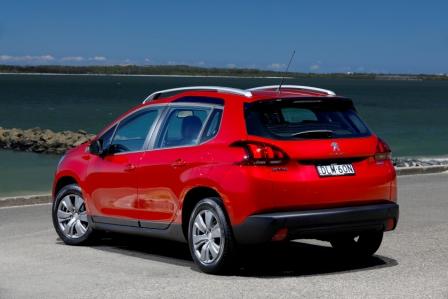
 Standard equipment will cover items such as reverse camera, parking sensors, Stop/Start, MirrorLink and Apple CarPlay. The Allure and GT-Line will also be equipped with Active City Brake and City Park, a self parking system, plus auto head lights and rain sensing wipers. The Active will roll on 16 inch alloys, with 195/60 rubber, whereas the other two go up an inch and slightly wider at 205/50/17. There’s a full sized spare but at odds with the others in 185/65/15 profile.

 At the time of writing, the GT-Line will be made available some time after the release of the Active and Allure. What the two cars at launch will offer is comprehensive. Hill Start Assist, Emergency Brake Assist, all power windows are one touch, heated and folding door mirrors, and seven inch touchscreen. The Active dips out on satnav as standard but can option it in. Leather trim for the tiller is common but on the park brake in the Allure only. A panoramic glass roof is also an option for the Allure as are heated seats (no ventilation for the Aussie market is an oversight.) Cargo is reasonable, with 410L which increases to 917L with the seats down.
 Pricing remains, understandably, sharp, at $26490 for the Active, an increase of $1000 but with extra equipment. The Allure remains the same price at $30990 and gains extra kit, and the GT-Line is slated to come in at $32990, with all prices at a Recommended Retail Price. Head to www.peugeot.com.au for details and to book a test drive.
 Level 2, 9 Help Street