

Author archive
Private Fleet Car Review: 2017 Holden Trax LS Turbo
Holden has a history of importing small cars for SUV style duties. Suzuki gave us the Drover, Isuzu the Jackeroo and a jacked up Barina became the Trax. A refresh to the car has been performed, with noticeable changes inside and out. The 2017 Holden Trax LS spends a week in the urban jungle. Up front is the 1.4L turbo four that once resided in the Cruze. In that car, even with an auto, it was lively, peppy, zippy. Not so in the LS auto. Holden have released the LS with the 1.8L engine and manual or the turbo four and auto only. Even with 200 torques at 1850 rpm it’s pulling close to 1400 kilos and felt as if the gear ratios were holding the little SUV back. When punched hard and under way, the performance characteristics did change…having said that, the auto had an unusual and odd whine, one not out of place in a manual transmission that wasn’t calibrated correctly.
 The turbo four drinks 95 RON as its preferred tipple and will do so at 6.9L per 100 km (quoted,combined) from a tank weighing in at 53 litres. That’s pretty much on the money in the week A Wheel Thing had the petite LS Trax however that’s the combined figure. Given this kind of car will be in short distance, stop start, style of travel, figure on something closer to 8.0L/100 km.
Ride quality is a mixed bag in the front wheel drive only Trax LS with a even and smooth feeling on freshly laid roads morphing into unsure and tentative on broken and rutted surfaces. There was even occasional mild bump steer and an odd sensation of the front MacPherson strut suspension’s settings not balancing the compound crank axle rear. Driving over the mildly broken surfaces of some local roads would have the front gently absorbing the irregularities and the rear would feel less tied down. All in all, just not a balanced mix. Handling was also a mixed bag with a numbness either side of centre of the tiller, a feeling of twitchiness in the communication from the steering wheel, and just hints of understeer from the Continental 205/70/16 rubber when pushed.
The brakes were the same odd mix, with nothing but pedal pressure for what felt like an inch before a gentle bite, a too gentle bite at that. In order to get any sense of stopping power a harder shove was required and there was no sense of progression, rather a change from soft to grab hard, a most disconcerting sensation in high traffic. That’s perhaps due to the drum rears, not discs. It’s also apparently fitted with HSA, or Hill Start Assist, however even gentle slopes such as those found in undergroup car parks had the car rolling back once the foot was off the brake.
The transmission in the LS Turbo is, as mentioned, a six speed auto. It is fitted with a manual override, accessible via a simple toggle switch on the selector. This was invaluable in the climb up Sydney’s Old Bathurst Road, just west of Penrith, at the base of the Blue Mountains. In traffic, rather than the indecisive self selector, by using the manual it would more than happily crawl/walk/run uphill depending on the traffic gaps. It was quicker in changing gears doing this and came in handly also in overtaking. Brownie points, also, for the interior of the Trax. It’s an office come boys club in that it’s a comfortable place to be yet efficient in design and layout. It’s a traditional key in the right hand side of the column, standard GM switchgear, all blended into a smooth, flowing, organically styled dash with the pews comfy and providing plenty of lateral support.
 There’s the MyLink system on board and housed in a seven inch touchscreen which includes phone projection which is Apple CarPlay and Android Auto, but the LS misses out on DAB as the entry level model in the three model range. There’s an LCD screen in the dash binnacle which also houses analogue dials, appropriate for an entry level vehicle.
 There’s also Bluetooth streaming, USB and Auxiliary inputs but the death of the car-based CD player was also on show, with no slot to slip the silver disc in. A point off, though, for the design of the tiller, as the centrepoint is above the horizontal centreline which makes for an uncomfortable 11 and 1 hand position. Storage wise you’re looked after with a tray under the passenger seat, door pockets, good sized cup holders and sunglasses holder.
 There’s good rear legroom at 908 mm, headroom at 985 mm, and shoulder room is good for two adults at 1340 mm. This is inside a petite 4257 mm overall length yet packing a 2555 mm wheelbase. This means the corners are pushed out into the pumped out guards and sees the otherwise somewhat dumpy looking five door seem a touch larger than what the dimensions suggest. The height has a bit to do with it, being an inch shy of 1700 mm.
 Otherwise, you’re looking at a redeveloped nose, bringing the Trax into line looks wise with the Colorado and Captiva, with the flattened six sided lower air intake under the single bar upper. There’s LED driving lights but no halogens in the lower quarters. The rear is less made over, with the family resemblance to big sibling Captiva perhaps more slightly enhanced and hides a 356/785 litre cargo capacity accessed by an easy to open and lift tailgate. Naturally there’s a camera for reversing and it provides a crisp and clear picture on the screen.
 There’s six airbags, the now mandatory safety aids under the skin, pretensioning seatbelts, collapsible pedals, plus Holden’s standard three year or one hundred thousand kilometre warranty. Reverse sensors partner with the aforementioned camera to complete the package. At the time of writing, the first four services will cost you $229 each at intervals of one-year or 15,000km, a fair ask for peace of mind and for budget conscious buyers.
 At The End Of The Drive.
The LS Trax with turbo four and six speed auto was, at best, competent in this particular vehicle. Performance was somewhat lacklustre until pushed and that transmission whine was a worry. It does though look smooth and organic inside and offers enough usable room for four adults. At around $25K driveaway it’s not a budget breaker either however. For details and to book a test drive to make up your own mind, go here:2017 Holden Trax range
A Long Time Ago…
In May of 1977 a film was released, a film intended to be an homage to the serials of the 1940s one might watch at the local flicks on a Saturday. With a nod towards westerns and featuring a cast of mostly unknown actors, Star Wars hit an unsuspecting public smack between the eyes. 2017 sees the fortieth anniversary of that film and Private Fleet takes a look at a few of the cars that turn forty also.
Holden HZ.
Yes, a bit of nothing more than a new grille differentiated the HZ Kingswood from the previous model visually, but it was underneath, with the introduction of RTS or Radial Tuned Suspension , that made this an important car for the then flourishing Aussie market. It was also the last large sedan Holden would make for some time.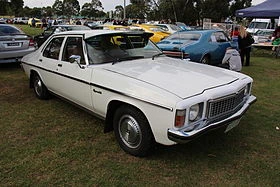
Chrysler Sigma.
“It’s a sensation” went the advertising for a car that was built by Chrysler Australia and was based on the same car made by Mitsubishi. Powered (stop snickering) b,y at the entry level, 1.6L carbied four cylinder that was good for 56 kilowatts and 117 torques, the GE series Sigma became a mainstay of the Aussie market for a few years and kept the Sigma name plate when Mitsubishi took over the Chrysler manufacturing. There was even a Sports pack for the 2.0L version, with striping, low fuel warning light, sports tiller, and steel belted radials.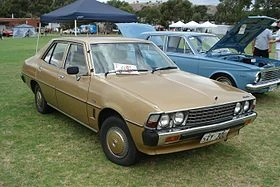 Ford LTD 2.
Although a nameplate once familiar to Aussies, this was the American version and was, oddly, classified as an intermediate sized car. Given it was bigger than the German battleship Tirpitz and was powered by a strictly V8 engined lineup putting power down via a three speed auto, it’s hard to believe that a five point five metre machine could be considered an “intermediate” sized car. It was available in three trim levels including the top of the range Brougham, a name familiar to Australia Holden fans as the predecessor to the Statesman.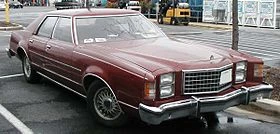 Volvo 262C.
The squared off, boxy, blocky Volvo designs of the 1970s gained some coolness with this car from Swedish manufacturer, Volvo. Built in Italy and powered by a 2.6 litre V6 engine, this two door beauty still looks as gorgeous as the day it first appeared in 1977. Italian design house Bertone was responsible for both the design and build, with the coupe’s roof ten centimetres lower than the donor car, the Volvo 260. Standard equipment included power windows and mirrors, central locking, full leather interior, power mirrors, cruise control, air conditioning, heated front seats, alloy wheels and electrically powered radio antenna.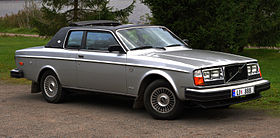 Triumph TR7 Sprint.
British maker Triumph, along with MG, made some of the most memorable two door cars of the sixties and seventies but not always memorable for the right reasons. At least this one went some way towards a good purpose, being a limited run of 62 cars to homologate the Group 4 Triumph 7 rally car for the 1978 season. The engine was a two litre, 16 valve, single overhead camshaft type and bolted to a five speed manual. Peak power was 127 bhp, more than the same capacity slant four version found in the standard TR7.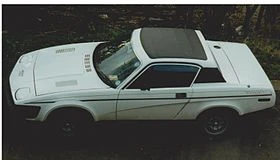 Aston Martin V8 Vantage.
Broad shouldered, hairy chested, metaphorically wearing a thick gold chain, Aston Martin’s V8 Vantage packed a 5.3L V8 with 280 kilowatts which promised a top speed of 280 kilometres per hour. Sharing the basic engine package with the Lagonda at the time, the Vantage received re-rated camshafts, a higher compression ratio, bigger valves and carbies, all which lead to a 0-60 mph time of a still rapid 5.3 seconds, quicker than Ferrari’s Daytona.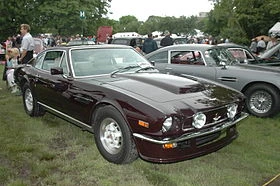 So where ever you are you the galaxy as you celebrate forty hears of these cars and forty years of Star Wars, May The Force Be With You.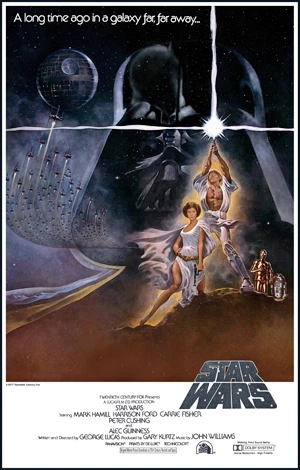
2017 Suzuki Ignis GLX: A Private Fleet Car Review.
The small car company has gone back to the future with a re-release of an old nameplate. Let’s welcome the 2017 Suzuki Ignis GLX. When I say the small car company, I mean in the sense of the size of the cars; the Ignis is a tiny 3.7 metres in overall length, stands just 1595 mm tall ( a bit higher than the donor chassis Swift) and is just 1660 mm wide yet never feels cramped inside. For four people, that is. Somehow, they’ve managed to cram in a wheelbase of 2435 mm which provides plenty of leg room up front and an adequate amount for adults in the rear.
 It’s a blocky, squared off, design bar the leading edge of the roof and windscreen bracketed by the A pillars donated from the Swift. The driving lights as they wrap around the lower section of the headlights offer a cheeky grin and there’s a spot of LED at the rear. There’s a sharp angled, triangular, panel section in the C pillar and rear door, above the rear wheels with three indentations to break up that area visually. There’s a hint of Renault in the rear wheel arch, with a reminder of the pertness the French design into their hot hatches.
 Inside the test car is a mix of light and shade. There’s black plastic throughout most of the cabin bar white inserts in the door and dash and colour coded centre console and door grabs. The rear seats it higher than the front and for an unsuspecting adult, it’s all too easy to see the side of the head hit the door entry at the top. The charcoal and dark grey seats are comfortable enough if lacking in side support.
 The trim itself is an eclectic mix, with a carbon fibre look to the outermost airvent covers, piano black in the console, the bone white contrasting with the almost matt black in the rest of the cabin. The GLX comes with a four quarter touch screen mounted top front and centre. It splits up into audio, phone, guidance, and smartphone connection for allowance to Apple CarPlay and Android Auto. Easy to use? Yes indeedy. Leather wrapped tiller? Natch. Voice command and Bluetooth? Of course.
 The Ignis is motorvated by Suzuki’s 1.2L TwinJet four cylinder. There’s a CVT, Constant Variable Transmission, on board, which takes full advantage of the 120 torques at 4400 rpm and 66 kilowatts 1600 rpm further up the range. There’s a disconcerting hesitancy off the line before the CVT bites, a hesitancy enough that a double check for oncoming traffic is needed. It’s old school CVT in that it’ll rise in revs before plateauing even as speed increases before backing off and seeing freeway speeds at around 2000-2200 rpm.
  The CVT is also fitted with a low gear ratio, which, in certain circumstances such as climbing or descending hill roads, helps greatly in acceleration and engine braking.It’s an economical little beast, with a worst figure of 5.7L per 100 kilometres to move the 820 kilo machine. Economy as quoted by Suzuki for the combined cycle is 4.9L per 100 kilometres and you’ll need an economical package give the thinble sized fuel tank of just 32 Litres. It’s a surprisingly quiet engine and transmission combo too, with little of the expected thrashing and rattling.
 What was also unexpected was the ride and handling. Considering the tube sock tyres wrapping the black painted alloys, at 175/60/16 in overall size for the GLX, there was little tramlining, little unsavoury movement on rutted and dishevelled roads, and little sideways movement in crossbreeze. The coil sprung suspension combo of struts and torsion beam hold disc and drum brakes, and makes for a suprisingly well sorted ride.
 There’s a bit of road noise on rougher tarmac however the ride itself is supple enough. In fact, the only time the suspension made itself known was on the longer duration undulations and shorter dips, where the rear would compress quickly and the bumpstops would say hello.
At the End Of The Drive.
The two model range, GL and GLX, starts with a driveaway price just shy of $17000. The GLX is just two thousand more and one can option a black roof for $1000 and naturally there’s pricing for the predominantly metallic paint range. Suzuki will throw in their standard three year or one hundred thousand kilometre warranty, capped priced serving over the six monthly intervals with a maximum of $300 at the 60 month mark.
Suzuki have made the small car market pretty much their own and the Ignis continues that tradition, even if it is a return from the past for the nameplate. The 2017 Suzuki Ignis GLX rewards with a surprisingly competent ride, handling, engine and transmission, and is spacious enough for two. The small car king is back. Here’s more information: 2017 Suzuki Ignis range
2017 Kia Sorento GT-Line: A Private Fleet Car Review
SUVs are the big ticket seller in Australia and one of the brands that nails this market is Kia. The Sorento is their big gun here, and quite bluntly, the 2017 Kia Sorento GT-Line is an absolute pearler. Here’s why the $58490 (plus on roads) Sorento looks like a winner. It’s a seemingly tiny 2.2L diesel up front of the two tonne beast. Seemingly, until you find out there’s 441 torques on tap at a very useable 1750 to 2750 rpm range. Economy around town is quoted as 10.1L per 100 kilometres. Combined is 7.8L/100 km. Private Fleet had slightly more urban than highway usage yet managed to finish on a highly credible 8.5L/100 km, from a 71L tank. In fact, the Sorento had just ticked over to 750 km as we rolled into a station to top up and still had an expected range of sixty kilometres.
There’s a surprising amount of peak power, 147 kW, at 3800 rpm, meaning the transition between peak torque and power is a smooth and natural transition. Acceleration is, as a certain British brand would say, adequate. What isn’t are the brakes. For such a heavy and quick vehicle the brakes need more bite initally, as there’s just too much travel before anything feels like it’s about to bite. It’s a niggle, given the size of the front and rear discs at 320 mm and 305 mm respectively. That’s about it for anything not quite right. The rest of the GT-Line Sorento is as good as you’re going to get in the market right now. Standard equipment is pretty solid on the Sorento Platinum, on which the GT-Line is built upon. Naturally there’s a slick six speed auto and an all whheel drive system that’s front drive oriented until sensors divert grunt rearwards. The 19 inch alloys are chromed and look stunning, wrapping 235/55 rubber. You’ll enjoy tyre pressure monitoring and a full sized spare, for that extra peace of mind.
There’s an electrochromic rear vison mirror, which means it automatically dims any headlights and immediately minimises any potentially dazzle. On board are auto headlights, of High Intensity Discharge configuration and are auto leveling to boot. Kia also fits the Platinum and GT-Line with AFLS, or Adaptive Front Lighting System which “controls the headlight beam and adjusts it to suit the steering angle.” The mocha coloured leather seats are heated AND cooled with the driver getting a ten position adjustment and memory positioning, the gloss black and leather trimmed steering wheel is heated and yes, it does make a difference. A nifty touch to the front seats is the switch mounted high up on the passenger seat’s right hand side, which allows fore and aft adjustment & backrest tilt by the driver for any middle row passenger on that side feeling a touch cramped, not that they should with the leg room available.
 The driver gets a seven inch information screen and there’s a seven inch touchscreen for the Infinity ten speaker audio system, of which the junior reporters for Private Fleet said was the best car audio system they’ve heard. Naturally there’s satnav on board, which was easy to use and is designed with a clean to read look.
 The dash design is classic Kia, with ergonomics taking pride of place. Buttons and dials are where instinct would have your hands fall, the textures of the various plastics range from a leather look to gloss black, and there’s even extendable sunshades which, on the drive south to the beautiful NSW coastal town of Kiama, were a boon given the setting sun on the driver’s side of travel. Passenger comfort and amenities aren’t forgotten either, with 2 USB ports, three 12V charging ports, six cup holders, four bottle holders, map pockets, and rear seat aircon, plus a full glass roof for night time star gazing.
Inside the 4780 mm long machine lies a wheelbase of 2780 mm. Inside that is a seven seater configuration, allowing luggage space to go from 320 litres to a huge 2066 litres. As usual, Kia’s engineering is tending towards functional easiness, with a simple and highly effective pull strap system being used to raise and lower the third row seats. For privacy and secuity, Kia also add in a cargo screen, net, and offer an under floor compartment. Outside, the GT-Line gets alloy sidesteps and red brake callipers, which contrasted nicely with the test vehicle’s Snow White Pearl and the aforementioned chromed alloys. There’s folding mirrors, external lighting including in the door handle area, and the car responds to you as you approach thanks to the key fob triggering those mirrors and lights. And you’ll not be disappointed in the Sorento’s mix of assertiveness and flowing lines. There’s the quad or “Ice Cube” LED driving lights as seen in the sadly missed pro_ceed GT, the standout “neon light” look for the rear lights, and the trapezezoidal look for the windows in profile.
 It’s the road manners of the big car that will prove to be the crucial part of the experience. It’s adpet and dealing with road surface changes, nimble when required, sure footed and planted over almost everything, flattens those annoying shopping centre speed bumps into submission, and then there’s driveability from that torquey four for the extra dial it up factor.
 As mentioned, A Wheel Thing took the Sorento to Kiama, south of Wollongong, and chose to use the tight and twisty Mount Keira Rd and Harry Graham Drive, along the top of the imposing escarpment overlooking the town. They’re great roads for testing the handling mettle of cars and proved ideal in testing the two thousand kilo plus car.
 Brake travel feel aside, when they bite they do an excellent job on hauling the Sorento down to sharp corner speed, especially on some of the steeper turns. The three mode steering system adds a bit more heft in Sport but still remains somewhat artificial in feedback and is best left in Normal.
 It’s deft enough in that mode with quick response to light movement. Plus, the suspension on the Sorento is such that weight transfer, anything that may unsettle the vehicle in such a situation, is balanced nicely between comfort and control.
Naturally there’s the usual safety features although there’s no driver’s kneebag. There’s Blind Spot Detection, Lane Change Assist, Lane Departure Warning System, and Autonomous Emergency Brake with Kia’s Forward Collision Warning System. Two ISOFIX child seat mounts are standard across the range as are seatbelt pretensioners at the front.
At The End Of The Drive.
There really is very, very, little to find fault with in the 2017 Kia Sorento GT-Line. In honesty, the brake feedbake and lack of driver’s kneebag are all that really could be improved and added, as the rest of the package for the Sorento GT Line is near nigh perfect. Add in the now standard seven year/150000 kilometre warranty, roadside assist and capped price servicing and it’s a bundle that has nothing left to be added in. It’s a car that’s better than well placed to take on the Europeans and beat them at their own game.
For more details, click here: 2017 Kia Sorento range
 Level 2, 9 Help Street