

Author archive
Car Review: 2019 Tesla Model X 100D
This Car Review Is About:
One of the two vehicles currently available from Tesla. The Model S and Model X are very closely related and come with a choice of drive combinations. A new model, a smaller car called Model 3 is scheduled for Australian release from July 2019. The vehicle tested is the non-P 100D. P for Performance, 100 for the kiloWatt hour drive, D for Dual motor (or, if you will, all wheel drive). The Model X can be specified with different seating configurations and the test vehicle was fitted out as a six seater.  What About The Dollars?
Cost for the car tested started at $129,500. Metallic paint is $2,100, with the big black wheels $7,800. The seating colour scheme was $2,100 with the dash trim, a dark ash wood look, a standard no-cost fitment. It’s the electronic bits that add on, with the full self driving option and auto-pilot $7,100 and $4,300 each. With options fitted, Luxury Car Tax, and GST, plus charges such as government taxes, the car as tested came to $186,305.
Under The Bonnet Is:
Empty space. Yup, the Tesla Model X has a “frunk”, a front trunk, or in Aussie speak, a front boot. It’s big enough for a travel case of hiding the home charge cable that Tesla supplies. The engines for the 100D are located underneath at the front and rear, and engage via a single speed transmission. It’s this combination that gives the Tesla Model X startling acceleration, and in Ludicrous mode, a drive option available in the “P” designated cars, it’s quicker again. Call it three seconds to 100kph and you’d be on the money.
 On The Inside Is:
A choice of seating options. The test car came fitted with a white leather covered set of six seats. The three pairs all have their own form of power adjustment. Up front the driver has fore and aft movement, seat back adjustment, and lumbar support. The middle row are also adjustable for fore and aft, allowing access to the rear seats. However they do not have seat back adjustment. The third row are powered in a slightly different way, with a button locking or releasing them for raising or lowering.
Tesla fit a massive, vertically oriented, 17 inch touchscreen that houses virtually all of the functions. Audio, navigation, music access, air-conditioning, doors, car features, settings, online user manual, and some special features are all here. The map system is from Google and rendered in superb high definition on the screen. Drive orientation is in the upper right corner and can be set to swivel in direction or North as a permanent upper orientation.

 The overall front section presence is clean, uncluttered, traditional even. The driver’s binnacle has a full colour LCD screen that shows information such as energy usage, map, radio, and more. The steering column is perhaps the weakest part ergonomically. A left hand side indicator sits above the cruise control lever and both can be easily confused for the other as they’re very close together. The drive engage lever is on the right and is simple in operation.
 The centre row seats move forward and as they close towards the front seats gradually nose downwards to allow access to the rear. The rears are not adjustable for anything other than folded or not. Behind them is another storage locker with a lift away cover that otherwise provides a flat floor.
 The touchscreen itself houses “easter eggs”. At the top centre of the screen is a “T” symbol. Hold that for a second or two and a graphic that describes the individual car shows. A second or two later a screen appears above that and has an Atari games symbol, a Mars map symbol, a reindeer, a Christmas tree ornament and others. The Atari symbol brings up five games including Asteroids and Missile Command. The reindeer has the car’s driver display show a Father Christmas and sleigh, and rings Christmas bells on the indicator stalk. There is also an “emissions testing” icon that brings a grin to every ten year old boy when a sub-menu of different farts comes up.

 On The Outside Is:
The extended roof version of the Model S. Extended as in the Model S formed the basis for the Model X. A higher roof line houses the famous folding gull wing doors, and there’s another part of the delight. When the Christmas ornament is pressed from the easter egg list, it invites the passengers to exit, and close the doors. A few seconds later if it works, as it’s sometimes hit or miss, the front windows roll down, the superb sound system pumps up, and the exterior LED lights up front flash in synchronisation. The doors themselves open and flap in unison and it is one unbelievably entrancing sight to see. The rear view sees an embedded airfoil otherwise the same looking tail lights at Model S. The nose is slightly different but unmistakeably Model S. The footprint is huge, with fan shaped alloys painted in black spanning 22 inches in diameter. Rubber is Goodyear Eagle and are 285/35.
The doors are normally hinged at the front, gull winged for the rear, and the driver’s door can be set to open on the approach of a person carrying the Tesla key fob. Unlike the Model S the door handles don’t extend out from the body, and require a firm press on the handle or via the key fob individually. A tap or two on the top can open or close all doors.
On The Road It’s:
A mix of elation and mild levels of meh. The meh is the steering feel. Although there are three drive modes that change the weight of the steering, it feels artificial and isolated. That’s not unexpected in such a technologically oriented vehicle. But that’s the worst of the on-road feels.
The time with the Model X coincided with a trip from the Blue Mountains to Bega via Canberra. Door to door it’s just on 500 kilometres. The full charge range of the Model X is knocking on 480km. An app that can be installed into your smartphone shows, once the car is linked to your account, the range expected, and when charging, the charge rate and charge distance. The AMOUNT of charge can also be adjusted, from zero through to 100%, with 80% being the default.
All Tesla cars come with a charge cable to hook the car up to a home’s electric network and Tesla themselves provide a higher output charge station to their buyers. These charge at 7 to 8 kilometres of range per hour. The first stop was at the supercharger portal in Goulburn. That’s a two hour drive with a supercharger near Canberra airport approximately another hour away. Superchargers will add in somewhere between 350km to 400km of range in an hour according to the app.
 Cooma is the next supercharger stop, another hour or so from Canberra, and this one is in an off the main road and not entirely welcoming location. It’s a set of six in a carpark entrance for a shopping complex, and on our visit half of the supercharger bays were taken up by non electric cars. The drives gave us a chance to properly evaluate, in a real world, family usage situation, and although the range expectations were one thing, proper usage delivers another.
Cargo was two adults, two children, a small dog, and a few overnight bags. Then there is the weight of the car and the topography to consider. Autopilot and cruise control were engaged and a small point on the autopilot. The lever needs to be pulled toward the driver twice to engage, and the cameras strategically embedded around the car will then “read” the roadsides in order to keep the Model X as centred as possible. The autopilot function itself was in “Beta” testing mode and again accessed via the touchscreen. The biggest appeal of the the Model X, and Model S, for that matter, is the sheer driveability of the chassis and drivetrain. Electric motors deliver torque constantly, as per this and acceleration across any driving condition is stupendous. The “P” designation adds in “Ludicrous” mode, which amps up the “get up and go” even further. Engage the drive, and it’s a double pull to bring the car out of hibernation mode, and plant the foot. That mountain you could see on the horizon is suddenly there before you.
The braking system can be set for two energy harvest levels and on the ten kilometres worth of downhill running at Brown Mountain, some forty kilometres west of Bega, added an effective twenty kilometres of range. It’s the uphill runs that pull the range expectations downwards, and severely at that. The ever-growing network of destination chargers alleviate range anxiety and a visit to the beautiful coastal town of Merimbula found a destination charger at a bayside motel. The navigation system can provide locations of chargers and when a destination charger shows, a tap of the screen advises the usage, as in in this case, passing through holiday makers. A big thanks to the good people at the Albacore Apartments, by the way. There are two Tesla destination chargers and these add range at 75 to 80 kilometres per hour.
The return trip was via Cooma without stopping and heading to Canberra’s Madura Parkway charge stop. Handily located next to a major fast food store and a number of other shops, an hour’s break saw the Model X arrive back at its Blue Mountains lair with perhaps 70km worth of range left.
Actual ride quality is on the high side of decent considering the size of the wheels and low profile rubber. Ride height can be ajusted via the touchscreen but a high ride setting lowers the car back to its standard height once a preset speed is reached. The Model X is stiff but not bone-shakingly so, taut, but not uncomfortably so. It’s flat, exhibits minimal body roll, and is surprisingly compliant on unsettled and rough surfaces. And although the steering lacks “humanity” it also points the Model X exactly where the wheel tells it to. Naturally, brake feel is spot on too.
The Safety Systems Are:
A solid list of 360 degree cameras, parking sensors that measure in millimetres and show on the driver’s screen, distance sensing radar cruise control, AEB, overhead and knee airbags, plus the usual electronic driver aids. The cruise control can be set to one to seven seconds of distance between the Model X and the car ahead. It’s worth noting that the braking can be on the hard side so driver involvement is still required to watch the road ahead. The same goes with the autonomous steering. Hands on the tiller are recommended at all times.
And The Warranty Is:
Four years for the body and structure. The drive systems and battery get eight years. Extra information is here.
At The End Of The Drive.
The timing of the drive came just after the leader of the Australian Opposition party put forward a proposition that by 2030 fifty percent of cars to be made available for sale be electric. Naturally this sparked the conversation about costs, range, and the time taken to recharge versus refueling a petrol or diesel car.
There’s an undeniable time factor in regards to recharging. But there is a welcome upside. The Goulburn stop provided an opportunity to visit a street mall, the Cooma break a visit to a park with historic significance. The Merimbula stop provided a chance to sample the local lifestyle and the Canberra stop a welcome half way point, lunch, and a leg stretch. The Model X itself is not a tiring car to drive meaning driver fatigue is minimised.
Therein, as the saying goes, lies the rub. The return trip from Bega took as much time as a normal petrol/diesel powered trip, even allowing for the hour or so to recharge. The upside was the break allowing a safe, straight through, return drive and the lack of fatigue from driving a comfortable vehicle. The downside was the evidence that range expectations versus the real world have some way to go before the two meet with a lesser margin in between.
And yes, the cost is significant, especially with the extra Australian government charges involved. However there are plenty of cars that start at the same price and offer an extensive option list. And there is the fluctuating cost of fuel. Depending on location it is theoretically possible to not pay a cent in recharge costs with an electric car.
Tesla will be releasing a lower cost version, effectively, of the Model S, and a new, smaller, SUV called the Model Y is in development. With battery technology improving and the uptake of solar power and batteries for home usage also on the upswing, plus the promise of further electric cars as standard from makers, they all mean that for the Australian market our driving future is in for an undeniable change.
Model X information and more on the other cars from Tesla can be found here.
2020 Toyota Kluger Revealed.
Toyota has released details of the forthcoming Kluger. It stays with a petrol engine, doesn’t add a diesel, but does go to a hybrid drivetrain. The petrol V6 engine, at 3.5L and recently updated to provide 220kW, will be bolted to an eight-speed auto while the hybrid benefits from a new generation 2.5-litre four-cylinder petrol engine matched to a hybrid powertrain.
This is shared with the current Camry range. A torque split system in the all wheel drive versions will have a mainly front drive bias, but can send up to 50% of torque to the rear as required. A torque vectoring system will add extra agility, with splits between left and right as well as front to rear. Overall, the Kluger looks familiar but is virtually a new design from the ground up. It’s slipperier which means wind and road noise should be lowered, plus a more aerodynamic shape should add extra kilometres of range per litre of fuel. The design is part of the Toyota New Generation global Architecture, or TNGA.
It will be longer by 60mm than the soon to be superseded model, allowing better access to the second and third row seats, and increasing room all around. This includes an extra 30mm slide length for the second row seats. There will be plenty of safety tech on board to protect the occupants as well. Autonomous emergency braking, radar cruise control, lane-keeping assistance, blind spot warning, rear cross-traffic alert and speed-sign recognition are expected to be standard equipment. Also expected is a 12.3 inch touchscreen, and it’s fair to expect that Android Auto and Apple CarPlay will be embedded. Outside is a slimmer, more streamlined body and will roll on 20 inch wheels for the first time.
Released at the 2019 New York Motor Show, details of on-sale date and price for Australia are yet to be confirmed.
Private Fleet Car Review: 2019 SsangYong Rexton Limited.
This Car Review Is About: The redesigned SsangYong Rexton. It’s part of a three model range from the Korean car maker, with the Musso and Tivoli the other two. The Tivoli is to be replaced by a name semi-familiar to Australians in the form of Korando.  Under The Bonnet Is: A diesel engine for the Limited. The Euro6 compliant 2.2L pumps 133kW and 420Nm through a Mercedes sourced eight speed auto, down to the rear wheels or all four in a high and low range choice. The transfer case is engaged via an electronically operated system, accessed by a jog dial in the console. The torque is available from 1600 through to 2600rpm. Go for the petrol fed powerplant in the lower models and the gearbox is from Aisan.
Combined fuel consumption is rated as 10.4L/100km, with 13.9L/100km in the urban drive cycle. Get out on the highway and SsangYong says 8.4L/100km. We finished on 10.9L/100km from the 70L tank for a mainly urban drive.
On The Inside Is: A superbly appointed cabin, complete with a diamond stitched quilt pattern in the leather adorning the seats and dash. There is a splash of faux wood in a grey plastic which both contrasts and complements, somehow, the dash design. Otherwise, there is a swathe of alloy hued accents in the doors housing the tweeters for the sound system and the three memory settings for the driver’s seat. The seats themselves are super comfortable, with plenty of padding and support.  Heating and venting is a smart choice for the Australian spec cars and there’s heating to a Goldilocks temperature steering wheel. It’d be even better if the tiller itself was thicker to hold. It’s a seven seater too, with the third row fully folding and easy to operate via the pull strap system. The rear windows have privacy glass and do a great job of keeping Sol’s UV rays at bay from the side.
The centre dash section is akin to the other Korean brands. A clean layout to the switchgear for the anciliary controls and again in an alloy look adds an extra touch of class. The eight inch touchscreen looks good but doesn’t have satnav, nor does the audio side feature DAB. Android Auto and Apple CarPlay stand up to offer those services instead. The driver has a full colour screen as well, and the speedometer offers three different looks, along with tyre pressures, audio, and more. The gear selector has a toggle switch for manual shifts, and its both plasticky in feel and a little awkward to operate. There’s also a 360 degree camera view system installed and Rexton gets LED lights inside and out, including the glowing sill plates. The rear and middle rows get their own aircon controls, with the cargo section seats having a simple dial and a pair of twist operated vents. There’s a separate cargo cover that’s a bit fiddly to operate. The centre row gets an additional extra, a power socket that for the Aussie market needs an adaptor if you’re looking to plug in a cooling unit or a generator. A cooling unit isn’t a bad idea, in context, as the full length glass roof in the Limited has a thin white cloth shade and heat builds up quite easily.
 On The Outside:Is a completely revamped look. It’s not unfair to say the SsangYongs seen previously were ugly, very ugly. The Rexton looks more like a “traditional” SUV and is a big unit at that. It stands over 1.8m, is knocking on the five metre long mark, and is close to two metres wide. This adds up to plenty of interior space and an imposing presence on road. Rubber is big and comes from Kumho. Wheels are chromed alloys and the package on the Limited is 255/50/20.
The doors and wing mirrors feature LED lighting and the headlights have high intensity discharge lamps, as well as LED driving lights. It’s a far more cohesive look than the previously far too angular version Black urethane highlights the wheel arches and joins each end along the body. Some gentle curves in the sheetmetal lend an extra softness to the look, and draw the eye towards the front doors. The rear door is power operated and opens up to reveal a maximum of 1806L of space when the rear and centre rows are folded. Access to the centre and front seats is easy thanks to the wide opening doors but a little bit of gymnastics is required otherwise to enter the rear. Out On The Road It’s: An 80/20 mix. Eighty percent pretty good, dragged back by the twenty percent not so. Of real note is the horrendous lag from a standing start. Even though there is 420Nm available from just 1600rpm, getting the engine and turbo to spool up feels like watching paint trying to dry on a damp autumnal day. It’s an unusual feeling considering most diesels now don’t have that gap between the press of the pedal and forward motion. Once on tap though, the Rexton, which weighs around 2100kg, has some seriously good hustle.
 Load up the go pedal with a heavy right foot, and the drive system gets that 420Nm through to the rear rubber which will happily chirp the tune of wheelspin momentarily. The traction control gives it a second or two before there is the briefest of powerflow interruptions and the big rubber hooks up. The steering then becomes the second part of the equation. It’s a loosely connected sensation, with what feels like a half turn for a quarter turn of the front wheels left and right. There is a mechanical feeling to it, with a sensation of no damping in the setup. This means that the road surface and the engine’s vibrations are transmitted through and there is extra steering movement and adds a measure of twitchiness.
The ride is on the hard side, but doesn’t mean it’s either sporting or uncomfortable. Flat roads are great but find a bump or ridge and there’s less than expected give in the way the body rebounds. Think of the bump-thump your car has and add extra bump. It also means that body roll is virtually existent and the more rapid changes of direction have the Rexton Limited sitting flat. It’s a coil sprung front and a multi-link rear. Braking becomes the last part of that 20%, with a lack of feedback, a soft travel, and a real need to press down to get a sense of retardation. Along with the turbo lag, it adds up to needing to plan a little more than should be needed when it comes to moving the big machine around. Balancing that is the excellent response to the accelerator. When the revs are right in the sweet spot, response time is on point, and the Mercedes sourced seven speeder slurs through efficiently, quickly, quietly.
What About The Safety? No problems here. AEB and Forward Collision Warning go hand in hand, as do Rear Cross Traffic Alert and Blind Spot Detection. Lane Change Assist and High Beam Assist, along with a full suite of airbags including kneebag for the driver ensure the Rexton Limited is a safe office. Tyre pressure monitoring is on board and available as a visual option in the driver’s display. And The Warranty?There has to be something in the water in Korea, as SsangYong go up against Kia by offering seven years. Whack on unlimited kilometres, a good service schedule and pricing, plus seven years of roadside assistance.
At The End Of The Drive:If there’s any real indication of Korean car companies improving quicker than anticipated, it’s SsangYong. Given what the brand offered just a few years ago across the range, this car, the Rexton Limited, and the others such as the Musso four door ute and Tivoli small SUV, to be replaced by the shape of Korando, the brand is on a sharply upwards inclined trajectory. Ignore this one at your peril. Here is where to find out more.
Jeep Readies For Battle With The Gladiator.
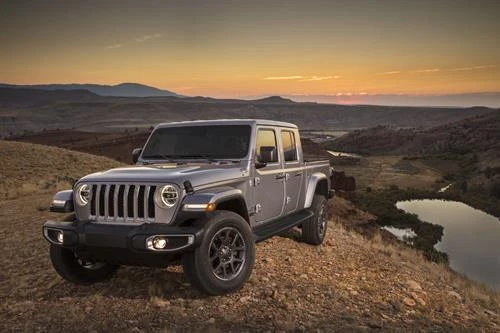 Jeep has unveiled its four door ute. Named Gladiator, it’s a Wrangler clone from the front until the beginning of the tray. From here it gets big. 5.5 metres big. The tray itself has a unique imprint which is part of the aim to have it seen as a lifestyle vehicle, not a “tradie’s ute”. For the family oriented, a dirt bike imprint in the front of the tray says straight away it’s for fun, not work. Backing that up is the set of four tie down points to help strap in the two wheelers.
Jeep have also ensured that when the going gets tough, it’s up to the task. The body underneath is steel, ensuring there is plenty of strength. The lower sides of the Gladiator are alloy.
Power will come from the 3.6L V6 petrol, and eventually a 3.0L diesel. Drive to the ground will pass through an eight speed auto with six speed manuals available overseas. Both engines will have ESS, Engine Stop Start, and the petrol engine will pump out 212kW. Peak torque should be around 350Nm. The diesel’s peak torque should be nudging 600Nm. Grunt gets to the dirt or tarmac via front and rear lockable diffs and sway bars with electronic disengagement. 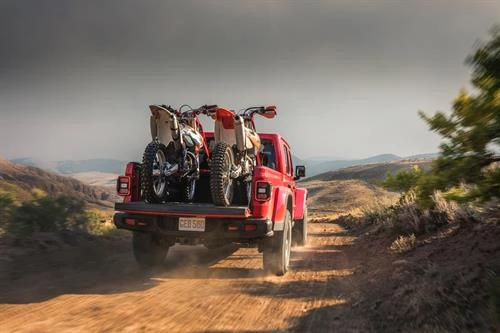 These go with a design line from Jeep: fit a 1.5m long tub, serious off-road chops, and carry a full sized spare wheel underneath the tray. That’s a hefty part of the brief, that last part, as in Rubicon spec the wheel’s overall diameter is 35 inches. And being Wrangler based, a removeable roof and doors, along with a folding forward front screen comes as part of the package.
Inside it’s standard Jeep, with a squared, blocky, design ethos. An infotainment screen of 7.0 inches or 8.4 inches will provide smartphone access and mirroring, and in the Rubicon will show pitch angles, plus a front facing camera shows the driver the forthcoming trail. This can be of importance as the length of the Gladiator means that agility may not be up to the standard shorter vehicles have. However, the Gladiator will have a ride setup at the rear that’s been adapted from the even bigger RAM1500, meaning that the jiggly ride a shorter wheelbase car may exhibit should be pretty much dialled out. Want to go “swimming”? The Gladiator will ford up to 30 inches.
The Gladiator is expected to have Autonomous Emergency Braking and adaptive cruise control, along with blind spot and rear cross traffic alerts. Warranty should be five years
Estimated prices are somewhere around $55K as a starter with a current estimated top whack of around $80k. Naturally these are subject to change. Register at Jeep Australia’s website for upcoming information.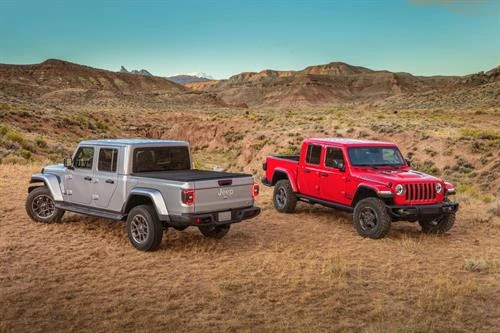
 Level 2, 9 Help Street